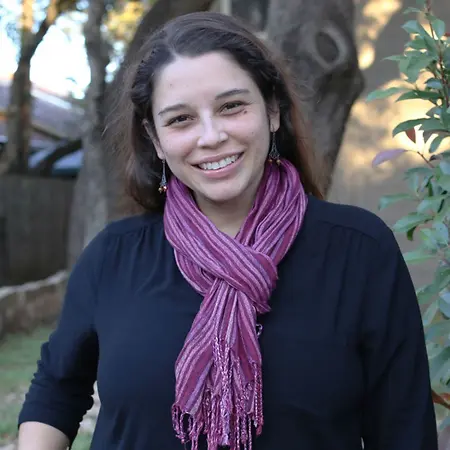
Her Story
About Tania
My typical day looks like I am usually teaching classes, and then I am on phone calls, sometimes sending emails, planning production for the weekend, doing Zoom meetings so we can coordinate location scouts. I'm constantly kind of living in two worlds, which is the world of academia where I get to hopefully inspire and be visible in the world of young people who want to get in this industry, but I also am a freelancer, so I'm in the hustle of phone calls and emails and networking opportunities and being in production whenever I don't have to be in class. Because of the work I do, I've had the opportunity to travel to different parts of the world to work, and also to meet different people, cultures, be surrounded by wonderful things this world has to offer. I was a film teacher in a high school for over a decade, so I've taught different levels. I also mentor for Reel Works New York, and I've mentored youth. As a Latina, as a Central American filmmaker, we aren't that many, and I get to be also in a world in academia where Latinos don't really, you know, less than 1% of academics are Latino, so the percentage is very low. I operate in worlds where Latinos are usually invisible, or not accounted for, or just misrepresented, especially in Hollywood. I've been many times the only female in the crew, at least in the technical role.
Her Interview
Ten minutes with Tania
01What do you attribute your success to?
100% my family, especially my parents. Both of my parents were educators. I believe in the power of education. My mother was an immigrant, just like I was. We came to this country when I was 9, and she was in her 30s, early 30s. I think the fact that she came to this country as a professional, she was always very mindful to help the community, to be part of a community, to be an active member who paid forward what she got. And so, to me, I always had that sense of my parents were the role models. My parents were paving the way for me to be able to choose the career, to even have a choice in career, and also to be able to be in the space where I could be free to choose what I wanted to do. I do appreciate the model that they gave me of just hard work, of always paying it forward, giving it back, of building not only yourself, but the community around you. And so, to me, that was 100% where everything came from. They're the root of my success.
02What’s the best career advice you’ve ever received?
I think the most useful advice was to keep showing up. I think as a Latina, as a Central American filmmaker, we aren't that many, and I get to be also in a world in academia where Latinos don't really, you know, less than 1% of academics are Latino, so the percentage is very low. I operate in worlds where Latinos are usually invisible, or not accounted for, or just misrepresented, especially in Hollywood. So the best advice was just to presence, you know, show up, be visible, be the squeaky wheel, be the person that asks questions, be engaged, and don't let that invisibility engulf you. You can get really overwhelmed with the fact that you're the only one in the room who has a unique experience, or who doesn't look like everyone else, and that can be very overwhelming and really set you back if you get into that mindset of, I don't belong here, but you belong where you need to, you know, where you are is where you belong, and don't let anybody tell you otherwise. Be in the room when you can.
03What advice would you give to young women entering your industry?
The first thing I would say to young women is to learn how to do everything on a set. I know that's counterintuitive, because sometimes you want to specialize, but learn a little bit of everything, so you become indispensable to that crew. Don't be afraid to pick up the camera, don't be afraid to pick up that C-stand, don't be afraid of the heavy equipment, because it is a boys club. It still is, unfortunately. And I think the best advice is, like, don't be afraid of the gear. Because that can be very intimidating. And I think that's everybody, but for some reason, I think it is more acceptable in society for young men to just get in there and not even know how to work a camera, and then they pick it up and go and do it. But for young women, there's a little bit of reluctance to be behind the camera to figure out how something works, and it's really unfortunate, because I see it in my classes. I see it in my workshops. And so I want to ensure that, and I want to inspire by example, but also by being in these learning spaces, that women can be creators themselves. So my advice is, like, learn a little bit of every position on the crew. Learn to do everything, and keep pushing for getting those jobs in those technical roles. Don't give up, because even as a PA in a grips department, or being an assistant to a camera operator, you learn a lot about the craft, and so don't be fearful of the gear that's involved. And lead by, again, being there. Don't, you know, always show up. Showing up is 100% in filmmaking.
04What are the biggest challenges or opportunities in your field right now?
I think the biggest challenge, which is a constant, has always been the gender bias. And I don't mean just that women don't get jobs, but that women, BIPOC community members, people who don't fit the mold often don't get the role that they applied for. They get kind of pigeonholed into, like, oh, you're a female, so you can probably manage and produce, or assistant direct, or be an assistant to something, rather than, hey, I'm a cinematographer, or I'm a gaffer. So they get kind of pushed into certain roles in production. So there's a lot of normalization of a type of filmmaker, people who should be on set, rather than thinking of more the inclusion of diverse mindsets and people on set. So there's definitely gender bias, there's an ethnic bias, there's a racial bias, there's all types of biases that have always persisted, unfortunately, in the work that I do. And it happens in storytelling, too. The gatekeepers only have room for one type of representation, because that's what makes profit. But the other challenge, I think, is especially today, that the industry is shifting. There's a lot more creators out there that are thinking independently, that are building their kind of rogue communities, and using this technology to push the storytelling boundaries, which I'm really impressed and really excited for, but that also presents challenges, because finding consistent work, finding your posse, finding your crew becomes a little bit harder. Because everybody's constantly creating, sometimes you get in situations where people create great stuff, but they're unpaid opportunities, and I think the increase of unpaid opportunities is creating a landscape where, oh, well, you don't need to pay that much for hiring a videographer or a sound person, when in reality, this field costs, it's an investment. And so you have to invest in your gear, you have to invest in a lot, so when opportunities are unpaid, that is problematic. And so I see the increase of unpaid opportunities, but a lot of creatives out there being courageous and doing the thing they want to be doing, but that presents some challenges for those who actually want to make a profession and live off of this craft.
05What values are most important to you in your work and personal life?
I think trust is a big one, both in my personal life and in my work. I think the nature of filmmaking is meeting people who you have not worked with in the past, so you have to trust that they know their craft, that they can do what they said they're gonna do, and that they're gonna show up. So, you have to have a lot of trust in people, in other creatives, and their talent, and what they bring to the table, and that's not easy to do. And so I value trust, and I also value community. I think that the nature of what I do, there's a lot of toxicity in the industry, and so I tend to gravitate towards the crews where there's respect, where there's kindness, where there's a human element to the work we do. We work long hours, and there's just really no need to put people down, or disrespect people. I'm a big proponent of making sets the most learning spaces as well. As much as they're creative spaces to create something new, to create the director's vision, and so forth, they are learning spaces. We learn something new, we adjust, we pivot on the fly, there's a lot of flexibility, and so I value building a community sentiment, a family sentiment. Like, we belong in that space, we respect each other. So I would say, trust and community are the two big things for me, the things I value.
Join Influential Women and start making an impact. Register now.