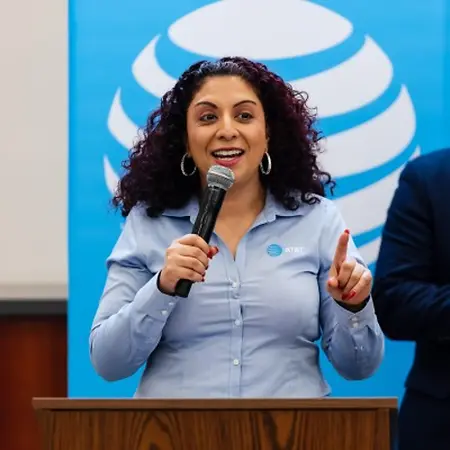
Her Story
About Tanya
I didn't have any intentions of working in government or politics when I started. I was a biochemistry major wanting to be a forensic investigator, but after finding organic chemistry very challenging, I switched to social services, sociology, and political science. I was given an opportunity to intern at the City of Houston, and that's where I started my career in public service and government. Prior to joining AT&T, which is my first private sector role, I worked for various city council members, the mayor of the City of Houston, a state senator, different City of Houston departments, and two nonprofits. Now at AT&T for nearly 5 years, I focus on government relations, covering various counties in the region like Harris County, Brazoria County, and Galveston County. My days involve maintaining key relationships on behalf of AT&T, attending city council meetings and commissioner's court meetings, monitoring agendas for contracts AT&T is being awarded or ordinances that might impact our business. It includes some lobbying, but mostly relationship development and maintenance. I troubleshoot everything from helping elected officials with their phones to working on complex policy issues, and even coordinating disaster response when hurricanes knock out cell towers. As part of our team, I helped secure $5 billion in state funding for broadband expansion to rural areas, working on coalition building and getting letters of support from chambers of commerce and elected officials.
Her Interview
Ten minutes with Tanya
01What do you attribute your success to?
I would attribute my success to having a rough childhood. I was the oldest child of a daughter of immigrants that were working, and I had to become hyper-independent at a very young age and learn to depend on myself, which is a good and a bad thing. I would definitely say that if I didn't have to learn to be independent and resourceful and look for solutions, I wouldn't be this successful. I had really no other option but to figure things out on my own.
02What’s the best career advice you’ve ever received?
I would say definitely have a mentor, or several mentors. Look at people where you want to be and find ways to engage with them and reach out to them. But mostly it's just about follow-through. If you said that you're going to do something, do it. If you don't know how to do it, figure out how to do it or ask the questions. Don't just sit back and let life happen. Take initiative, and especially in the beginning of my career, when there are those opportunities to do things after hours or on the weekend, do those, because then you're going to have those conversations with the elected officials or whoever it was that you weren't going to have just in the office, especially not as an intern. They get to know you and see that you're coming and organizing this trash cleanup on a Saturday instead of going out and doing something else that might be more fun. They remember that you're taking the initiative to go above and beyond and be available. So just knowing that if I ask this person to do something, it's going to get done.
03What advice would you give to young women entering your industry?
I love mentoring young women, and I get people that reach out to me randomly on LinkedIn or even at events. My advice is really about taking advantage of internships and volunteer opportunities, whether it's on a campaign or for an advocacy organization that you might be interested in a particular issue. There are going to be things that you may have to do that aren't going to pay you, but are going to develop those relationships. If you want to be in government relations and even in politics, there are going to be possibly campaigns that you have to work with. Now, what I do now is nonpartisan, so you want to be careful to not just be pegged as one party or the other. But just being in places and volunteering, people remember that. They remember that person came out to my campaign event, or this person volunteered at this cleanup more than, or as much as, giving a political donation to a campaign. So developing those relationships, whether it's through volunteerism or internships, is very important. And if there are opportunities for someone to go work at the state legislature or go to Washington, D.C., especially before having a family, I think that those are key opportunities if you can take advantage of them.
04What are the biggest challenges or opportunities in your field right now?
I think that what we do is not something that AI can do. Sitting in front of a department director or an elected official and explaining to them a policy issue or how something is going to impact our business, how it's going to impact their constituents, is not something that a computer can do. Yes, it can put together facts and all of that, but having relationship skills is something that I think won't go away. So I think there are always going to be opportunities for people that know how to work with people from all political spectrums, backgrounds, and ethnicities. There's always going to be opportunities for people in government relations, in policy development. I've done things in the communication space for elected officials or cities, basically being able to give out accurate information by being in the room where decisions are being made. So I think that there's definitely always going to be opportunity in this space.
05What values are most important to you in your work and personal life?
I am a person of faith, so as I've walked in my faith journey, being honest is really important to me. There are ways that you can try to play the system or take advantage of things, but I believe that whatever is done in the dark always comes to the light, so it's better to just go ahead and do the right thing, because especially in this economy and just the way things are, it's not worth losing your job or tarnishing your name for a quick fix. So honesty and integrity are critical. But also, not getting caught up in a lot of the negativity that can happen in any workplace. You'll have coworkers or colleagues that may want to be gossipy or talking about other people, and I've found that when I don't engage in that, then I feel better. I ask myself, would you say that in front of that person if they were actually there? I really try to remember that yes, we spend a lot of time at work, but we're here to get something done, and I don't need to engage in things that are going to take me out of my character or out of my values. Because if I'm engaging in negativity or speaking negatively, then my day is all jacked up already. I believe that whatever it is that you speak and you consume, whether it's in music, or your books, or social media, that's what you become. So if you're constantly talking about other people or all the things that are wrong in the world, then that's your reality.
Join Influential Women and start making an impact. Register now.