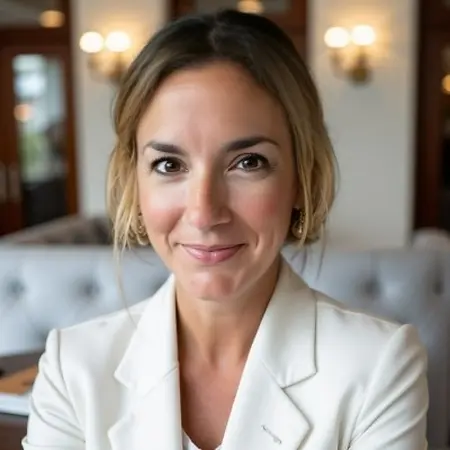
I stopped questioning my place at the table when I realized others sought my perspective first. Expertise is about bringing insight that others rely on.
Tara Falasco, Ed.D. · In Her Own Words
Her Story
About Tara
Dr. Tara Falasco has dedicated more than 20 years to education, knowing since elementary school that she wanted to become a principal. Inspired by a school leader who once dressed as Old Mother Hubbard to encourage reading, she set her sights early on educational leadership and the power principals have to shape school communities.
Tara began her career teaching 4th and 5th grade, where she spent 11 years building meaningful relationships with students and fostering a love of learning. She later served as an assistant principal for over two years before stepping into her current role as Principal of Blue Point Elementary School in the Bayport–Blue Point Union Free School District, a position she has held for the past eight years and describes as “absolutely the best job in the world.”
A hands-on and visible leader, Tara spends much of her day in classrooms, connecting with students and teachers while supporting instructional growth and social-emotional learning initiatives. She is particularly focused on addressing the evolving needs of students in today’s post-pandemic educational landscape.
Tara is a Nationally Certified Principal Mentor and a member of the NAESP Editorial Advisory Board, sharing her expertise nationally as a presenter and contributor. Her research on student anxiety and the changing needs of K–12 learners has been published in Principal magazine. She also serves as President of the Suffolk County Elementary Principals Association, where she led the development of the first-ever elementary leadership conference on Long Island.
Known for her transformational and collaborative leadership style, Tara prioritizes partnership with teachers and staff, fostering meaningful dialogue around instructional and behavioral practices while cultivating a culture of shared responsibility and continuous improvement.
She recently received her doctorate from Bethel University, where she researched women in educational leadership and is presenting her findings in New Mexico in the fall. Her work reflects a deep commitment to mentorship and the advancement of female leaders in K–12 education.
Throughout her career, Tara has remained dedicated to building strong school communities, empowering educators, and ensuring every student has the support they need to thrive. Through her leadership, she continues to contribute to local and national conversations on educational leadership, instructional innovation, and social-emotional development—guided by the belief that great schools begin with strong relationships and visionary leadership.
Her Interview
Ten minutes with Tara
01What do you attribute your success to?
I think at every step in my career, I’ve had someone—a mentor—who helped guide me toward where I wanted to go. I’ve also been incredibly fortunate to have a very supportive mom who would always remind me, ‘Tara, you can do this.’ That encouragement made a big difference.
Throughout my career, whether through professional organizations like NAESP or within my own school community, I’ve always had someone I could turn to for advice, support, or perspective when facing challenges.
Interestingly, my dissertation focuses on mentoring and sponsorship. I originally thought the research would show that mentorship was the most important factor for women in leadership. But what emerged was that sponsorship can actually be even more impactful. Women need people who will advocate for them in rooms where they are not present—people who speak positively about their work and help open doors to new opportunities.
For me, finding individuals I trust—people who guide me, support me, and champion my work—has truly been key to my success.
02What’s the best career advice you’ve ever received?
I was often told throughout my career that I had a lot to offer—not only to students, but to other educators as well. Hearing that encouragement pushed me to start presenting at conferences and writing articles. I realized that by sharing ideas and experiences, I could help influence and support other educators, which ultimately benefits the students we serve.
It also comes down to having faith in yourself. Confidence plays such an important role in leadership. When I was considering applying for new opportunities, hearing people say, ‘You can do this,’ was incredibly powerful. That encouragement helped me believe in my own abilities and take the next steps forward in my career.
03What advice would you give to young women entering your industry?
Sometimes you just have to go for it and ask yourself, what’s the worst that can happen? Having a trusted person you can turn to for advice and encouragement makes a big difference.
My dissertation actually focuses on mentoring and sponsorship. I initially thought the research would show that mentorship was the most important factor for women in leadership. But what I found was that sponsorship can be even more impactful. Women need people who will advocate for them in rooms where they are not present—people who will speak positively about their work and help open doors to new opportunities.
So my advice is to find someone you trust who will support you and champion you. That kind of advocacy doesn’t always come naturally for women, but it matters. I didn’t always feel completely ready for the opportunities I pursued—but I went for it anyway.
04What are the biggest challenges or opportunities in your field right now?
One of the biggest professional questions for me right now is whether I want to move into a district office role. That would be the natural next step in leadership, but I’m not sure that’s where I want to be at this moment. It’s an opportunity, but also a challenge—because I truly love the work I’m doing right now in a school building.
Another challenge in education today is that students are simply different than they were before. We’re seeing significantly more anxiety and dysregulation, and schools are working hard to support students socially and emotionally. For example, our current fifth graders were in kindergarten during COVID—they were wearing masks, sitting six feet apart, and in many cases learning from home. Because of that, many of the social skills we once assumed students would naturally develop just aren’t there in the same way.
Teachers sometimes say, ‘They should know how to do this.’ And while that may be true developmentally, the reality is that many students didn’t have those experiences during critical years. As educators, we have to meet them where they are and help rebuild those skills.
Technology is also a major factor, particularly in the older grades. Many students are getting cell phones at very young ages, often without guidance on how to use them responsibly. That has changed the landscape for both students and schools. At the same time, parenting dynamics have shifted, and education overall has evolved significantly. Schools today are responding to a much more complex set of needs than ever before.
05What values are most important to you in your work and personal life?
One of the most important lessons I’ve learned over time is the importance of work–life balance. It’s not always easy, and it’s something I’ve gotten better at over the years. That balance is essential—not only so you don’t burn out professionally, but also so you can maintain meaningful time for family and for yourself.
For a long time, I was very focused on my career and my ambitions, sometimes at the expense of my personal life. I don’t regret that path because it helped shape where I am today, but I’ve learned that balance is healthier and more sustainable.
Another core value for me is trust. I want people to trust me as a leader, and just as importantly, I want to build a circle—a tribe—of people I trust and can rely on. Having those relationships makes such a difference both personally and professionally.
I’ve also learned to trust the journey. Earlier in my career, if I didn’t get a job I really wanted, I would feel devastated. Over time, though, I’ve realized that sometimes those moments happen for a reason. The opportunities that didn’t work out helped guide me to where I am today—and I truly feel grateful to be in a place that I love.
Join Influential Women and start making an impact. Register now.