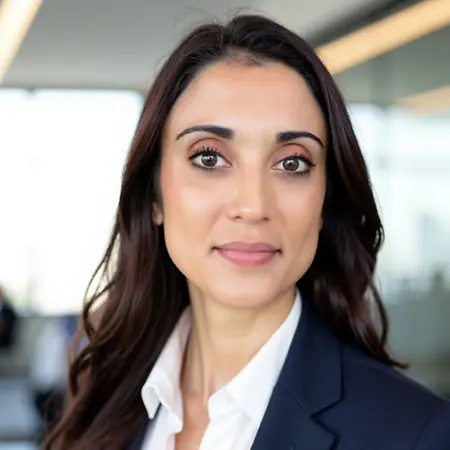
Her Story
About Tara
Tara White is a seasoned Client Management, Business Development, and Marketing professional based in Herndon, Virginia. With a Bachelor of Arts in English, Linguistics, and Communication from the University of Mary Washington, she combines a deep understanding of how people process information with strategic marketing expertise to craft messages that resonate and drive results. Throughout her career, Tara has demonstrated a unique ability to bridge communication, operations, and client engagement, helping organizations achieve growth and operational excellence.
Currently, Tara manages a large-scale security operations portfolio for Allied Universal, overseeing 54 client sites and approximately 300 officers. She is responsible for the full lifecycle of client contracts, including hiring, daily operations, billing, invoicing, and renewals, while building strong, lasting relationships with clients. Her approach emphasizes client-centered service and results-driven leadership, often turning professional partnerships into trusted, collaborative relationships. Tara supervises an operations manager who handles scheduling and payroll, allowing her to focus on high-impact, client-facing responsibilities.
Before joining Allied Universal, Tara spent over a decade in client management, business development, and marketing across diverse industries such as EdTech, SaaS, and interior design. She has led initiatives to grow and diversify accounts, implemented programs that increased revenue, and fostered customer success through hands-on support and innovative solutions. Known for her people-first philosophy and operational excellence, Tara thrives in dynamic environments and advocates for efficiency, collaboration, and strategic growth—consistently delivering measurable impact wherever she applies her skills.
Her Interview
Ten minutes with Tara
01What do you attribute your success to?
I owe everything to my mother, Sharon.
Growing up, I was certain she lived in a different universe—one where the days were longer, where it was somehow possible to pour yourself fully into everything and everyone without ever coming up short. She didn’t just get things done—she showed up. For every meeting, every moment, every person who needed her. No excuses. No half-measures.
Now, my husband looks at me the same way I once looked at her.
What my mother taught me wasn’t just about hard work—it was about urgency. About refusing to drift through life as if there will always be more time. Because there won’t. There are no do-overs, no second chances to relive the moments we let pass us by. You get one shot. That’s it.
So I choose to give everything I have, even when it leaves me exhausted. I choose to be present, to show up, to stretch myself beyond what feels comfortable—because I would rather be tired than full of regret.
Right now, I’m in a role that demands a lot from me. It asks for my time, my energy, my whole self. And yes, it’s hard. But I believe in what it’s building—not just for today, but for the long run. Because the work you put in now echoes. People remember. They see who stayed committed, who carried the weight, who didn’t step back when it mattered.
My mother lived that truth. She made time for people even when she had nothing left to give. And that’s the legacy she passed on to me: not perfection, but presence. Not balance, but intention.
Twenty years from now, I don’t want to look back and wonder if I could have done more. I want to know I did. I want to see a life that was built with purpose, that impacted people, that meant something.
More than anything, I want it said—without hesitation—that I was all in. Every time. On everything.
02What’s the best career advice you’ve ever received?
The best career advice I’ve ever received was this: “Don’t shrink your ambition to make other people comfortable.”
As the first in my family to earn a college degree, I spent a long time feeling like I had to prove I deserved every opportunity. I carried the weight of my parents’ sacrifices, the uncertainty of being the “first,” and the quiet pressure to not fail because failure felt bigger than just me. And as a working mother, there were moments when I questioned if wanting more for my career somehow meant I was taking away from my family.
That advice changed everything.
It reminded me that my ambition isn’t something to apologize for. It’s something that was built through generations of resilience, risk, and hope. My parents didn’t come this far for me to play small. They came this far so I could step fully into rooms they never had access to.
Now, when I walk into a new opportunity or take on a challenge that scares me, I don’t second-guess whether I belong. I remind myself that I carry more than just my own story. I carry proof that progress is possible.
And maybe the most important part? My child is watching. They’re learning what it looks like to take up space, to work hard, and to believe that they don’t have to choose between where they come from and where they’re going.
So I don’t shrink anymore. I build, I grow, and I keep going.
03What advice would you give to young women entering your industry?
Act like you belong—because you do.
Don’t shrink yourself to make others comfortable. Don’t let them see you hesitate because you’re the only woman in the room, or because they’ve spent decades building a circle that was never designed to include you. Those dynamics only have power if you accept them.
You bring something different—and different is not a weakness. Women are often the ones who see the gaps, who connect the moving pieces, who turn chaos into clarity. We build systems, we optimize them, and when necessary, we challenge them. Just because something has always been done a certain way doesn’t make it right—or untouchable.
There will be moments when the confidence isn’t there. When you feel like an outsider looking in. In those moments, you don’t wait for permission—you step forward anyway. You speak anyway. You lead anyway. Confidence isn’t always something you feel; sometimes it’s something you decide.
I work in security, and I hear it all the time—questions about my background, doubts because I haven’t walked the exact same path, judgments based on how I look. I’m 5'9", 115 pounds. I don’t fit their image of what “security” looks like. But this work isn’t about appearances—it’s about judgment, strategy, and results. Risk is risk. Clients are clients. And outcomes are what matter.
That’s the truth people don’t say out loud: most of the time, no one cares about the narrative in your head. They care about whether you deliver.
So deliver.
Don’t let outdated expectations define your limits. Don’t wait for validation to claim your space. Walk in like you’ve earned it—because you have. And then prove it, over and over again, until there’s no room left for doubt.
04What are the biggest challenges or opportunities in your field right now?
One of the biggest challenges in the physical security field right now is that the job is no longer just “physical.” The industry is being pulled into a space where traditional guarding meets technology, data, and real-time decision-making, and not everyone is ready for that shift.
We’re seeing more advanced systems like AI-driven surveillance, remote monitoring, and integrated platforms that connect access control, cameras, and analytics. The opportunity here is huge. Done right, these tools can make environments safer, more efficient, and more proactive instead of reactive. But the challenge is that technology alone doesn’t solve problems. It still comes down to people. You need officers and leaders who understand not just how to stand a post, but how to interpret information, respond appropriately, and think critically in high-pressure situations.
Another major challenge is staffing and retention. It’s tough to find reliable, well-trained professionals in a field that demands long hours, constant vigilance, and often goes underappreciated. At the same time, this creates an opportunity for companies that invest in their people. Training, clear career paths, and strong leadership can turn what is often seen as a temporary job into a long-term profession.
There’s also a growing expectation from clients. They don’t just want a body on site anymore. They want partnership, insight, and accountability. They want security teams who understand their business, anticipate risks, and communicate effectively. That raises the bar across the board, but it also opens the door for those willing to step up and lead differently.
Right now, the field is at a turning point. The biggest opportunity is for security professionals to evolve from being seen as a cost center to being recognized as a critical part of operational success. The ones who embrace that shift, who combine strong fundamentals with adaptability and leadership, are the ones who will shape the future of this industry.
05What values are most important to you in your work and personal life?
Boundaries aren’t a luxury for me—they’re survival.
There’s a quiet pressure, especially as women, to prove we can do it all. And the truth is—we probably can. But capability isn’t the same as responsibility. Just because I can carry everything doesn’t mean I should. That “Superwoman” instinct will take everything you have if you let it.
So I’ve had to learn—intentionally, sometimes painfully—to say no.
To delegate. To draw a line and stand by it. To tell a client, “This is what I can deliver—and this is what I can’t.” To close my laptop after a 13-hour day and go home, because I’m not just a professional—I’m a mother, a partner, a human being with a life that also needs me. If I ignore that, everything else eventually breaks down.
But boundaries don’t mean disengagement. They mean clarity.
I lead hundreds of people who rely on me—for direction, for decisions, for stability. That’s not something I take lightly. I know many of them are living paycheck to paycheck. So when someone calls late at night because something is wrong, that’s not a minor inconvenience—that’s their livelihood. And in those moments, showing up matters.
This is the balance: knowing when to step back to protect your capacity, and when to lean in because it truly counts.
When you’re clear about your limits and consistent in what you deliver, people trust you. They stop questioning your boundaries because your results speak louder than your availability ever could.
In the end, it’s not about doing everything. It’s about doing what matters—fully, honestly, and without burning yourself out in the process.
Join Influential Women and start making an impact. Register now.