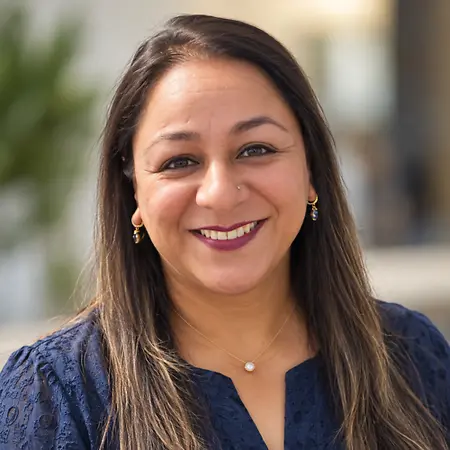
Her Story
About Tasnim
Long before Tasnim Rehamani became a mental health advocate and community leader, she was being shaped by the roles and experiences that would ultimately give her work its purpose: daughter, sister, wife, mother, South Asian Muslim woman, survivor, caregiver, volunteer, and someone learning—sometimes painfully—how to find her own voice.
Family has always been central to Tasnim’s identity. She was raised within a culture where community, responsibility, resilience, and caring for others carried tremendous meaning. Those values became some of her greatest strengths, while life also taught her that culture and community can carry complicated expectations around what is spoken about, what remains private, when help is sought, and how vulnerability is perceived. She came to understand the weight that stigma and silence can carry, particularly around mental health and trauma.
Her own experiences with trauma and survival changed the course of her life. They gave Tasnim an understanding that cannot be learned solely through professional experience: what it feels like to be vulnerable, to need support, to navigate systems while carrying fear and uncertainty, and to hope the person on the other side sees a human being rather than a circumstance. Those experiences became inseparable from the way she approaches others—with empathy, curiosity, respect, and an awareness that there is often much more behind a person’s story than what is visible.
Motherhood brought another dimension to that journey. Tasnim’s son became one of the greatest influences on how she thinks about courage, service, and legacy. Raising him has challenged her to consider not only the world he will inherit, but what she is modeling for him within it. She wants him to understand that strength can include vulnerability, that compassion and leadership can coexist, and that using one’s voice for others is both a responsibility and an opportunity. Watching him develop his own commitment to service and community has reinforced her belief that legacy is not simply what someone accomplishes—it is what they inspire others to carry forward.
Tasnim’s professional life evolved alongside this personal journey. Beginning her career in healthcare in 2001, she eventually found her way into human services, housing, basic needs, community support, mental health, and crisis care. Across different roles and organizations, a consistent thread emerged: she was drawn to people and to the gaps between them and the systems intended to serve them.
Her lived experience gave her insight into those gaps; her professional experience taught her how to navigate them.
That intersection has become one of the defining strengths of Tasnim’s work. She understands what it means to sit on both sides of a system—to be the person seeking support and the professional working to make support more accessible. It has shaped her ability to build trust across communities, listen without assuming she knows the answer, and bring perspectives from lived experience into rooms where decisions are being made.
That perspective has not always been easily understood. Tasnim often recognizes barriers that may be less visible to others because she has experienced them from multiple sides—personally, culturally, and professionally. What may appear straightforward within a system can feel entirely different to the person trying to access it. At times, seeing and naming those gaps has meant being misunderstood, underestimated, or viewed differently. Rather than allowing that to quiet her, Tasnim has learned to remain curious, lead with warmth, and trust the value of what her perspective can bring. She believes that understanding a barrier others may not yet see is not a reason to step back; it is often an invitation to help widen the view.
Her journey eventually brought her into crisis services, including becoming the first employee hired for the Connections Health Solutions crisis center in Kirkland, Washington. Being present during the center’s early development deepened her understanding of what becomes possible when communities create accessible and compassionate alternatives for people experiencing mental health crises.
Community service has been equally formative. Over the years, volunteering became more than something Tasnim did outside of work; it became part of how she understood leadership. Some of her most meaningful contributions happened without a title, recognition, or audience—through showing up, listening, connecting someone to a resource, advocating when a voice was missing, or helping create a space where another person felt they belonged.
For many years, Tasnim was far more comfortable creating opportunities for others than imagining herself standing at the front of the room. Her journey has required learning that using her own voice does not take space away from someone else. It can create more space.
Today, she carries her lived experience, cultural identity, family, professional knowledge, community relationships, and years of service into the same purpose: helping make mental health care and community systems more human, accessible, and responsive to the people they serve.
Increasingly, Tasnim thinks about legacy—not simply the positions she has held or recognition she has received, but what remains because she was willing to show up. She hopes her son sees a mother who turned difficult chapters into purpose without allowing those chapters to define the entirety of her story. She hopes other women—particularly those who have lived through trauma, carried cultural expectations, questioned their worth, or spent years making themselves smaller—can see that their experiences do not disqualify them from leadership. They can become part of what uniquely prepares them for it.
For Tasnim, influence is ultimately about what we leave in other people: the doors we open, the voices we make room for, the systems we help change, and the courage we pass forward.
That is the legacy she is still building.
Her Interview
Ten minutes with Tasnim
01What do you attribute your success to?
I attribute my success to resilience, relationships, service, and a willingness to keep learning through every chapter of my life.
Motherhood has been one of my greatest teachers. Raising my son, including more than a decade as a single mother, taught me responsibility, perseverance, sacrifice, and how to keep moving forward even when the path was uncertain. Family, in all of its chapters, has continued to ground me and remind me that success is not only about what we accomplish, but also about the example we leave behind.
I also credit the people and communities who have allowed me to learn alongside them. Some of my greatest lessons have come from listening—to individuals and families, colleagues, community members, and people whose experiences were different from my own. I have learned that meaningful relationships are built through consistency, trust, humility, and simply showing up.
There have been people along the way who saw potential in me before I fully recognized it in myself. I remain deeply grateful for those opportunities, and I try to honor them by creating opportunities for others, making connections, sharing what I have learned, and continuing to grow.
Ultimately, I do not attribute success to one title, award, or moment. I attribute it to staying connected to my values, learning from both the difficult and beautiful chapters of my life, keeping my word, and continuing to show up with purpose. To me, success means becoming more of who I am while helping create space for others to become more of who they are.
02What’s the best career advice you’ve ever received?
The best career advice I have received did not come as a single piece of advice—it came through experience: do not wait for someone else to give you permission to invest in yourself.
My path was shaped by family, responsibility, and choices that did not always leave room to put myself first. I learned through working, serving, asking questions, building relationships, educating myself, and continuing to show up.
Today, that lesson shapes what I pass forward, especially to my son and the young people who come to me for guidance: pursue the education, apply for the scholarship, ask the question, find the mentor, knock on the door, and take the opportunity. If one path is not available to you, find another.
Your path does not have to look like anyone else’s, but you do have to believe it is worth pursuing.
03What advice would you give to young women entering your industry?
Do not confuse caring for others with having to continually put yourself last.
Women are often taught—through family, culture, community, or simply expectation—to be the helpers, caregivers, listeners, and people who hold everything together. Those qualities can make you extraordinary in mental health and human services, but they should not require you to make yourself smaller in the process.
Learn your field deeply. Pursue the education and training. Find women whose leadership you respect and ask them questions. Seek mentors and become one when you can. Speak up when you see a barrier others may have missed, and do not assume that being the youngest woman, the only woman, or the woman with a different cultural or lived perspective means your voice carries less value.
You do not have to know everything to contribute something meaningful, and you do not have to sacrifice your own growth to prove how committed you are to serving others.
Build a career that allows you to care about people without forgetting that you are one of those people too.
04What are the biggest challenges or opportunities in your field right now?
One of the biggest challenges across mental health, human services, and social services is that we talk a great deal about collaboration, yet too many people are still left to navigate disconnected systems on their own. I know what that feels like because I was once one of them.
At a time when I needed help, I found myself in what felt like an unfinished circle of hope—being given resources and numbers to call while still carrying the responsibility of figuring out what came next. One person, in one agency, changed that experience. She welcomed me into her space, sat beside me, and made the calls with me. She did not solve everything; she simply refused to leave me alone in navigating it.
That experience showed me what is possible.
Our greatest opportunity is to stop working in silos and turn collaboration into action. Nonprofits, healthcare organizations, human and social service agencies, public systems, and for-profit providers each hold different pieces of the support people may need, but we do not consistently understand or educate one another about how those resources can complement each other.
Leadership can change that culture. Instead of allowing the first point of contact to become a gatekeeper, we can empower people throughout our organizations to open a door, activate a relationship, or make a warmer connection to the next resource.
No organization has to provide everything. We simply need to know one another, understand where our services connect, and sometimes make the call with the person instead of handing them another number to call.
Sometimes the difference between knowing a resource exists and actually accessing help is one person willing to stay beside you long enough to make the connection.
05What values are most important to you in your work and personal life?
The values most important to me are humanity, family, service, integrity, courage, and belonging. At the center of all of them is one belief: people should know that they matter.
Life has taught me that values are not simply what we say is important; they are revealed in how we treat people, especially when there is nothing to gain from doing so. I value keeping my word, remaining curious about experiences different from my own, having the courage to respectfully question what is not working, and choosing kindness without mistaking it for weakness.
Family has taught me love, responsibility, sacrifice, and resilience. Service has taught me humility and the responsibility that comes with being invited into someone else's story. My professional journey has taught me that titles may give us authority, but relationships give us trust. And my own difficult chapters have taught me that caring for others and caring for ourselves should not have to exist in opposition.
More than anything, I think about what I am leaving behind. I do not want the hardest chapters of my life to be my legacy; I want what I chose to do with them to be. I hope my son remembers a mother who loved him deeply and showed him through her actions that compassion and service matter. I hope the people whose lives intersect with mine leave knowing, in some small way, that their presence, perspective, and story mattered.
I cannot control how every chapter of my story is understood or remembered. I can choose how I live the next one. If I can leave behind more dignity, connection, courage, and hope than I found, then I will have lived according to the values that matter most to me.
That is the woman I have worked to become, and the legacy I hope to leave.
Join Influential Women and start making an impact. Register now.