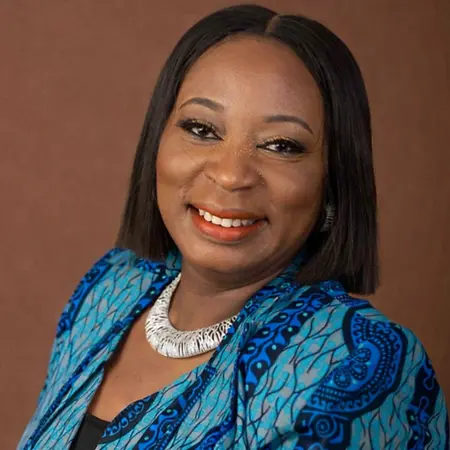
Her Story
About Tessie
Tessie Kuhe is a Gender Advisor at EnCompass LLC and a seasoned international development professional with 25 years of experience, including the last eight years focused specifically on gender and inclusion. She has dedicated her career to empowering adolescent girls and young women, challenging negative gender norms, and creating equitable access to resources regardless of sex at birth, age, physical ability, religion, or ethnic background. Tessie addresses inequality across education, planning, and programmatic implementation, engaging at community, policy, and organizational levels while emphasizing the importance of intersectionality and the nuanced needs of marginalized groups.
Throughout her career, Tessie has held senior roles with USAID and federal government contractors, including serving as Senior Orphans and Vulnerable Children Program Manager and leading gender collaboratives in Nigeria. She has managed complex, multimillion-dollar portfolios, integrating DEIA, gender, and safeguarding principles across programs and partners. Tessie’s expertise spans public health, social inclusion, partnership development, training, facilitation, and capacity strengthening. She has provided mentorship and guidance to organizations implementing U.S. government-funded gender and inclusion initiatives, ensuring programs are inclusive, evidence-based, and impactful.
Now an independent consultant in the United States, Tessie supports proposal writing, workshops, and conferences while continuing her work in gender and inclusion. She is a licensed financial professional and certified government contract manager, with a proven record of overseeing contracts for USAID and other partners. Tessie combines technical depth in gender equity with strategic acumen in program management, training, and policy implementation. Her faith-driven, collaborative, and values-centered leadership empowers individuals and organizations to design and deliver inclusive programs that foster sustainable social impact.
Her Interview
Ten minutes with Tessie
01What do you attribute your success to?
I attribute my success to the fact that people believed enough in me to give me opportunities and space to be myself and fully deploy my abilities. Things were handed to me, and I was allowed to build them gradually until they became something meaningful. People walked with me and oversaw what I was doing until it grew enough for others to identify. The secret of my success is that people believed in my abilities enough to reward my work with more and more responsibilities. I was given the chance to exhibit and grow, and that made all the difference.
02What’s the best career advice you’ve ever received?
Don't let a title stop you or limit you. Once you have interest in something, pursue it and give your all into whatever it is you're pursuing, because you'll be surprised to find that titles emerge at the end that line up with your passion. I was already doing gender work for many years even though I was a Senior Orphans and Vulnerable Children Advisor, a completely different portfolio, before an opportunity emerged for me to go full-time into gender and inclusion. The advice I would give is to allow yourself to believe enough in your passion and your dream to pursue it, and to give expression to it in whatever work you're doing right now. Give expression to your passion in that work, and you'll find that sooner or later, people will begin to find titles to match your passion for you.
03What advice would you give to young women entering your industry?
Entering the gender and inclusion industry right now is very difficult, especially if you're here in the United States. It's not a very conducive environment right now. My advice is to find a way to do your gender and inclusion work in spaces that are not necessarily government. Get involved at the community level, get involved with other organizations, get involved in the private sector. There is plenty of work to be done as far as inequality is concerned. There's inequality in every space where there are human beings, so there's more than enough work to be done. Just don't be looking for it in the typical places where we did previously, in government, in donors, and things like that. Look for it in other spaces like private sector, smaller organizations, religious groups, academia, in training people, in facilitation, and you'll still be able to make a huge difference in people's lives.
04What are the biggest challenges or opportunities in your field right now?
The biggest challenge in my field right now is a very unaccommodating political environment. People aren't hiring gender advisors or inclusion advisors anymore, so there's an overflow of people with my type of skills who are not finding regular desk jobs. The good thing is that now we are being forced to reinvent ourselves and make ourselves useful in other spaces, supporting other types of work that wasn't what we were used to in the past. The challenge with that is that a lot of people have lost income, have families to feed, and cannot afford to continue, so they're leaving the field of gender and inclusion and pivoting to something else just to survive. The U.S. government was one of the largest donors on the planet for international aid, and that was the space where a lot of changes were being made globally as far as gender and inclusion were concerned. All of that is coming to a grand crashing halt because of the inharmonious environment we have to live and work in right now. The environment is forcing gender practitioners to pivot into other spaces, and we're losing skill, information, data, know-how, and people, and that's a major challenge.
05What values are most important to you in your work and personal life?
I love to be very collaborative in the work that I do. I like to involve people in the planning, in the execution, in the reporting. Active participation is something that I value deeply. I love to build capacity and give people a chance to exhibit their abilities, because that's how I came into my own. People gave me a chance and allowed me to apprentice myself to them. I love to build capacity, to apprentice young people or not-so-young people who are interested in what I do. I love to give them a chance to learn so that they can have an opportunity to grow and become better in that field. The ability to build capacity, to mentor, to train people and organizations is central to who I am.
Join Influential Women and start making an impact. Register now.