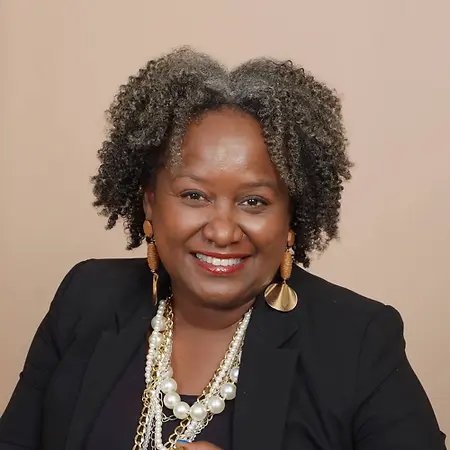
Influential Woman · Social Services
Tewabech Genet Stewart
Thought Leader, Speaker & Writer
Tampa, FL 33558
Her Story
About Tewabech
After more than 25 years working to improve outcomes for children and families, Tewabech began asking a different question: What if we've been trying to reform systems that were never built on the truth?
Rather than stopping at criticism, Tewabech has dedicated her work to developing a practical alternative. She believes lasting change requires the courage to tell the truth, the humility to question long-held assumptions, and the willingness to rethink who holds expertise, responsibility, and decision-making power.
Central to her work is the belief that communities already possess the relationships, wisdom, and leadership needed to solve many of their own challenges. The role of institutions is not to replace that expertise, but to recognize it, invest in it, and create the conditions for it to thrive. She challenges leaders to measure success not by how much they control, but by how effectively they build trust, support families, and expand the dignity of choice.
Her faith is the foundation of this work. Tewabech believes every person is created in the image of God with equal worth, dignity, and purpose. That conviction shapes how she views leadership, justice, and public responsibility. It compels her to challenge assumptions that diminish people's humanity and to help leaders build decisions rooted in truth, recognizing the God-given dignity and potential of every person.
As an adoptive mother, Tewabech brings both professional and personal perspective to her work. Her vision extends beyond reform. She has developed a practical approach that helps leaders build systems that support families instead of separating them, creating the conditions for healing that can be passed from one generation to the next.
Her Interview
Ten minutes with Tewabech
01What do you attribute your success to?
I attribute my success first and foremost to my faith and to the way I was raised by my parents. They taught me that every person is created in the image of God and deserves to be treated with equal dignity and worth. That belief has shaped not only who I am, but how I lead and how I see the world.
My faith gives me the courage to ask difficult questions, speak truth to power, and challenge assumptions that many people have accepted for generations. It reminds me that my responsibility is not to preserve comfortable narratives, but to pursue truth with humility, even when it is unpopular or comes with personal and professional risk.
That foundation is reflected throughout the practical approach I have developed for reimagining child welfare. Scripture is woven throughout because my work is grounded in biblical principles of truth, justice, responsibility, and the sacred value of family. I believe children are a gift entrusted to families, every person bears the image of God, and those entrusted with the greatest power bear the greatest responsibility.
Ultimately, my faith gives me confidence to step into the unknown. I don't know where this journey will lead, but I trust that when I walk in the purpose God has placed before me, He will guide my steps. That confidence has allowed me to say "yes" to work that feels bigger than me and to keep moving forward, even when the path isn't clear.
02What’s the best career advice you’ve ever received?
The best career advice I've ever received was simple: Always do what's right, regardless of what you think might happen.
That advice has stayed with me throughout my career because doing the right thing is rarely the easiest thing. There have been moments when I questioned whether speaking honestly would cost me professionally or whether challenging long-held assumptions would create backlash. Like many people, I've experienced the fear that comes with standing apart from the crowd.
What I've learned is that integrity requires courage. You cannot control how others will respond, but you can control whether you remain faithful to your values. Time and again, I've discovered that when I choose truth over comfort and conviction over fear, things have a way of unfolding as they should.
For me, that lesson is deeply connected to my faith. I believe our responsibility is to do what is right and leave the outcome to God. That perspective has given me the courage to speak truth to power, challenge systems that no longer serve people well, and continue moving forward even when the path is uncertain. Looking back, I can honestly say that every time I chose integrity over fear, I was strengthened by the experience.
03What advice would you give to young women entering your industry?
My advice would be to lead with humility and give yourself grace. Most people enter this work because they genuinely want to help children and families. But it's also important to recognize that good intentions do not always produce good outcomes. Sometimes we become part of systems that cause harm, even when our personal intention is to do good.
Don't take that realization as a personal indictment. Instead, let it deepen your curiosity, compassion, and willingness to keep learning. Ask difficult questions. Listen to families. Be open to the possibility that the people most affected by the system see things that you cannot yet see.
While you are in the work, use your influence wisely. Every interaction is an opportunity to treat people with dignity, lessen harm, and preserve relationships. You may not be able to change the entire system overnight, but you can decide how you exercise the authority you've been given.
Most importantly, never forget the weight of the power you hold. The decisions made can change the course of a family's life for generations. Because of that, we have a responsibility to hold ourselves and the systems we serve, to the highest standard. Good intentions are not enough. The greater the power we have over people's lives, the greater our responsibility to seek truth, remain humble, and continually ask whether our actions are truly serving the families we were called to help.
04What are the biggest challenges or opportunities in your field right now?
The biggest challenge in my field is not a lack of knowledge. We know far more today about child development, trauma, attachment, and what helps families thrive than we did decades ago. The real challenge is having the courage to act on what we know. Too many systems, funding structures, and professional incentives are built around maintaining the status quo, making meaningful change difficult even when the evidence points us in a different direction.
At the same time, I believe our greatest opportunity is also our greatest responsibility: to tell the truth. Parents have been courageously sharing their stories for years. Too often, those stories have been dismissed or questioned. But when those of us who worked inside the system speak honestly about what we witnessed and acknowledge the harm we participated in, the conversation changes.
I don't speak as a parent who lost custody of a child. I speak as someone who spent 22 years inside the system and who harmed families by participating in their separation. My intentions were to protect children, but I have come to recognize that separating families caused profound harm. Telling that truth is uncomfortable, but it is also necessary. Meaningful change begins when those of us who held the power have the courage to acknowledge the harm, tell the truth, and help build a better way forward.
When professionals are willing to speak honestly alongside parents and people with lived experience, we create trust. Truth is not about assigning blame. It is the foundation for accountability, healing, and building systems that truly strengthen families instead of separating them.
05What values are most important to you in your work and personal life?
Without question, the value that guides both my professional and personal life is courage. Maya Angelou once said that courage is the greatest of all the virtues because without courage, you cannot consistently practice any other virtue. The older I get, the more I understand what she meant.
We are living in a time when there is real fear. Speaking honestly can come with personal and professional consequences, especially when you are advocating for people whose humanity has too often been overlooked. It doesn't take courage to say what is popular or what everyone already agrees with. Courage is choosing to speak the truth when it would be easier to stay silent.
My faith is what gives me that courage. Faith isn't certainty about the outcome; it's trusting God enough to take the next step even when I cannot see the entire path. It reminds me that my responsibility is not to control how people respond, but to be faithful to the truth and to the purpose God has placed on my life.
That courage is rooted in a simple conviction: every person is created in the image of God and deserves equal dignity, worth, and opportunity. When we truly believe that, we cannot remain silent in the face of injustice or settle for systems that treat some families as less deserving than others. Courage calls us to tell the truth, to act with integrity, and to keep pursuing what is right even when it is uncomfortable, unpopular, or costly.
Join Influential Women and start making an impact. Register now.