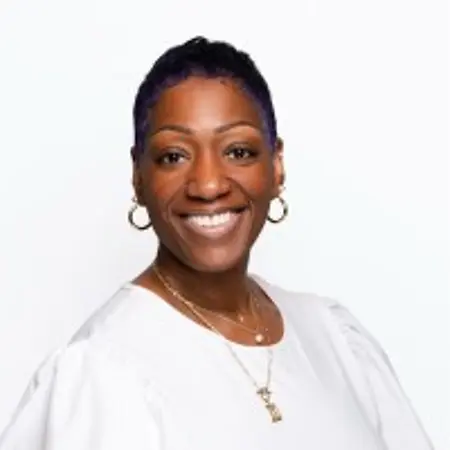
Building my own life meant letting expectations fall away, keeping only what was anchored in God. Choosing alignment over performance is where I found room to breathe.
Building a Life That Actually Felt Like Hers
Explore moreChampioning another woman's success doesn't diminish my own; It simply makes the room brighter for everyone!
Tia Payne · In Her Own Words
Building my own life meant letting expectations fall away, keeping only what was anchored in God. Choosing alignment over performance is where I found room to breathe.
Building a Life That Actually Felt Like Hers
Explore moreI realized my journey could help others when I spoke my truth and saw it give someone else permission to breathe, turning obedience into purpose.
When She Realized Her Journey Could Help Someone Else
Explore moreHer Story
Tia Payne is a survivor-leader, nonprofit executive, and systems builder dedicated to advancing safety, dignity, and long-term stability for survivors of intimate partner violence and trauma. As the Founder and CEO of Legacy31, she leads at the intersection of faith-informed advocacy, direct service, and organizational strategy, creating systems that are both compliant and compassionate. Through Legacy31, Tia focuses on education, advocacy, prevention, and community engagement, ensuring that survivors are supported beyond crisis toward sustainable independence, with particular attention to the intersection of trauma and faith.
With over 15 years of experience in victim advocacy and social services, Tia has served in multiple leadership roles, including Director of Shelter and Housing Services at Hope and Healing Survivor Resource Center and Director of Operations at The Genesis Program. She specializes in building trauma-informed systems that enhance both survivor outcomes and staff sustainability, overseeing crisis shelters, HUD and VAWA programs, CARF accreditation compliance, and leadership development across multidisciplinary teams. Tia also develops and delivers workshops such as “Healthy Relationships” for youth and families, and “When Trauma Meets Faith,” bridging gaps between faith communities and secular agencies to provide respectful, trauma-informed care.
Beyond her executive work, Tia is a sought-after writer, speaker, and trainer who amplifies survivor voices and strengthens organizational leadership capacity. Her philosophy emphasizes survivor autonomy, ethical leadership, and building intentional systems that honor the whole person. Tia’s career reflects a commitment to integrity, clarity, and purpose, underpinned by her belief that real change happens when survivors are supported by structures designed to hold them well and communities are equipped to respond with dignity and care.
Her Interview
01What do you attribute your success to?
I attribute my success to my relationship with God. I've been through therapy and those were great practices for me, but along the way, due to being a survivor and especially being raised in a church, I actually lost what I would say was my connection with God. You automatically connect God to whatever your pain is, like 'you could have stopped this and you didn't.' I truthfully believe that once I was able to reconcile a lot of those questions and different things that I had about who God was, and once that reconciliation came, I was really able to start exploring my own personal relationship with God and just being authentic in that relationship with God. I think that's what's helped me the most.
02What’s the best career advice you’ve ever received?
The best career advice I received was that if no one makes room for you, sometimes you really do have to kick the door in. Someone told me that when I was complaining about the gap in services for faith-based survivors. Unfortunately, in the field that I work in, being a Christian is not well received. I've been tokenized as the faith-based woman when it comes time for that, so sometimes it's not very welcoming. I was passionate about bridging the faith-based angle, but it was not well received when I was working in the agency. So I took a step back from 2019 to 2022 and created Legacy 31, because that's what was needed. Someone needed to bridge that gap, and it was not being heard when I was working in the agency. When I ended up going back in 2022, we had created a space to be able to offer that to survivors that come in the door. It was due to me branching off on my own and becoming my own entity.
03What advice would you give to young women entering your industry?
My advice is to not come in with a saviorism mentality. It is very hard working with people who've experienced some type of interpersonal violence. You need to come in knowing that you're here to help them along the way, but not be the expert in their story, because they're actually the expert. You have to be okay if what you would want to suggest is not what they implement on their journey. The savior wants you to do A, B, C, and D, and then we're going to equal E, but it just really does not work like that in this field. They maintain their autonomy in their story, and they are the expert of their story. We are here just to really be a helping hand, to encourage, to give resources, to help with safety planning, and all of those types of things. That is our role. Our role is not to control what their outcome is going to be.
04What are the biggest challenges or opportunities in your field right now?
The biggest challenge in my field is having the conversation of trauma and faith. Churches really don't want to deal with it, and I personally think it's because churches teach how awesome God is and how good God is, so when we couple that theology with trauma, it doesn't mix very well. In the advocacy field that is not faith-based, you're going to meet someone who believes God is going to be a part of their healing journey, and the question is how are you as an agency going to handle it, even if it makes you uncomfortable, because maybe you're not a spiritual person, maybe you're atheist, or you don't believe in theology. That shouldn't impact how we serve who this whole survivor is. As for opportunities, I'm exploring different avenues for grants to expand the work that I do. I've been submitting proposals to different organizations for workshops within community conventions. I've recently been approved on a marketplace called Advocates Paying Advocates where I've been developing digital toolkits for people to download, including tools like 'Faith Informed, Not Faith Forced' to help advocates work with faith-based survivors, and 'Strength Without Harm' to help men in the field.
05What values are most important to you in your work and personal life?
Being a person of integrity is most important to me. I want to have integrity and good character. I know a lot of times we put on our forward-facing personality when we're out in public, but I want to be that same person when I'm at home. I want people to know that they can come to me with authenticity and they'll get authentic truth from me. I don't sugarcoat things. Just being that person of integrity is one of the values that I hold dear, because I think that takes you so much further. I don't want to mute who I am as a person. I've often found myself having to do that in the advocacy field because I'm Christian and I'm the faith-based person, but they want to swallow what makes them comfortable but not swallow the whole person of who I am. I found that difficult to continue doing, which is partially the reason why I chose to resign recently. I wanted to be authentic to who I am and who I believe God has called me to be. I gave up a very lucrative job because I wanted to be authentic to who God called me to be, and that meant my integrity had to match in whatever room that I was in.
Her Content Hub
Explore how women leaders can harness their strength while establishing healthy boundaries to prevent burnout, sustain effectiveness, and lead with intentionality rather than obligation.
Why Boundaries Are a Leadership Strategy

Strength may open doors.
But boundaries are what allow you to stay in the room.
In leadership, especially for women in high-impact roles, strength is often the trait that gets recognized first. You are capable, dependable, and solution-oriented. You handle pressure well. You show up consistently. And because of that, you are trusted with more—more responsibility, more complexity, and more access to people, problems, and decisions that require greater discernment. But the same strength that elevates you can also overextend you if it is not supported by clear boundaries.
In professional spaces, being known as “the one who can handle it” comes with an unspoken expectation: You will continue to handle it—plus more—without complaint, strain, or needing any type of adjustment. Over time, this creates a pattern where you are given more but supported less. In the majority of cases, your capacity is assumed without being properly assessed. And get this—you are capable, but a heavy load is still a heavy load. What makes this even more glaring is that it is not always intentional; it is often structural. Boundaries for peace of mind and to perform at your best are necessary because carrying a heavy load without them becomes unsustainable.
One of the biggest mindset shifts strong women in leadership must make is understanding that boundaries are not about distancing yourself from people—they are about defining how you lead effectively.
Boundaries protect capacity management and your ability to make sound decisions. They give role clarity and prevent you from absorbing responsibilities that are not yours. Without them, leaders often drift into reactive leadership, constantly responding and rarely directing.
Women in leadership are often expected to carry more than their job description outlines—“and other duties as assigned”—especially in the non-profit field. Every new grant comes with a restructuring of your original job duties. You are managing:
Often, you are doing this in addition to your actual role. I call this emotional labor, and every leader navigates this role in some way. While it is a valuable leadership skill, it becomes a liability when it is unbalanced. Over time, it leads to decision fatigue and reduced clarity.
One of the most strategic decisions a leader can make is choosing what not to carry. Not every issue requires your involvement. Not every problem requires your emotional investment, and not every opportunity aligns with your assignment. Saying no is not a rejection of others; it is a protection of your leadership capacity. Strong leaders are defined by how well they discern what is theirs to hold.
Many high-capacity women operate from a place of internal responsibility:
“If I can help, I should.”
But sustainable leadership requires a shift:
This is where leadership matures from being helpful to being intentional.
Strong women are often taught to endure, but in business, endurance is not the goal—effectiveness is. The strongest leaders are not the ones who carry everything. They are the ones who lead with intention, protect their capacity, and build systems that allow them to sustain what they’ve been trusted to lead.
Women in leadership are often known for their strength, yet few see the quiet weight they carry. This reflection begins a deeper conversation about resilience, faith, and navigating the unseen responsibilities that come with serving others.
Understanding the hidden cost of strength and the faith required to carry purpose through life's transitions.

There are certain roles in life where people stop seeing your humanity.
When you are known as the strong one—the leader, the advocate, the woman others come to when life feels heavy—something subtle begins to happen. People begin to assume that your strength means you are unaffected by the weight you carry.
They see your composure.
They see your leadership.
They see your confidence.
What they do not see are the quiet moments behind the scenes.
The moments when you are praying for wisdom before walking into a difficult conversation.
The moments when you carry the stories and pain of others long after the room has emptied.
The moments when the assignment feels bigger than your capacity—yet walking away is not an option, because you know the work matters.
For many women who serve in leadership, advocacy, ministry, and community work, strength becomes both a calling and an expectation. While the world celebrates strong women, it rarely pauses to ask what it costs them to remain strong.
We carry influence, but we also carry people’s pain.
We hold difficult conversations while advocating in spaces where our voices are sometimes ignored.
And while the world celebrates strength, it rarely acknowledges the emotional and spiritual weight that comes with it.
Sometimes the strongest women are also the ones quietly learning how to keep going while carrying things no one else sees.
Servant leaders are often placed into a strange box of perception.
If you show emotion, some people perceive it as unprofessional.
If you are a faith leader and express spiritual struggle, people question your faith.
Because of this, many women leaders learn to manage their humanity quietly behind the scenes.
They pray privately.
They process silently.
They heal quietly—so their recovery does not become another place of judgment.
The world often struggles to hold both strength and vulnerability at the same time, especially when it has placed you on a pedestal of influence.
When I think about the women who carry heavy assignments, I’m reminded of a powerful verse that has shaped the foundation of my work through Legacy31:
“She is clothed with strength and dignity; she can laugh at the days to come.”
—Proverbs 31:25
This verse is often quoted when we celebrate strong women. But the part that speaks to me most is not simply the strength—it is the confidence in the future.
To laugh at the days to come does not mean life is easy.
It means a woman has developed a level of faith that allows her to trust God even when she cannot see the full picture yet.
Many women in leadership today are navigating far more than responsibilities or career growth.
They are navigating transition.
What is admired on the outside is often the visible evidence of a woman learning to trust God through a season she does not yet fully understand.
The space between what was and what is coming next is where faith stretches us in ways we never expected.
And for many women carrying purpose and responsibility, this is where they find themselves today.
Welcome to faith in transition.
Join Influential Women and start making an impact. Register now.