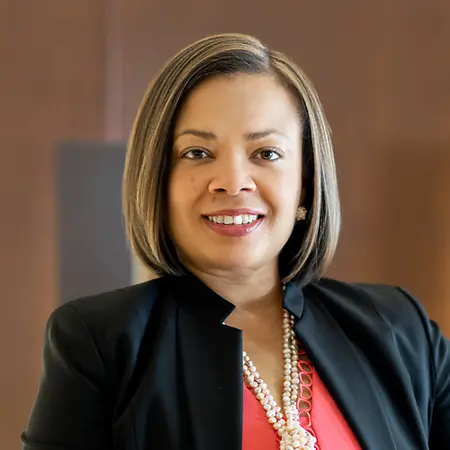
Her Story
About Tiah
Tiah E. McKinney, Ph.D. is the Co-Founder and Executive Director of The McKinney Foundation, Inc., where she leads initiatives dedicated to advancing health equity, education policy, and high-quality instruction for underserved youth. With more than seventeen years of leadership across education, nonprofit management, and public policy, Dr. McKinney has built a career focused on ensuring that every child has the opportunity to succeed. As a fifth-generation educator, her work is rooted in a deeply held belief that teaching is both a calling and a responsibility. Through the Foundation’s programs and national convenings, she collaborates with educators, policymakers, and community leaders to address systemic barriers that impact student achievement and long-term educational success.
Dr. McKinney began her career in 1999 as a science teacher at a charter high school in Detroit focused on marine immersion, where she worked with students from economically disadvantaged communities. Determined to expand opportunities for her students, she wrote grants, developed new curricula, organized out-of-state educational trips, introduced students to competitive ocean science programs, and established a scuba diving initiative that broadened their exposure to STEM fields. Her work soon drew broader recognition, leading to her appointment as Education Director at the Detroit Science Center, where she expanded her impact by supporting hundreds of educators and forging partnerships with cultural institutions such as the Charles H. Wright Museum, the Detroit Historical Museum, and the Detroit Zoo. Dr. McKinney later served as a State Science Consultant for the Michigan Department of Education and was selected as an Albert Einstein “Distinguished Educator” Fellow at the National Science Foundation, where she helped lead initiatives to expand diversity and opportunity within the geosciences.
Her academic work further shaped her national perspective on education reform. Dr. McKinney earned a Bachelor of Arts in Marine Affairs (Marine Biology and Business Administration) from the University of Miami and a Master of Arts in Teaching in Science Education from the University of Michigan–Dearborn before completing her Ph.D. in Educational Policy with a concentration in Nonprofit Management at George Mason University. Her doctoral research examined the often-overlooked role of social determinants of health in shaping educational outcomes, a framework that became central to her work. She is the author of Equipped to Thrive, which provides educators and policymakers with evidence-based strategies to address health disparities that affect student achievement. Under her leadership, The McKinney Foundation continues to expand initiatives such as Equipped to Thrive and Equipping Families to Thrive, convening national education policy symposia and partnering with schools and communities to address chronic absenteeism, learning loss, and the broader systemic factors that influence student success and the future strength of the nation’s workforce.
Her Interview
Ten minutes with Tiah
01What do you attribute your success to?
I attribute my success to passion, values, and an intense desire to serve. I'm a fifth-generation educator, so teaching was in my blood - it was the family business. But what really drove me was understanding my purpose and being passionate about it. When you are immersed in what you do, you love what you do, what you do reflects your values. I've always been led by my values, my passions, and what I really love to do, which is support our youth and help with their full development. I understood instinctively that I deal with our most precious resource, our children, and I'm helping to develop that raw talent. That's a gift, but it's also a huge undertaking because you share that responsibility with the parent. I knew that I had an obligation to serve families and our youth, who are our future leaders. When you understand that you're upstream, that you're dealing with raw materials and helping to form and shape them, you do it with a standard of excellence. Not just professionalism, but a standard of excellence, because you know you have an obligation. I wasn't pursuing promotions or recognition - I was just doing what I love. When you do something well and you're passionate about it, when you see clearly what needs to happen and the connections that need to be made, opportunities follow. Every role and position gave me the good fortune of seeing education from a very important but different view, giving me deeper depth and breadth and a greater appreciation of what is needed. I've always been driven by what I saw - the invisible problems, the unmet needs - and I couldn't unsee it once I saw it clearly. I was enraged by the inequities, but I was also determined. Not on my watch. That conviction, that sense of intergenerational responsibility as a fifth-generation educator, and that understanding that today's classroom issues will have direct implications for our nation's workforce tomorrow - that's what has driven everything I do.
02What advice would you give to young women entering your industry?
Understand that you deal with our most precious resource, our children, and you develop that raw talent. When you are immersed in what you do, you love what you do, what you do reflects your values. Do your work with a standard of excellence - not just professionalism, but a standard of excellence - because you know that you have an obligation to serve families and our youth, who are our future leaders. You share that responsibility with parents. Understand that you're upstream, and what you're doing today in the classroom will have direct implications tomorrow. These classroom issues and disruptions that schools are dealing with right now, today, they will have direct implications for talent loss, labor force, workforce disruptions for our nation's labor tomorrow. When you think about our 21st century workforce, our economic prosperity, our innovation, and our national security - those are the issues at stake, and they start in the classroom. So understand the weight and the gift of what you're doing. Don't just pursue positions for prestige - pursue what you're passionate about, what reflects your values. When you do something well because you love it and you're committed to excellence, opportunities will follow. But most importantly, never forget that as an educator, you are in a position of leadership, and with the knowledge we have, we have an obligation to use it responsibly. You're not only touching kids' lives, you're touching their parents and their communities.
03What are the biggest challenges or opportunities in your field right now?
The biggest challenge and opportunity right now is addressing the intersection of health and education through social determinants of health. We're dealing with chronic absenteeism, learning loss, reduced education attainment, teacher retention issues, and poor engagement - all issues that were accelerated by COVID-19. The pandemic took health from the backseat to the front seat, and we saw in real time how it was impacting our loved ones and our schools. Schools were shuttered for years, and we're still dealing with the aftermath. The way people have been oriented to solving the problem - through turbocharged tutoring, more tutoring, and elongated school days - is not the full and complete way to address this. It's half of it. The other half is the piece that's missing: addressing the non-academic health piece in a way that's well coordinated, well organized, and well partnered. Many students face barriers that have nothing to do with intelligence or effort - they're health barriers, economic barriers, social barriers. Some students couldn't see the board clearly because they didn't have access to vision care. Others were managing asthma or chronic health issues. Some were dealing with food insecurity or trauma at home. These social determinants of health disproportionately affect children in underserved communities and quietly shape educational outcomes every day. Once I saw it clearly, I couldn't unsee it. The opportunity is that we now have a research-informed framework through our Equipped to Thrive initiative that addresses both academic and non-academic needs. People are now coming aboard and understanding that we need to partner schools, families, and community organizations so children receive the support they need - not just academically, but physically and emotionally as well. This is not just a Detroit issue, it's not just a Michigan issue - it's a 50-state solution and beyond issue. And it's urgent because these classroom disruptions will have direct implications for talent loss and workforce disruptions for our nation's labor tomorrow. When you think about our 21st century workforce, our economic prosperity, our innovation, and our national security - those are the issues at stake, and they start in the classroom.
04What values are most important to you in your work and personal life?
The values most important to me are child-centered purpose, intergenerational responsibility, health equity and social justice, and authenticity and alignment. I view children as our most precious resource and raw talent to be developed. My career decisions have always been driven by impact on students rather than prestige or compensation - I didn't want to leave the classroom, but I understood I would have a larger platform to multiply the impact. As a fifth-generation educator, I'm carrying forward a family legacy and connecting today's classroom issues to tomorrow's workforce implications. I have a 'not on my watch' mentality about preventable student struggles. When I discovered that social determinants of health disproportionately disadvantage some groups to higher propensity of disease, poor quality of life, and premature death, I was enraged. I dedicated my PhD research to social determinants of health and have focused my life's work on addressing non-academic barriers like food insecurity, housing, and healthcare access that affect marginalized communities. I've always been led by my values, my passions, and what I really love to do. When you are immersed in what you do, you love what you do, what you do reflects your values. I understood that I share responsibility with parents and that I have an obligation to use my knowledge responsibly. I'm not only touching kids' lives, I'm touching their parents and their communities. Everything I do is driven by this understanding that we're upstream, that we're dealing with the raw materials of our future, and that we must do this work with a standard of excellence because of the obligation we have to serve families and our youth, who are our future leaders.
Join Influential Women and start making an impact. Register now.