Exploring why workplace accommodations for neurodivergent employees are essential accessibility tools, not special treatment, and how true inclusion requires moving beyond performative diversity to create environments where different minds can thrive.
“
Rebuilding is possible with a strong foundation. Supporting yourself mentally, physically, and emotionally is the best foundation.
Tiffany S. Campbell, MS, MA · In Her Own Words
Her Story
About Tiffany S.
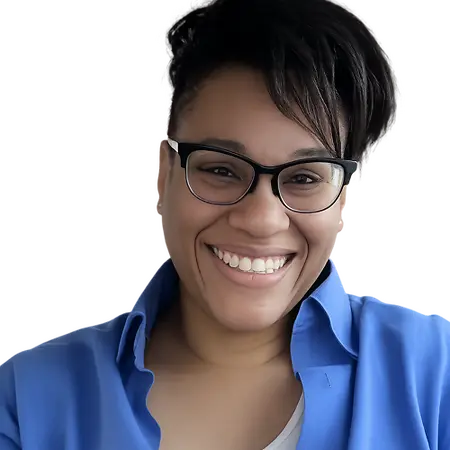
Tiffany S. Campbell, MS, MA, is an experienced professional based in Houston, Texas, with a career spanning a broad range. Over the past 10-plus years, it has been applied to behavior analysis (ABA) and housing services. She currently works as a Case Manager with the Galveston Housing Authority, where she supports veterans, low-income individuals, and people with disabilities in securing and maintaining stable housing. Her daily responsibilities include coordinating with landlords, clients, and other housing authorities, conducting briefings, and managing recertifications, income updates, and housing vouchers.
Before her current position, Tiffany gained extensive expertise in ABA, providing care to individuals with autism and other neurological conditions in diverse clinical and home therapy settings throughout Texas. She served in roles such as Registered Behavioral Technician with organizations including Action Behavior Centers, Success On The Spectrum, and BlueSprig, where she assisted in implementing behavior plans, collecting data, and supporting clients in developing adaptive, social, and communication skills. Her background in ABA reflects a long-term commitment to neurodiversity support and client-centered care. Additionally, she utilized the skills and knowledge acquired in the clinic setting to support those in her case manager role.
Tiffany holds two master’s degrees: a Master of Arts in Applied Behavior Analysis with an emphasis in autism from Ball State University, along with additional graduate-level certifications, and a Master of Science in Strategic Communication from Troy University. With a goal of obtaining her PhD.
Throughout her career, she has also worked in social media and client services, but her primary focus has remained in direct support roles. She describes her professional purpose as helping individuals navigate complex systems to improve quality of life, particularly through housing stability and behavioral support services.
Her Interview
Ten minutes with Tiffany S.
01What do you attribute your success to?
I attribute my success to living life being misunderstood and never quite fitting in. As a proud AuDHDer (autism and ADHD) who was not diagnosed until 30, I have been through so much in life without knowing my place. I have experienced things that people would not believe are real. Yet, I REFUSED to back down. The moment someone tells me I cannot do something, I am going to prove them wrong. While going through all the pain and struggle it may cause me with a smile on my face.
02What’s the best career advice you’ve ever received?
The best career advice I ever received is “As long as your eyes open, and you have breath in your lungs, it's not too late”. No matter where you are in your journey or what stage of life you're in, it's never too late to pursue your goals or make a change or seven.
03What advice would you give to young women entering your industry?
A tip for young women starting in any field is to prioritize themselves before considering others. Fill your cup before you fill someone else's. You can’t fill a cup if yours holes in it.
To be the best you, it's important to take care of yourself first. I mean your personal health, mental health, social health, financial health, and overall enjoyment of life. Your goals will be achievable when you feel and see your best self.
04What are the biggest challenges or opportunities in your field right now?
In housing, the biggest challenge right now is the lack of funding. There just isn't enough money available to help all the people who need housing assistance. Also, to be honest, people are taking it for granted.
In ABA, the biggest challenge is the lack of understanding. People don't have enough knowledge about applied behavior analysis and what it can do for individuals on the autism spectrum. People who work in the field do not understand what a person on the spectrum needs in real life. Life does not care if a person has autism or any other difference; it’s coming for all of us. There are so many skills a neurodivergent person can learn to help navigate the world. They are so simple, but people without that diversity do not understand the importance of those skills. There needs to be an understanding that “no” is a complete sentence.
There needs to be more mental health benefits for those who work in the field. The RBTs need much better pay with paid time off. NO QUESTIONS asked paid time off. There needs to be more support for RBTs in general. They go through a lot and get no support from leadership.
05What values are most important to you in your work and personal life?
I value honesty more than anything. That is just a huge, HUGE thing for me. I'm completely honest with my clients, and if I don't know something, I'll tell them. They all appreciate it. This is in both ABA and housing. Honesty is so, so important to me. That is a huge part of who I am: being honest and straightforward helps me build rapport and maintain relationships. Honesty eliminates misunderstandings and many problems. Just be honest and straightforward.
Also, learn to apologize. I will be quick to tell someone that is not correct, but I am just as quick to say I was wrong. I apologize all the time when I know I am incorrect. I even apologize to my children as they grew up and now. If you admit your mistakes, you can learn how to fix them. There is no one walking this earth who is perfect.
Her Content Hub
Articles by Tiffany S.
Rethinking Neurodiversity in the Workplace
A Series Exploring Understanding, Accessibility, and Workplace Culture
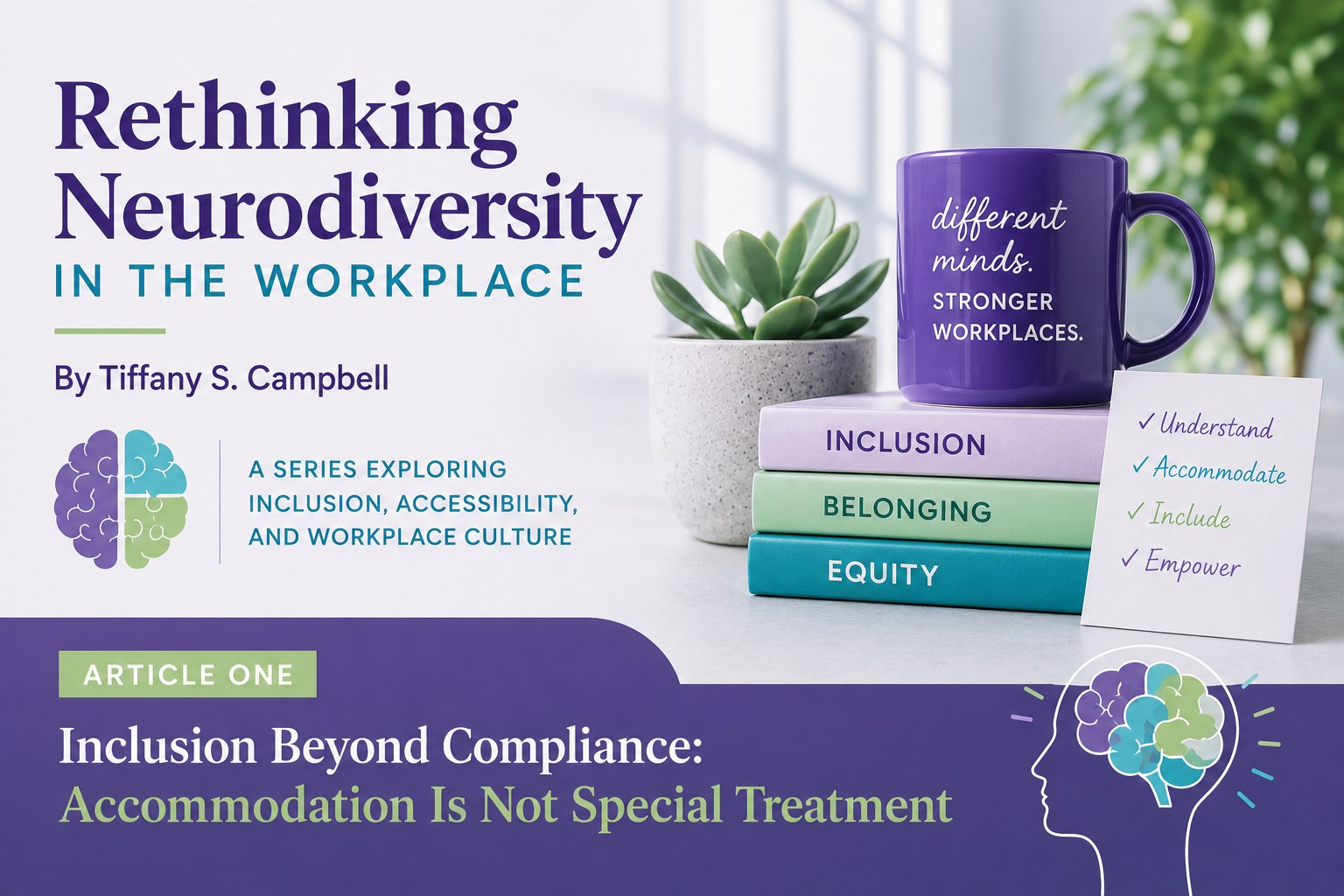
Many workplaces now proudly promote diversity and inclusion initiatives. Companies celebrate innovation, encourage employees to “bring their authentic selves to work,” and publicly support mental health awareness. Yet when neurodivergent employees request accommodations, their requests are often met with discomfort, skepticism, or outright resistance.
Some people still view accommodations as advantages rather than necessities. They assume flexibility means lowered expectations or unfair treatment. While co-workers see them as special treatment, leading to complaints that management would rather not deal with. It makes it difficult for neurodivergents to ask for support. When in reality, accommodations are not about giving neurodivergent employees an easier path. They are about removing barriers that were never designed with different brains in mind.
A workplace built around a single communication style, a single sensory threshold, and a single definition of professionalism will naturally exclude talented people who function differently.
Neurodiversity includes conditions such as autism, ADHD, dyslexia, OCD, Tourette syndrome, and other neurological differences. Neurodivergent employees are present in every industry, whether they openly share or know their diagnosis or not. They are managers, analysts, creatives, caregivers, educators, administrators, engineers, and leaders. Many are highly capable problem-solvers who bring innovation, pattern recognition, creativity, hyperfocus, and resilience to their workplaces.
However, many of these same employees expend enormous energy adapting to environments that do not adapt to them.
For some, accommodations may look small from the outside:
- Written instructions instead of verbal-only directions
- Noise-canceling headphones in overstimulating environments
- Flexible scheduling
- Additional processing time during meetings
- Clear expectations and direct communication
- Remote or hybrid work options
- Adjusted lighting or workspace modifications
These are not luxuries. They are accessibility tools.
A wheelchair ramp is not considered special treatment for someone who cannot use stairs. Closed captions are not considered unfair advantages. Yet, when neurodivergent employees request accommodations that support focus, regulation, communication, or sensory needs, they are often perceived as difficult, dramatic, or less capable.
This misunderstanding reveals a larger issue within workplace culture: many organizations still confuse sameness with fairness.
Equal treatment does not always produce equitable outcomes. Treating everyone the same only works when everyone starts from the same place, experiences the same environments, and processes information in the same way, which is not the case in real life for anyone. Neurodivergent employees often navigate invisible challenges that coworkers may never notice.
For example, an employee who appears quiet in meetings may not be disengaged. They may be processing multiple streams of information simultaneously while trying to manage sensory overload. An employee who requests written follow-ups may not be inattentive. They may process information more effectively through email. An employee who struggles with eye contact may still be deeply engaged in the conversation.
Too often, neurodivergent employees are expected to mask these differences to appear “professional.”
Masking is the process of suppressing natural behaviors and forcing oneself to conform to social expectations. In the workplace, this can include scripting conversations, mimicking communication styles, suppressing stimming behaviors, forcing eye contact, constantly monitoring tone, or hiding sensory distress. While masking may help employees avoid judgment temporarily, it often comes at a high emotional and psychological cost.
Many neurodivergent employees are not struggling because they lack capability. They are struggling because they are spending their energy surviving environments that were not built with them in mind.
Ironically, the same workplaces that resist accommodations often praise the strengths neurodivergent employees bring. Companies value innovation, crisis management, attention to detail, deep focus, unconventional thinking, and creative problem-solving. Yet these strengths frequently coexist with support needs.
You cannot celebrate neurodivergent talent while rejecting neurodivergent realities.
Creating inclusive workplaces requires moving beyond performative awareness. Accommodation should not be viewed as an inconvenience, an exception, or a favor. It should be understood as part of building environments where employees can perform at their best without sacrificing their mental health or identity.
Real inclusion is not asking neurodivergent employees to become less neurodivergent to succeed.
In my current job, I have accommodations that genuinely help me function and succeed. I am allowed to use lamps instead of harsh overhead lighting, have a silent keyboard and mouse to reduce sensory overwhelm, and listen to music or background noise while I work. These adjustments are relatively simple, but they make a significant difference in my ability to focus, regulate, and avoid burnout. My job also allows its employees to have mental health days. They strongly feel that “if you are not feeling well, you are not performing well.” This is something many companies need to follow.
What stands out to me is how different this experience has been from my time working in an ABA (Applied Behavior Analysis) clinic in the mental health field. Despite working in an environment centered around behavioral and mental health support, staff mental health was often overlooked. Getting even basic accommodations for ANYONE felt nearly impossible. I struggled just to get a short 15-minute break off the floor, and requesting any support felt like it required an act of Congress. Getting a bathroom break while you are on the floor is a miracle. Some clinics do not even offer a “client-free lunch”, meaning the technician would have to eat lunch with the client.
Anyone who has ever tried to eat with a child knows it is very difficult, let alone a child with special needs. Try eating a sandwich when your client is a runner, or they struggle to eat and throw their food at you, on the floor, other people, and so on. So, imagine if you are neurodivergent in this environment. You are ready to cry or have a meltdown; your mask is hanging by a thread, and you might forget where you are and just let go. That would be unprofessional, and you are doing your best to keep it together when you ask for a 7-minute bathroom break, to no avail. Yet people in the ABA field get no breaks. Add to the fact that clients often abuse them for hours with no break at all. No support from leadership is a HUGE problem. The irony of working in a mental health profession that does not adequately support its own employees is impossible to ignore.
Experiences like these highlight how accommodations are not about convenience. They are about sustainability, dignity, and creating workplaces where employees can actually function without sacrificing their well-being.
It is creating workplaces where different minds are allowed to exist, contribute, communicate, and thrive without being punished for needing support.
© 2026 Tiffany S. Campbell All Rights Reserved
Join Influential Women and start making an impact. Register now.