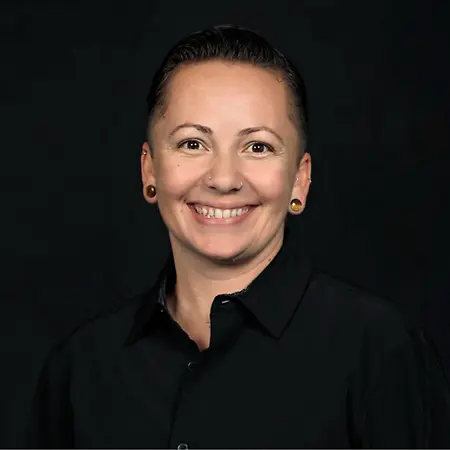
My path didn't have to mirror anyone else's to be meaningful. My experiences didn't disqualify me. They shaped me. I stopped chasing someone else's success and built a life rooted in purpose.
Tiffany Schillaci, LCSW- Q.S, MCAP, CCTP · In Her Own Words
Her Story
About Tiffany
Tiffany Schillaci is a Licensed Clinical Social Worker and behavioral health leader based in Fort Lauderdale, Florida, specializing in trauma-informed care, substance use disorder treatment, and integrated behavioral health program development. She currently works at Broward Health Medical Center, where she provides clinical supervision to MSW-level clinicians while also delivering therapy, crisis intervention, and case management services across psychiatric and correctional settings. Her work extends into Broward County’s jail system and drug court programs, where she supports diversion, treatment access, and reentry services for individuals with complex behavioral health needs.
With more than a decade of experience in behavioral health, Tiffany’s career began as a behavioral health technician and evolved through case management roles into advanced clinical leadership. She previously worked extensively in HIV/AIDS services and community-based care before earning her Master of Social Work from Florida Atlantic University and becoming a licensed clinical social worker. Along the way, she developed expertise in Medication-Assisted Treatment (MAT) program design, regulatory compliance, and cross-system collaboration with courts, emergency services, and correctional institutions.
Her professional philosophy is rooted in harm reduction, rehabilitation over incarceration, and the belief that recovery is best supported through compassion, structure, and access to care. Tiffany is known for building and scaling innovative MAT and behavioral health initiatives that improve treatment retention and outcomes for underserved populations. In addition to her clinical and leadership responsibilities, she is deeply committed to mentoring emerging clinicians, offering supervision to MSW interns and licensed associates as they develop their professional identities in the field.
Her Interview
Ten minutes with Tiffany
01What do you attribute your success to?
I attribute my success to my personal background and lived experience. My journey started when I got my GED after dropping out of high school - that GED is actually my favorite achievement out of all my degrees and fancy letters, because that's what really started my life change. From there, I just paid attention to everything and everybody I could get information from, and I went on my own journey which was focused on people helping people. Being able to focus on recovery allowed me to work my way through education, from being a behavioral health tech 14 years ago all the way to becoming a licensed clinical social worker and clinical supervisor at Broward Health Medical Center. I think my success also comes from my ability to connect with people by stripping away labels and just being human with them - reminding them that we're just people coming from similar backgrounds, not defined by titles like 'criminal' or 'drug addict' or 'social worker with fancy degrees.' As a single mom of four, I'm also driven by my commitment to breaking the cycle of trauma, and that personal mission fuels everything I do in my work with individuals suffering from mental health and substance use disorders.
02What’s the best career advice you’ve ever received?
The best career advice she ever received was that she could have a successful career and change her life, a belief that proved especially meaningful to her after earning her GED, which became the foundation for her entire professional journey.
03What advice would you give to young women entering your industry?
The advice she would give to young women entering her industry is that they can make a real difference and give purpose to their lives by leading with passion, compassion, and commitment, while also embracing the things she loves most—her work and spending meaningful time with her children, including coaching their sports.
04What are the biggest challenges or opportunities in your field right now?
The biggest challenge and opportunity in my field right now is changing how we view and respond to substance use disorder in the criminal justice system. When I step up to those podiums in front of courtrooms, I say that substance use disorder should not be a crime - it should not be penalized, and having a mental health disorder or substance use disorder should not be punitive. We're reducing recidivism rates in jails by like 90% through our diversion and treatment programs. The opportunity is in rehabilitation versus incarceration - I'm now doing expert testimony to get individuals out of prison who have been serving for 12 years, and working with drug court to divert people with substance use disorders into treatment instead of jail. Another major opportunity is in harm reduction and medication-assisted treatment, which is saving lives from fatal opioid overdoses. The challenge is that our community partners don't always know what we're doing - we're all talking in silos - and if we could just get together and share the same mission and vision, I think we'll touch more people. It's also about spreading awareness and breaking stigma, because as I say, you don't know what you don't know, and substance use disorder can happen to anybody.
05What values are most important to you in your work and personal life?
The most important value to me is being able to make a difference and help others with their mental health and substance use disorders. I'm passionate about bringing awareness to substance use disorders and breaking stigma, because it can happen to anybody. I believe strongly in seeing people as human beings first, not as labels - when I work with clients, I always start by saying we're just people coming from similar backgrounds, not defined by terms like 'criminal' or 'drug addict' or 'social worker with fancy degrees.' Connection and understanding matter more than credentials. In my personal life, breaking the cycle of trauma is central to everything I do as a single mom of four. I also value giving back and being present for my community - whether that's coaching three sports teams for my children, which brings me the most joy outside of work, or working to create family connections and being role models. It's not just about baseball or my own kids, it's about parents coming together and supporting each other. I always share my story because I think it matters, and I believe in rewriting narratives and showing that recovery and transformation are possible.
Join Influential Women and start making an impact. Register now.