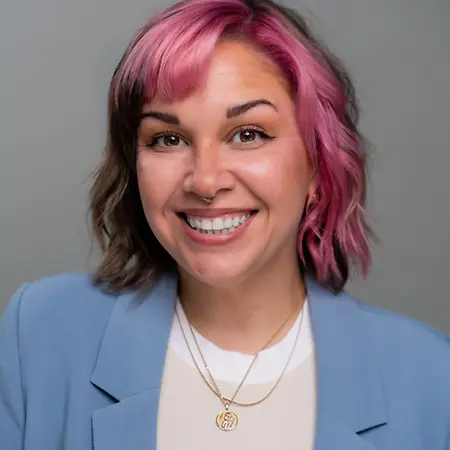
Her Story
About Dr. Timberly
Dr. Timberly Monaghan is a national leader in education strategy, systems improvement, and career-connected learning. She currently serves as a Director on the K–12 team at MGT, a national social impact solutions organization that partners with school systems, state agencies, and education-focused organizations to drive transformational change. Though she has been with MGT for only a short time, she was brought on for her deep expertise in career and technical education (CTE) and her insights into the national shifts reshaping workforce-aligned learning pathways. Her work focuses on helping systems translate vision into practical, scalable solutions that enhance student outcomes and community impact. Prior to joining MGT, Dr. Monaghan spent three years as the Executive Director of Fast Forward in the Office of Career and College Readiness at the Louisiana Department of Education. In this role, she oversaw the secondary experience for Louisiana students and led efforts that positioned the state as a national model for career-connected learning. Her leadership enabled other states to learn from Louisiana’s approach, establishing programs that are set to transform the educational and economic prospects of communities across the state. Earlier, she spent six years with the Louisiana National Guard Education Programs as Education Coordinator and Academic Chief of Staff, managing the Youth Challenge Program for at-promise students, Starbase STEM enrichment for fifth graders, and the Job Challenge Program, which provided graduates with industry-recognized trade credentials. Dr. Monaghan began her career as a high school English teacher, earning recognition as Avoyelles Parish District Teacher of the Year in 2015 while teaching AP and standard courses. Across her 17-year career, she has been a keynote speaker at national conferences and statewide professional development events, consistently driven by a passion for broadening positive impact and building education systems that change communities. Her work blends hands-on classroom experience with executive leadership, ensuring that every initiative she leads is grounded in practical, student-centered results while supporting systemic growth and sustainability.
Her Interview
Ten minutes with Dr. Timberly
01What do you attribute your success to?
I truly attribute my success to my spouse. I would not be where I am today without the steady support of someone who loves me deeply and believes in me even in moments when I didn’t fully believe in myself.
Time and again, when I hesitated to apply for an opportunity because I questioned whether I was “good enough,” they would gently challenge me: What’s the worst that could happen? They say no... and then what? That simple reframing gave me the courage to take risks I might have otherwise avoided.
I almost didn’t apply for my role at the Youth Challenge Program. I hesitated before submitting my application to the Louisiana Department of Education. And when the opportunity at MGT arose, I had that same initial instinct to hold back. Each time, my spouse encouraged me to step forward anyway.
Having someone in your corner, someone who will not let self-doubt win and who pushes you, kindly and consistently, toward your potential is an extraordinary gift. I am fully aware of the privilege of being loved and supported in that way. It has made all the difference in my journey.
02What’s the best career advice you’ve ever received?
“Do not shrink yourself to fit the room.” Timberly has embraced this advice throughout her leadership journey particularly as a queer woman working in sometimes partisan environments choosing to lead with excellence while remaining fully herself.
03What advice would you give to young women entering your industry?
I would encourage young women entering this field to resist the pressure to make themselves smaller. Be unapologetic about who you are. You do not have to trade authenticity for advancement. It may feel, at times, like fitting a particular mold would make the path smoother or faster, but long-term success that costs you your identity is not real success.
There will be moments when you encounter people or systems that are not designed to serve you. That can be discouraging. Stay grounded in your values anyway. It may take longer to rise without compromising who you are, but the leadership you build will be stronger, more sustainable, and far more fulfilling.
I am proud that I’ve reached an executive level while still holding onto joy, purpose, and a sense of perspective. I don’t take myself too seriously. I love the work. And I did not have to sacrifice who I am as a woman to get here. That matters.
And once you reach positions of influence, don’t pull up the ladder behind you. Intentionally create space for other women - especially those who are determined to lead without losing themselves and whose voices and presence are often left out of the conversations. We need more women at the highest levels of leadership who model both excellence and wholeness.
04What are the biggest challenges or opportunities in your field right now?
One of the most significant challenges in our field right now is breaking down silos. When I first moved into executive roles, I assumed that agencies and partners were naturally aligned around a shared mission. What I discovered instead was that many organizations operate in clearly defined lanes - “we do this, you do that" or "this is how we've always done it" - with limited cross-collaboration.
The reality is that high-quality career pathways and workforce programs simply do not function well in isolation. This extends beyond state agencies. It shows up in how schools engage with business and industry. Are partnerships transactional, focused on sponsorships and surface-level engagement, or are they truly aligned around shared outcomes? If we want students to graduate ready for high-demand fields, our programs must reflect the skills employers actually need. That requires ongoing, substantive dialogue.
The work can feel uncomfortable because it demands vulnerability. It means approaching employers and saying, “We don’t have all the answers. What skills matter most to you? Will you help us evaluate whether our classrooms are aligned to real-world expectations?” That level of openness challenges traditional structures, but it is essential if we are serious about building strong economic futures for students.
The opportunity, however, is powerful. Across states and communities, there are leaders who share a vision for more integrated, employer-aligned systems. When we intentionally find one another, critically examine longstanding practices, and distinguish between what is simply familiar and what is actually effective, we create space for innovation. Unsiloing systems requires courage and sustained effort - but it is also where the most meaningful transformation happens.
05What values are most important to you in your work and personal life?
Joy is at the top of the list for me... joy, whimsy, and the freedom to be fully myself. I care deeply about doing meaningful, high-impact work, but not at the expense of authenticity. I have worked at the executive level, helped shape policy and legislation, and influenced accountability systems that affect thousands of students. Those responsibilities matter enormously to me because they change lives. At the same time, holding onto my sense of self while doing that work has been just as important.
I am openly queer and have built my career in spaces where that visibility is not always common, welcome, or easy. Representing my community in a way that is confident and unapologetic is something I value deeply. I recognize that not everyone has the safety or opportunity to lead out loud in that way, and I do not take that lightly. If my presence at the table makes it easier for someone else to show up fully as themselves one day, that is meaningful to me.
I'm also proud that I have reached senior leadership while still maintaining perspective and joy. I do serious work, but I do not believe leadership requires losing your humanity. I have not had to sacrifice who I am - as a woman, as a queer leader, as someone who values creativity and warmth - to make an impact.
Ultimately, impact is the throughline in both my professional and personal life. The decisions I make about where I work and what I build are grounded in one question: Where can I broaden positive change? I want my work to matter, and I want to do it in a way that reflects who I truly am.
Join Influential Women and start making an impact. Register now.