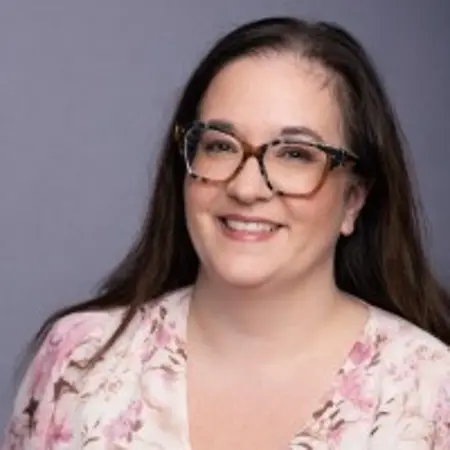
Losing my job was humbling, but that uncomfortable space gave me clarity to ask who I am beyond my title and choose a role that truly fits my strengths.
Tina Sherman, MBA, CPIM · In Her Own Words
Her Story
About Tina
Tina Sherman, MBA, CPIM, is a seasoned Enterprise Transformation Executive with 35 years of progressive leadership experience in manufacturing and global supply chain management. She has built her career across a diverse range of highly technical and regulated industries, including OEM manufacturing for viscometers, glass-to-metal seals, underwater autonomous vehicles, package inspection equipment, specialty chemicals, lithium batteries, and anti-vibration components. This breadth of experience has shaped her ability to operate effectively in complex, high-mix environments where precision, reliability, and continuity of supply are critical to enterprise success. She is widely recognized for her ability to translate operational complexity into structured, scalable systems that improve performance, strengthen financial outcomes, and enhance customer satisfaction.
Throughout her career, Tina has held senior leadership roles including Plant Manager, General Manager, and Director of Operations, where she has been accountable for end-to-end manufacturing performance, workforce leadership, and cross-functional execution. While she has successfully led full operational organizations, her enduring professional focus has consistently returned to supply chain management—where she brings the greatest value and personal fulfillment. Her expertise lies in developing and optimizing supplier relationships, leveraging supplier core competencies, and building resilient supply networks that support long-term enterprise growth. She has consistently driven improvements in working capital, inventory optimization, lead time reduction, and operational efficiency while aligning supply chain strategy with broader business objectives.
In her current role, which she has held for the past year, Tina concentrates on strengthening supply chain resilience through risk mitigation, continuity of supply planning, strategic sourcing, and negotiation of pricing and long-term contracts. She is also at the forefront of integrating AI-enabled tools into ERP systems to enhance planning, procurement, and decision-making processes. By leveraging AI as an operational assistant, she is improving forecasting accuracy, accelerating analysis, and increasing overall efficiency across supply chain functions. Known for her disciplined execution and forward-thinking approach, Tina combines deep operational expertise with modern digital transformation strategies to build agile, data-driven supply chains that are prepared for the evolving demands of global industry.
Her Interview
Ten minutes with Tina
01What do you attribute your success to?
I attribute my success to watching my parents struggle growing up. My father is an immigrant from Portugal and doesn't have a high school education, and my mother also didn't have a high school education, so I watched them struggle where they were not in positions of security. They were always the line workers, and if something happened, they were the ones being laid off. I didn't want to be in that position myself as I grew up seeing that. So I think that really drove me to put myself in a position that I watched them be in that I didn't want to ever be in, so that really gave me the drive to change my story. Also, my husband and my daughter were important motivators. Work was important to me because I never wanted us to have to go through what I watched my parents struggle with.
02What’s the best career advice you’ve ever received?
The best career advice I've ever received is to not take everything personally and take the emotion out of your responses. Not everything is an attack, and not everything is meant to cause friction. The saying that I'm living by right now is assume good intent with everybody that you're interacting with. Even if you're frustrated, if you kind of step back and say, let me assume good intent here, then respond based from that frame of mind, it really changes the whole dynamic of the conversation.
03What advice would you give to young women entering your industry?
Don't be afraid to speak up. I think a lot of women feel timid or intimidated standing in a room with people, both with men and women, feeling like they're an imposter and maybe they shouldn't be there. But they're there for a reason, and they should use that to their advantage and speak up and be part of the team and contribute, because you're there for a reason. You didn't get there by chance, you got there for a purpose.
04What are the biggest challenges or opportunities in your field right now?
I think the biggest challenge is the technology change. With the introduction of AI, it's really reshaping supply chain, but that's the biggest challenge and also the biggest opportunity because it's enabling faster decision-making and faster information gathering. It still needs to be put in context and have a human's input into the real solution, but AI is reshaping it, and we want to be part of the reshaping and not excluded from the reshaping. It's a double-edged sword, so you can either embrace it and use it to your advantage, or be against it and then you're going to be negatively impacted by it. One of the things that I have done is I have embraced it and been a volunteer to say, hey, let's do this, I want my team to be part of this as the first phase, because then I'm able to shape how it looks as opposed to someone telling me this is what it's going to be doing for you. The other challenges we face today are the geopolitical situations and what are apparently one-time events but happening almost every year. You can use COVID, the ice storm in Texas, the war in Iran, weather impacts, and large weather happenings whether in the United States or internationally that really impact supply chain in ways that you can't predict.
05What values are most important to you in your work and personal life?
The values that I think are important are integrity and being ethical, especially in a supply chain role. It's important to not have a bias and give everybody a fair chance. I think it's most important for me to have integrity, be ethical, and be humble. That's another important one, to be humble. If you look at things and say, you know, boy, I'm really thankful that I have a job and that I'm able to contribute, and from where I started to where I am, I've come a long way, but I never want to forget how I got here.
Join Influential Women and start making an impact. Register now.