Her Story
About Toni
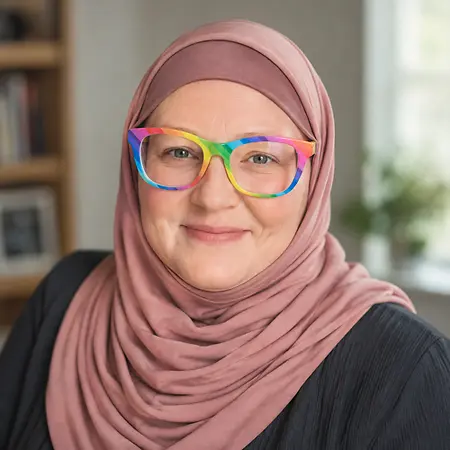
Toni Strak is an educator based in Greenville, South Carolina, whose work centers on the intersection of trauma, education, and access. She has tutored privately and in higher education since 2011 and currently works with learners across a range of educational settings.
Strak teaches English as a second language to adults and works with K–12 students from underserved populations, including young people in foster care and behavioral treatment settings. She is also involved with the Peaceful Prisons Project, a Maine-based nonprofit supporting incarcerated and recently released individuals through education, connection, and reentry support.
Her approach to education is shaped in part by her own lived experience in a psychiatric residential treatment facility. That experience informs her commitment to helping students recognize that a diagnosis, placement, circumstance, or label does not have to determine who they become.
Strak holds a bachelor’s degree in psychology from Southern New Hampshire University and is pursuing a Master of Science in Education focused on curriculum and instruction, with the goal of developing trauma-informed approaches to curriculum and classroom practice. Her professional training includes ESL instruction, trauma first aid, Psychological First Aid, Skills for Psychological Recovery, FEMA emergency-management coursework, and naloxone and opioid-overdose response.
She is a member of Phi Theta Kappa and Alpha Sigma Lambda and has studied multiple languages, including French, Arabic, and Spanish. Before her current work in education, Strak founded and operated Avery’s Bottom Cloth Diaper Ministry from 2014 to 2019, distributing more than 250 packages of reusable diapers and parenting resources to low-income families around the world.
Strak attributes her success to tenacity and the support of her children. It took her 24 years to earn her associate’s degree, an experience that shaped one of the principles she carries into her work: never give up simply because the path takes longer or looks different than expected, and never diminish yourself so much that you become too miserable to be what you set out to be in the first place.
Her Interview
Ten minutes with Toni
01What do you attribute your success to?
I attribute my success to tenacity and the support of my kids. It took me 24 years to earn my associate's degree. There were plenty of opportunities along the way to decide it was taking too long or that I should just give up, but I kept going.
That is why I believe so strongly in never saying, "I can't." The minute you convince yourself that you can't do something, you've already put a barrier in your own way. It might take longer than you planned. You might have to change directions, start over, or find a completely different way to get there, but taking a long time to accomplish something does not make it any less of an accomplishment.
My path has taught me that success does not have to happen on anyone else's timeline. Keep going until you get there.
02What’s the best career advice you’ve ever received?
Never give up, and never assume that choosing one career means there is only one way to do it. There might be 1,400 different branches of that one thing, and sometimes it takes a while to figure out which branch is yours.
I always thought being a teacher meant working in a traditional school and standing in front of a classroom every day. I eventually learned that teaching can happen almost anywhere. You can teach in schools, treatment facilities, nonprofits, community programs, one-on-one settings, or places you never would have considered when you first chose the profession.
You have to be willing to explore until you find your niche and the place where what you are good at meets what people actually need. Sometimes changing direction does not mean you gave up on what you originally set out to do. It means you figured out what it can look like for you.
03What advice would you give to young women entering your industry?
Never, ever, ever diminish yourself so much that you become too miserable to be the person you set out to become in the first place.
04What are the biggest challenges or opportunities in your field right now?
Resources, especially funding. There's just not enough money put into in education, especially these days. No matter the educational setting, it seems like we're constantly being asked to stretch a dollar further than it can reasonably go. Teachers and other direct-service professionals are underpaid, and the problem becomes even more apparent when you're working with people society tends to forget, ignore, or hide away: immigrants and undocumented people, underserved communities, foster children, people receiving mental health services, people with disabilities, incarcerated people, and others whose needs are too often treated as though they aren't worth investing in.
The people doing this work frequently end up filling those gaps out of their own pockets, with their own time, and sometimes at the expense of their own well-being. We need more sustainable funding, both public and private, that actually reaches the people receiving services and the people providing them. And we need to recognize that supporting educators and human-service professionals also means giving them the resources, time, and ability to care for themselves. You can't build sustainable systems by continually exhausting the people holding those systems together.
05What values are most important to you in your work and personal life?
Individuality, personal responsibility, and genuineness are probably the values that matter most to me. I believe people should be able to be who they actually are instead of constantly trying to become whatever someone else expects them to be. I value people who are genuine, even when that means they do not fit neatly into what is considered typical or expected.
At the same time, individuality comes with personal responsibility. Being true to yourself does not mean ignoring how your choices affect other people. It means knowing who you are, taking ownership of your decisions and mistakes, and being willing to grow without losing yourself in the process. That is something I try to carry into both my work and my personal life.
Join Influential Women and start making an impact. Register now.