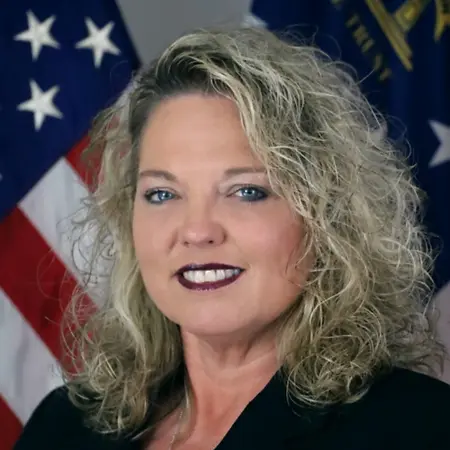
Her Story
About Tonya
Tonya Ashley is a seasoned public service professional with more than 32 years of experience with the Georgia Department of Corrections, where her career has been defined by resilience, leadership, and a deep commitment to rehabilitation and humane correctional practice. She began her journey unexpectedly in medical records, despite initially pursuing a pre-law track with the goal of becoming a prosecutor. After a change in direction during college, she shifted to criminal justice to enter the workforce sooner, influenced in part by her mother’s encouragement to seek stable state employment—though she once believed she would never work in a correctional setting.
Her perspective changed early in life after a formative childhood experience in which her father’s life was saved by outside detail inmates when she was in the fourth grade. That moment profoundly shaped her understanding of humanity within correctional environments and ultimately influenced her decision to dedicate her career to the field. Over the years, she has advanced through a wide range of leadership and specialized roles, including Deputy Warden at Wilcox State Prison, one of Georgia’s largest male facilities, and serving as the state’s first re-entry coordinator. She has also contributed to the creation of the Bostic Skilled Nursing Center and participated in numerous process action teams focused on system improvement. Her professional development includes extensive training such as Warden’s Pre-Command, Deputy Warden’s Academy, Supervision I and II, and national certification as an ADA Coordinator.
Throughout her career, Tonya has remained committed to servant leadership, even through significant personal and professional challenges. She has been separated from state employment on multiple occasions but has consistently returned with a steadfast belief in her purpose and calling to the work. In 2022, she sustained a serious spinal injury that required two surgeries and resulted in a disability, yet she continues to remain active in her profession training staff, conducting site visits, evaluating programs, and working directly with incarcerated populations to promote rehabilitation and hope. In addition to her full-time role as an Americans with Disabilities Coordinator, she serves as President of the Southern States Correctional Association, works part-time transporting children through DFACS, and speaks at high schools and BCOT programs to mentor and inspire young women entering the field. Her career reflects a lifelong dedication to service, advocacy, and improving outcomes for both staff and justice-involved individuals.
Her Interview
Ten minutes with Tonya
01What do you attribute your success to?
Early on in my career, I had a female tell me that I would not succeed in the Department of Corrections because I was a little dainty person. When I say dainty, I was tall, but I was really slender. I've always been one that if you told me I couldn't, I was gonna show you that I could. That determination to prove people wrong has driven me throughout my entire career. I have been rifted four times by the state of Georgia, and each time I told them that the good Lord put me here, and if He wants me to stay, this is where I shall stay, because I had no intentions of staying with this department initially. Even after suffering a spinal cord injury in 2022 that required two surgeries and left me disabled, I still get up and go to work. I am still out in the trenches trying to teach people who have lost all hope, because I have always been a servant leader doing all I could to empower people. My success comes from that refusal to give up, no matter what obstacles are placed in my way.
02What’s the best career advice you’ve ever received?
The best career advice I have ever received is to hone your craft. It has stayed with me because it is a reminder that long-term success is built through consistent effort, continuous learning, and a commitment to improving even the smallest details of what I do. Rather than focusing only on outcomes or titles, I have learned to invest in developing my skills, staying curious, and refining my expertise over time, knowing that excellence is earned through discipline and practice.
03What advice would you give to young women entering your industry?
I do this all the time. This is now a female-driven industry, and I always tell them that there's always gonna be another mountain that they got to climb. However, once they're going down the other side, they'll realize that that was only an obstacle in their way, and that there's nothing that they can't succeed at. You have to walk in there like you're 10 feet tall and bulletproof, and mean what you say, and say what you do, and do what you say you're gonna do. The environment that we currently work in will eat you alive if you're not strong, because there's more male institutions than there are females, so there's predators everywhere. In order to survive, you have to be strong and confident. I go out and speak to high schools and BCOT classes to tell them my story, because I actually started out in medical records 32 years ago, and I want them to know that success is possible no matter where you start.
04What are the biggest challenges or opportunities in your field right now?
I think that women as a whole, in the most part, in rural communities, are not taught to be strong unless they're in single-parent households. They're not taught to be strong, and if you're not strong, the environment that we currently work in will eat you alive, because there's more male institutions than there are females, so there's predators everywhere. In order to survive, you have to walk in there like you're 10 feet tall and bulletproof. It's sad, oftentimes, because they are conditioned by the men they get involved with to not be that person, to be the weaker sex, so that they can be taken advantage of. I just feel like that if there was something out in our communities that would increase their self-esteem, they would have a better chance at being successful. COVID did a number on us, and if there was something out in our communities that would boost their self-esteem, they would have a better chance at being successful. Because 1 out of 50, or 1 out of 100, will climb that ladder, but oftentimes, in rural Georgia, that's not the case. The biggest challenge is helping women in rural communities build the confidence and self-esteem they need to succeed in this male-dominated field.
05What values are most important to you in your work and personal life?
The values most important to me in my work and personal life are empathy, morality, selflessness, and being a servant. These values guide everything I do in corrections. I have always been a servant leader throughout my career, doing all I could to empower people. I try to teach staff who have lost all hope inside these facilities to do better and understand the needs of incarcerated individuals. I explain to people that every person who is incarcerated is somebody's mother, brother, sister, father, daddy, stepdaddy, husband, uncle, or son, and I have always been that person to explain to family members and people out in my community how institutional life affects them. My work is about serving those who need help the most, whether that's the incarcerated individuals themselves or their families trying to understand reentry and the trauma that leads to incarceration.
Join Influential Women and start making an impact. Register now.