Her Story
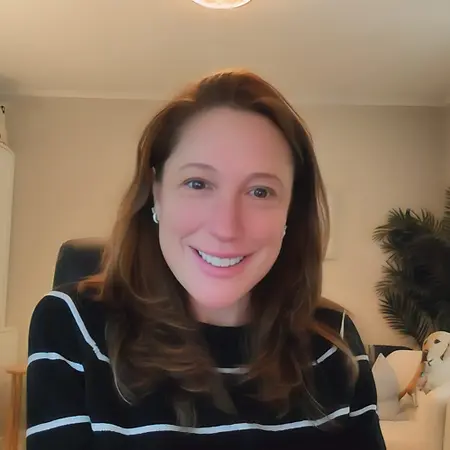
About Tracey
Tracey Stoll is an experienced special education professional and nonprofit leader based in Greater Boston, with approximately 30 years of work spanning education, social-emotional learning, and autism support services. She began her career in customer service and technical support within the project management software industry in Atlanta and New York City, where she developed strong problem-solving and communication skills. She later pursued graduate studies at Lesley University, earning dual master’s degrees in special education and general education, which became the foundation for her transition into teaching in integrated early childhood classrooms and working directly with neurodiverse learners. Building on her classroom experience and personal journey as a mother of three sons—two of whom are on the autism spectrum—Stoll founded Learning Solutions, a comprehensive social-emotional learning center focused on supporting children and adolescents through multidisciplinary services. Over 13 years, she grew the organization into a robust program serving over 100 students weekly offering executive function coaching, social skills groups, and therapeutic learning supports. Additionally consulting across multiple school districts. Her work also extended into curriculum development, including programs such as Social Fit and S.N.A.P. (Social Notes About People), designed to strengthen social understanding and decision-making skills. During this period, she also advanced her professional credentials, including certification through the International Board of Credentialing and Continuing Education Standards, specializing in autism spectrum disorders and behavioral methodology. Today, Stoll serves as Executive Director of The Common Room, a nonprofit dedicated to creating structured social, recreational and cultural opportunities for young adults with high cognitive autism and related social-emotional learning profiles. In this role, she leads a multidisciplinary team delivering 40–50 weekly programs designed to foster genuine peer relationships, independence, and community connection. Her professional philosophy emphasizes dignity, accessibility, and meaningful engagement for neurodiverse individuals, while her affiliations with organizations such as AANE (Association for Autism and Neurodiversity) reflect her ongoing commitment to advocacy and inclusive community building.
Her Interview
Ten minutes with Tracey
01What do you attribute your success to?
Personally, what contributes to my success is I am an incredibly hard worker, and I am a talented problem solver. I might not know everything, but I will work really hard to figure out one, if not more, solutions that can get us through what we need to get through or bridge any problems. I would also say the people around me - having family members that understand that there's a passion for work and there's a passion for home, and helping one family is about helping the community and helping your own family. I'm really good at troubleshooting, so I tend to be given a lot of problems. Things don't always go smoothly, but I find creative solutions. I have a diversity of experience, and I've worked in small business now for a while. My personality is to look at the individuals underneath me and say, how can I help you? If you're on my team and something's not going right, I ask how can I help you. Though I'm learning that sometimes when I do that, I have the propensity to sort of take over and do their job for them, which doesn't help me get my job done. My mentor is always saying to me, stay in your own lane - give them the tools, give them the time, and give them the empowerment to do it or not do it. That's sort of a personal goal that I'm working on, just to help me be even better at management and strengthening the team.
02What’s the best career advice you’ve ever received?
The best career advice I've received comes from my current mentor, a business coach, who's always saying to me: stay in your own lane. Because of my diverse background and my personality, I always try to figure out a way that I can help and give assistance to the team. But what happens is, when I do that, I sometimes have the propensity to sort of take over and do their job for them, which doesn't help me get my job done. My mentor tells me to give them the tools, give them the time, and give them the empowerment to do it or not do it. My goal is to empower my team, and this is something I'm still working on. It's helping me be even better at management and strengthening the team.
03What advice would you give to young women entering your industry?
I would say anticipate a lot of work that doesn't really revolve around a typical 9-to-5 schedule, because that's not how families and humans live, really. You need to have flexibility, you need to be resilient, and you need to be constantly learning. You also need to really be able to keep your sort of caregiver instinct to help other people, yet find a way to hold some boundaries so that you, yourself, personally continue as well. It's not easy - there's an emotional toll across the board. You have to have that fine line.
04What are the biggest challenges or opportunities in your field right now?
A lot of the challenges I'm seeing in the industry right now have a lot to do with federal and state funding sources - significant cuts and redistributions that have been made in the last few years that have really, really hurt the individuals and the families that need these services. Research has shown these services help them to maximize their capabilities and be more independent as an adult in the community later on. That funding piece filters down to the school systems who are feeling strapped, to the families that don't necessarily find the caregiver coverage that's experienced to be home with their kids. Then there's a family member who can't work. It's such a challenge in general for organizations to be able to provide for individuals and families that are going through this across the whole life. It's also really hard medically - the doctors are struggling, so now you've got a backup of getting into those services, same with therapy. It's kind of like a whole snowball effect. Working in the nonprofit sector, it's especially challenging because our mission is to be as philanthropic as possible and not pass the cost off to our members if we don't have to. Many of them are unemployed or living on Social Security, and they're not in a position to pay a lot of money to be able to actually have a part of life where they can go out and meet people like other people, versus being isolated at home.
05What values are most important to you in your work and personal life?
The values most important to me are hard work, problem-solving, and having supportive family members around me. I'm an incredibly hard worker and a talented problem solver - I might not know everything, but I will work really hard to figure out solutions that can get us through what we need to get through or bridge any problems. Having family members that understand that there's a passion for work and there's a passion for home is crucial. They understand that helping one family is about helping the community and helping your own family. I also value being able to keep my caregiver instinct to help other people, while finding a way to hold some boundaries so that I, myself, personally continue as well.
Join Influential Women and start making an impact. Register now.