I learned to lead across generations by holding space for both experience and fresh perspectives, building systems that help others move forward.
How She Learned to Lead Across Generations
Explore more
Influential Woman · AI Consulting and Workforce Development
AI Consulting Workforce Dev, InclusAI
Harrisburg, PA 17110
I stopped waiting for complete certainty before speaking. That small change created a confidence rooted in presence rather than perfection, revealing who I had been all along.
Traci Brown · In Her Own Words
I learned to lead across generations by holding space for both experience and fresh perspectives, building systems that help others move forward.
How She Learned to Lead Across Generations
Explore moreHer Story
InclusAI was created from a simple belief: artificial intelligence should be accessible, understandable and empowering for everyone. When AI started changing how people work, it became clear that most professionals were not lacking ability but clarity, confidence and practical guidance. InclusAI exists to close that gap.
At its core, InclusAI takes a human-centered approach to AI adoption. It helps professionals integrate AI into real workflows in a practical, ethical and sustainable way. Rather than positioning AI as a technical tool for specialists, InclusAI frames it as a collaborative partner that enhances judgment, improves efficiency and strengthens decision making.
A key focus of InclusAI is mindset readiness. Many professionals hesitate when approaching AI due to uncertainty, trust concerns or fear of change. InclusAI addresses this by building confidence, reinforcing human expertise and guiding individuals from awareness to real-world application. The goal is not to teach how to use AI but to help people understand when and why to use it effectively.
InclusAI also emphasizes responsible implementation. AI requires discernment. By promoting verification awareness, ethical usage and thoughtful interpretation of AI output, InclusAI supports environments where technology improves clarity rather than creating confusion.
The initiative recognizes that modern roles demand more than task execution. InclusAI helps professionals shift from managing tasks to building systems, improving workflows and supporting stronger organizational outcomes. It also promotes inclusive learning, ensuring that individuals at all experience levels can approach AI with confidence while preserving their professional strengths.
InclusAI is about helping people move forward with clarity and confidence as technology evolves. It helps individuals combine human intelligence with artificial intelligence to work more effectively, make better decisions and shape the future of work in a thoughtful and intentional way.
Her Interview
01What do you attribute your success to?
I attribute my success to consistency more than anything else. Not the kind that looks impressive from the outside, but the kind that shows up quietly over time. I have learned to stay with things, even when they are unclear, even when they take longer than expected, and even when the outcome is not guaranteed. That has shaped how I move more than any single moment or opportunity.
I also trust my ability to recognize what I am seeing, even when it has not been named yet. There have been points where I realized I was looking at something others had not fully articulated, and instead of waiting for validation, I stayed with it long enough to understand it for myself. That has made a difference in how I build and how I think.
My background plays a role in this as well. Working in environments where you are responsible for keeping things moving, supporting others, and holding multiple layers of work at once teaches you how to think in a way that is both structured and adaptive. Over time, that becomes a kind of discipline that you carry into everything you do.
More than anything, I would say my success comes from not separating who I am from the work I do. The same mindset that has carried me through life shows up in how I approach building, learning, and creating. I do not step in and out of it. I stay consistent with it, and that consistency compounds in ways that are not always visible at first, but become clear over time.
02What’s the best career advice you’ve ever received?
The best career advice I have received centers around ownership. You are the one shaping your future, and no one is coming to step in and do that work for you. Once you understand that, your decisions start to shift. You become more intentional about how you move, what you pursue, and how you respond when things do not go as planned.
Along the way, I have also learned that effort alone is not the goal. It is about learning how to work in a way that is sustainable and thoughtful. Working smarter requires you to step back, assess what is actually needed, and make adjustments instead of pushing forward out of habit.
Leadership, to me, has always been tied to how you treat people. Kindness and empathy are not separate from strong leadership. They are part of it. The way you show up for others, the way you listen, and the way you support people through challenges is what builds trust over time.
Accountability is another piece that cannot be overlooked. Being open to constructive criticism, even when it is uncomfortable, creates growth that you would not reach on your own. It requires a level of honesty with yourself that strengthens both your work and your relationships.
I have also found that who you surround yourself with matters more than people often realize. Being around individuals who think differently, who challenge you, and who bring perspectives you do not yet have pushes you to grow in ways that are difficult to do alone.
Taken together, all of this has shaped how I approach my career. It comes down to ownership, intention, and how you show up, both for yourself and for the people around you.
03What advice would you give to young women entering your industry?
The best career advice I have received centers around ownership. You are the one shaping your future, and no one is coming to step in and do that work for you. Once you understand that, your decisions start to shift. You become more intentional about how you move, what you pursue, and how you respond when things do not go as planned.
Along the way, I have also learned that effort alone is not the goal. It is about learning how to work in a way that is sustainable and thoughtful. Working smarter requires you to step back, assess what is actually needed, and make adjustments instead of pushing forward out of habit.
Leadership, to me, has always been tied to how you treat people. Kindness and empathy are not separate from strong leadership. They are part of it. The way you show up for others, the way you listen, and the way you support people through challenges is what builds trust over time.
Accountability is another piece that cannot be overlooked. Being open to constructive criticism, even when it is uncomfortable, creates growth that you would not reach on your own. It requires a level of honesty with yourself that strengthens both your work and your relationships.
I have also found that who you surround yourself with matters more than people often realize. Being around individuals who think differently, who challenge you, and who bring perspectives you do not yet have pushes you to grow in ways that are difficult to do alone.
Taken together, all of this has shaped how I approach my career. It comes down to ownership, intention, and how you show up, both for yourself and for the people around you.
04What are the biggest challenges or opportunities in your field right now?
The biggest challenge I see right now is that mid-career women remain largely invisible in the AI conversation. When I began researching after writing my book, I expected to find at least a small ecosystem built around this group, something that acknowledged their presence and experience. Instead, there was almost nothing there, and that absence did not discourage me so much as it clarified what I was looking at. It revealed a gap that had not yet been named, and more importantly, not yet claimed.
Inside organizations, what is happening often looks like strategy, but it is closer to a miscalculation. There is a growing tendency to phase out mid-career professionals under the assumption that knowledge can be transferred downward, as if experience moves cleanly from one person to another. On paper, that may appear efficient. In practice, it creates loss. Institutional knowledge, judgment, and lived operational experience do not translate in neat handoffs, and organizations are beginning to feel the weight of that absence even if they cannot yet articulate it.
Beneath that, there is a quieter issue that rarely gets addressed directly, and it sits at the center of what I see unfolding. This is not simply a matter of skills or access to training. It is a formation gap. Experienced professionals are being introduced to AI at the point of expectation, not at the point of orientation. They are asked to engage with systems that are already in motion, without ever being given the space to understand how they themselves fit within that shift or how their existing knowledge translates into this new context.
What forms in that environment is often misunderstood. Hesitation begins to surface, and it is quickly labeled as resistance. Distance shows up, and it gets interpreted as disengagement. In reality, many of these professionals are not behind. They are unformed in the context they are being placed into, and that distinction carries weight. When formation is skipped, adoption becomes surface-level. It may look like participation, but it does not hold under pressure because it was never grounded in understanding.
At the same time, something very different is happening outside of traditional structures. Many women are no longer waiting to be repositioned within systems that do not fully recognize their value. They are stepping out, building, creating, and redefining what work looks like on their own terms. AI is not presenting itself as a threat in that space. It is creating an opening. It allows for ownership, autonomy, and reinvention in ways that were not previously accessible at this scale.
What makes this moment significant is the pace at which both of these realities are unfolding. Organizations are still operating from assumptions about age, relevance, and contribution that no longer hold, while mid-career professionals are quietly building new models of ownership and integration that do not rely on those assumptions at all. That tension will not sustain itself for long. There will need to be a shift in how experience is recognized, engaged, and integrated into the systems that are now shaping work.
The opportunity sits directly inside that gap. Those who recognize it early are not simply preparing for what is coming. They are participating in defining it.
05What values are most important to you in your work and personal life?
Life, for me, has always been shaped by sacrifice, but not in a way that feels like loss. It is a choice I would make again without hesitation. Nothing I have done for my children has taken anything away from me. If anything, it has clarified who I am. I move through life as someone who does not give up, and when I decide I want something, I commit to it fully and follow it through.
That sense of commitment carries directly into my work. I am deeply intentional about being a voice for mid-career women, especially in the AI space, where most of the narrative is still being shaped from a technical perspective. What I bring is different. I come from the inside out. I understand the lived experience of the people who are being asked to adapt, not just the systems they are being asked to use.
What matters to me is representation that feels real and grounded. I want to contribute a perspective that reflects what it actually looks like to engage with AI from where many women stand today, not from a distance, but from within it. That has become a responsibility I take seriously, because I know how rarely that perspective is centered.
At the core of everything I do is a commitment to support others in a way that is meaningful and usable. I have always approached my work with that mindset. It is not just about building something for myself. It is about taking what I have learned, what I have experienced, and turning it into something that other women can use to move forward in their own lives.
That is how I see my role. Not just as someone building, but as someone who carries what she learns back with her and makes it available to others in a way that helps them grow.
Her Content Hub
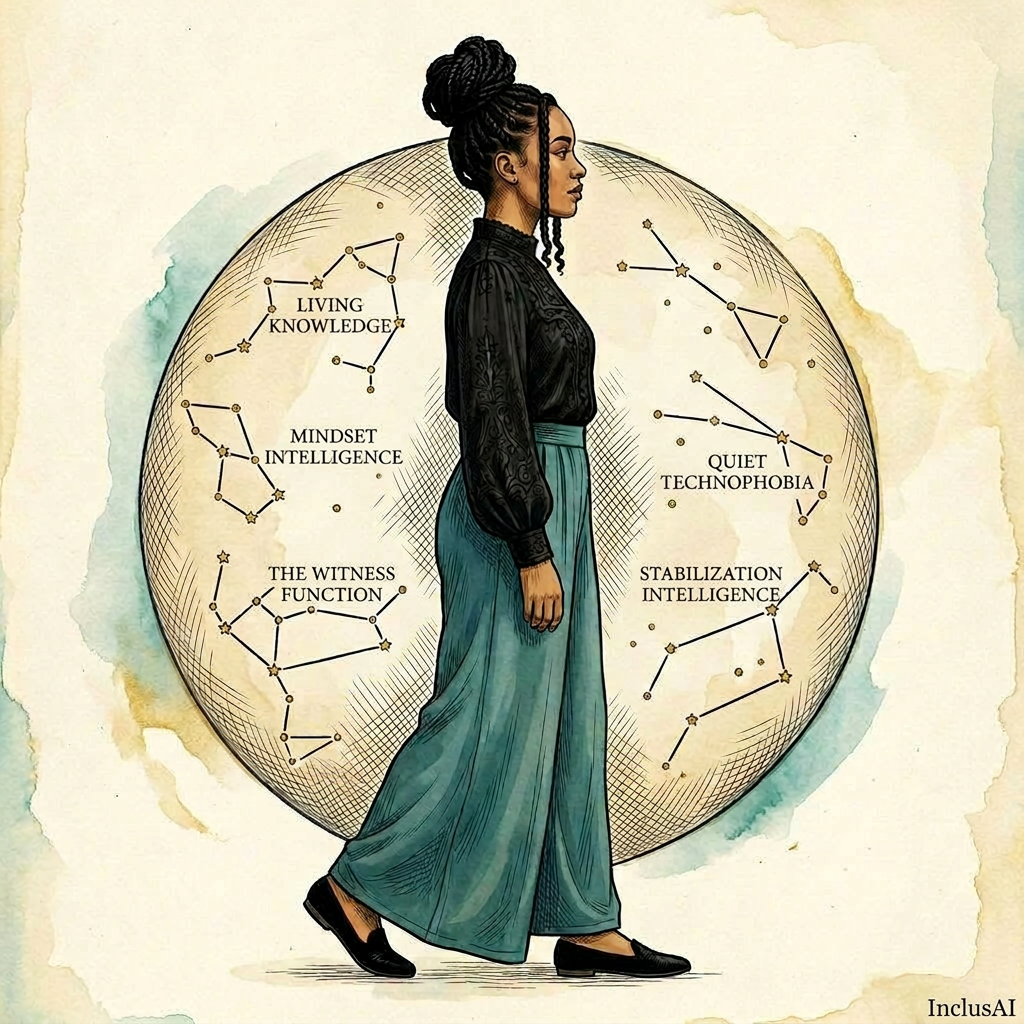
An exploration of how recognizing and leveraging accumulated professional expertise—termed "Living Knowledge"—can unlock untapped potential and transform a career trajectory through intentional action and consistency.
How I Discovered That What I Was Already Carrying Was the Foundation for Everything I Could Become
I managed complexity, carried institutional memory, and kept the work moving in ways that most people benefited from without always stopping to name. I was competent, steady, and deeply experienced, and I had spent years contributing at a high level while privately wondering whether what I carried had the potential to become something more. For a long time, I did not have the language for what was happening beneath the surface of the work.
More than fifteen years of professional experience built something in me that I had never stopped to name. I organized information in ways that made other people’s thinking clearer. I anticipated what would break before it did. I moved through ambiguity quickly and accurately because I had developed a calibration that only comes from years of doing the work—absorbing enough professional reality that you stop consciously deciding and start simply knowing.
None of that lived in a document, nor could it have. I carried it into every room I entered and treated it like background noise rather than the asset it actually was.
What I know now is that it had a name all along. I call it Living Knowledge—the accumulated intelligence a professional carries that cannot be fully extracted, documented, or replicated because it grows, adapts, and self-corrects through lived experience in ways no static system can follow. I had been sitting on a significant body of it without once considering that it was mine to build from.
The shift did not come from a promotion, a course, or a moment of external recognition. It came from a tool.
When I began incorporating AI into my daily work, I expected to feel behind. What I did not expect was to feel seen—not by the technology itself, but by what it revealed about what I was already carrying.
Every time I brought my professional context into a prompt, every time I redirected an output because I knew it did not match the reality of the work, I was watching my Living Knowledge operate in real time. The tool did not replace what I knew. It showed me where my knowledge was already working, and that distinction mattered more than I had anticipated.
At the start of March 2026, nothing was wrong. I want to be clear about that because it matters. I was not stuck, not starting over, not behind. The work existed, and the thinking was documented.
But there is a particular kind of professional tension that most experienced practitioners know and rarely name: the space between having done the work and waiting for the world to fully receive it.
I was in that space. And rather than wait through it, I decided to move within it.
For thirty consecutive days, I published intentional content daily while working full-time. No cleared calendar. No ideal conditions. I used AI as the operational infrastructure that made sustained execution possible while my thinking continued to expand.
What I did not expect was what that consistency would do to the work itself.
The ideas sharpened. The frameworks I had been carrying for years became more precise through the act of articulating them every single day. And I began to understand not just what I had built, but what it was genuinely capable of becoming.
That is the part I had not given myself permission to see before.
My Living Knowledge was not just useful in the work I was already doing—it was the foundation of something I could build, share, and offer at a scale I had never seriously imagined.
The thirty days did not create that potential. They revealed it.
What had been operating quietly in the background of my professional life moved to the foreground—not because someone finally saw me, but because I finally decided to trust what I was carrying.
The growth I am most proud of did not come from adding more. It came from acknowledging what was already there—recognizing that the expertise I had accumulated through years of real work was not simply a record of tasks completed.
It was raw material for something far larger.
And it had been there the whole time, waiting for me to stop treating it as background.
That acknowledgment opened something—not urgency, not pressure, but a steadier, more directed momentum that comes from moving with the full weight of what you actually know behind you.
Many experienced professionals carry a quiet question about whether their insights have the potential to reach further than where they currently apply them. It is a question that rarely gets examined out loud—and it deserves a better answer than silence.
What you carry is not ordinary.
It is Living Knowledge.
And it is yours to build from.
Join Influential Women and start making an impact. Register now.