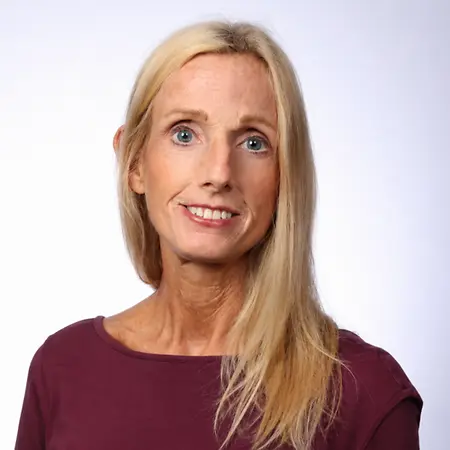
Her Story
About Tracie
Tracie Jackson, RD, CDCES, is a highly experienced Registered Dietitian and Certified Diabetes Care and Education Specialist with 37 years in healthcare and more than two decades dedicated specifically to diabetes management and patient education. She specializes in advanced diabetes care, including insulin pump therapy and continuous glucose monitoring systems, helping patients interpret device data and make informed adjustments to their treatment plans. Known for her clinical precision and compassionate approach, Tracie is committed to empowering individuals with diabetes through education that is personalized, practical, and rooted in empathy.
Throughout her career, Tracie has held a wide range of clinical and academic roles, including diabetes program leadership positions at AdventHealth Ocala, Children’s Nebraska, and Nebraska Medicine. She has extensive experience training interdisciplinary healthcare professionals, including medical students, physician assistants, pharmacists, and dietitians in evidence-based diabetes care. In her role as Diabetes Program Coordinator in Omaha, she also trained nursing staff on insulin pump technology and provided education to daycare providers, school nurses, and foster families, ensuring continuity of care for pediatric patients across all environments.
Currently, Tracie works as an independent contractor and Certified Diabetes Care and Education Specialist with Your Diabetes Insider, where she provides virtual diabetes education, insulin pump training, and behavior change coaching. Her work is grounded in a deeply empathetic philosophy—she is driven by the belief that patients deserve individualized support rather than generalized advice or judgment. She is especially passionate about helping individuals who feel discouraged or blamed for their condition, taking time to truly listen, educate, and guide them toward sustainable health improvements. Embracing innovation and technology, Tracie continues to expand her expertise while maintaining her commitment to high-level, patient-centered care that transforms outcomes and restores confidence.
Her Interview
Ten minutes with Tracie
01What do you attribute your success to?
My drive is a huge part of my success - I'm a Capricorn, so I don't back down. What really sets me apart is my desire to continuously expand myself, expand my knowledge base, and expand the types of things that I can do. I could have backed away from technology when I was in my 50s. I could have been like, too old to learn that. But instead, I was like, teach me, teach me, teach me. I want to know how to do this, I want to help people. I also want to teach other professionals, because that helps me be able to teach patients better. When other professionals ask questions like 'I don't understand why you do that,' I realize that patients are probably going to wonder that as well. So I just become an expert in it so that I can provide the resource for them. I'm a worker - I'll work myself into the ground, I won't say no to anybody. But that doesn't make me sad. It makes me feel good that I'm needed and that I can be helpful. That's really important to me.
02What’s the best career advice you’ve ever received?
The best career advice I've ever received is that old adage - if you love what you do, it doesn't seem like work. And it's true. Because I do love what I do, and I don't go to work dreading it, or thinking, oh, I don't know how I'll ever accomplish this. I love it, and I'm confident, I know I can do it. It changes your attitude as to how you approach it. Another piece of advice that really shaped me came from a dietitian during my internship who told me: you don't have to know everything that a person asks you, but you need to know where to find it. I've really taken that to heart. When people ask me about something outside my area of expertise, I just tell them that's not particularly in my area of expertise, but I promise you, I will find the information for you and get back to you. That's been incredibly important in how I've developed my professional style.
03What advice would you give to young women entering your industry?
My advice to young women entering this field, especially those training to be dietitians, is this: we don't need to accomplish anything today. When you're working with patients, especially in outpatient diabetes education, they're not like hospital patients who need information to be discharged. They're here if they want to be. We just have to establish something with them today. If they're not in a place where they can deal with this right now, or if they have all this other stuff going on, that's okay. We don't have to do anything more than they're ready to do. If that's just scheduling another appointment today and we don't talk about anything, then it's okay. It's hard for interns who are learning to let that go. They think, no, I gotta teach them about this, I gotta give them this handout, I gotta record this. But you're just doing it for a nod at that point if they're not ready, or if you don't feel comfortable just yet. You don't have to shove information at them. You have to develop a rapport with them. Usually, they'll allow you to give them some pieces of information, even though they didn't think they were ready for it, and it's going to be much better received when you get them back. I'd rather form a rapport and say, okay, now this is how we're going to move forward, out of respect for you at this minute. You're not feeling well, you have all of this going on. Come on, let's make a plan to move forward, not give it all at once.
04What are the biggest challenges or opportunities in your field right now?
The biggest challenge in my field is always money. We all know that because we have to use healthcare too. I have a lot of patients I would love to help, but their insurance doesn't cover diabetes education. What do you do? We can't give it away for free, or there won't be any of us left. The real problem is that insurance companies are going to end up covering all of these patients' complications because they never got to anybody who could help them. Diabetes could single-handedly drain the healthcare economy - it's probably even worse than cancer. It affects your digestive system, your hearing, your blood - there isn't a part of your body that's not touched by blood. If it has too much sugar in it, it's doing damage everywhere it touches. There's no 'just don't do this and you'll save your kidneys.' Healthcare's biggest problem is insurance and lack of financial support. You could be bankrupt overnight because of some catastrophic health experience. At our clinic, we weren't allowed to give cash pay prices to people who had insurance, because that's called insurance fraud. So if someone had a high deductible and said they couldn't afford it, we weren't able to offer them the cash price because they have insurance - they're just underinsured, and there's nothing we can really do about that. I don't know how we fix it, because money is obviously always a problem. Insurance companies are for-profit organizations, and that's how they do it, whether it's car insurance, health insurance, or home insurance.
05What values are most important to you in your work and personal life?
The values most important to me are honesty, being upfront and real with people, fairness, compassion, and empathy. Just being open and honest, and just being real with people. Understanding is a big one too. You don't think about these things very often, but they guide everything I do. I have to be willing to understand people's journeys and what got them there. My patients are there talking with me because they know they have to change the direction of their journey to sustain themselves. I also have to undo a certain amount of what they've been told before, which is challenging because you never know if they're going to believe you at first. I had a patient recently tell me she didn't believe me in the beginning when I wanted her to change everything about her son's diet, but now he's doing the best he's ever done. That kind of openness and honesty between us is what makes the difference.
Join Influential Women and start making an impact. Register now.