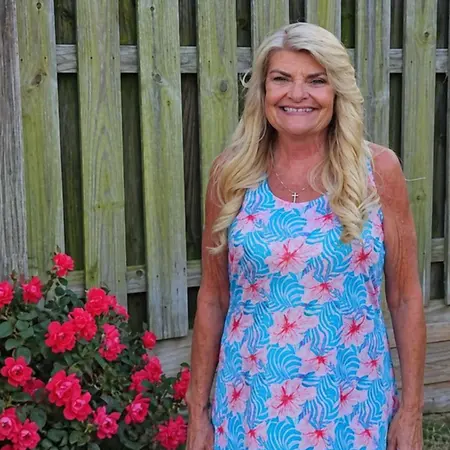
Her Story
About Tracy
Tracy Poe is a Licensed Clinical Mental Health Counselor in the state of North Carolina and has worked in the mental health field for 37 years. She holds a Doctorate in Christian Counseling and is recognized as a leading expert in problem gambling within the state. Tracy serves as a panelist on Sports Gambling and Gaming legislation, where she provides expert testimony to governors and members of the North Carolina House of Representatives on gambling-related policy and public health concerns. Her specialty is gambling addiction, an area in which she has built a distinguished career as both a clinician and researcher.
Tracy is a published researcher who has presented for over seven years at the National Center for Responsible Gaming in Las Vegas, contributing to the national dialogue on gambling disorder prevention and treatment. She has also conducted research on opioids through the Rural Communities and Opioid Response Program, expanding her expertise into substance use and community-based behavioral health challenges. In addition, she spent seven years as an adjunct professor at Campbell University in Buies Creek, North Carolina, where she taught courses including General Psychology, Abnormal Psychology, Psychotropic Medications, and Social Psychology.
For the past two years, Tracy has worked in utilization management, reviewing approximately 60 clinical cases per week to determine continued authorization for mental health treatment, collaborating closely with psychiatrists and other healthcare providers. In January 2024, she experienced a significant health crisis involving a large brain tumor, which temporarily impacted her ability to speak for four months. Through recovery and resilience, her MRI results by March 2026 showed no residual effects. Outside of her professional work, Tracy volunteers in downtown Wilmington supporting individuals experiencing homelessness, particularly those with serious, persistent mental illness and addiction, offering compassion, presence, and dignity through simple human connection and care.
Her Interview
Ten minutes with Tracy
01What do you attribute your success to?
I attribute my success 100% to God, especially after surviving a brain tumor in January 2024 that left me unable to speak for 4 months. I had the biggest tumor my surgeon had ever seen, and I never had to have chemotherapy or radiation - they were able to get it completely out, and by March 2026 my MRI was perfect with no residual effects. The fact that I can talk to you and have an interview with you - this has been, yeah, but God for me. That's bottom line. I also credit my parents who gave me such good work ethic. My mother died in 2021 from cervical cancer, but my father just turned 87, and as an only child, my parents taught me from day one to treat other people well and that everything's not about me - what can you do to help other people. They're Christians, and they taught me to help other people. My dad was the one I reached out to when my words wouldn't work during the tumor, and he has been my biggest supporter.
02What’s the best career advice you’ve ever received?
The conversation briefly touched on the participant's family background and how their parents instilled good work ethic, with her father being her biggest supporter.
03What advice would you give to young women entering your industry?
100%, I would tell them that you have to look at the big picture, not just for yourself. Women and men, you need to have a community and be a team player, not look just for yourself. When you first start in this field, you're seeing people who are hurting - they are hurting to get therapy or treatment at an emergency department. So I tell them that, first and foremost, understand that these people are hurting. Give a little grace. Just give a little grace. If they're a hooker, if it is somebody who has human trafficked other people, children, whatever - and again, I 100% disagree with it 100%, but you gotta think, how did they get there? Nobody just wakes up one day and decides, I'm gonna be a prostitute. That's just not the way it works. What happened to hurt this person? This person is hurting. That's what I tell those folks, particularly at a college-university level. I would start by telling them day one, just day one, before I go across the syllabus, I say, number one, I'm going to talk to you about people who are hurting. Remember this: always remember grace. By grace to God, I could be dead right now.
04What are the biggest challenges or opportunities in your field right now?
Mental Health is still seen as a stigma, but there are many resources available. The career growth is vast in the mental health field.
05What values are most important to you in your work and personal life?
My values are 100% that I have as a therapist - I've always had good empathy, but now, at this level after my brain tumor, boy, I really reach out to people, I appreciate people, I love people. Before, I would say, not like that. But when you go through that kind of experience, all of a sudden your values change. I want to appreciate what people want to say, because they can talk, instead of trying to get people to shut up, no matter which side of the spectrum that people are on. If it's Republican, if it's liberal, whatever, listen to what people are saying, because people are hurting. That's my value - my value is that people who are hurting, we have all got to do better, because as a community, we are the backbone. We need to, as a community, come behind other women and say, hey, it's okay, because I got your back. For utilization management, I've only done that for 2 years, but I have never been on a team like these women, and there's some men too. I have a team - if I see somebody is struggling, I'll say, hey, let me have a couple, I can do it for you, because they do it for me too. So that community needs to be a team. My value is team, just to be a team. Don't just look at yourself - know that people are hurting. How can we help people who are hurting? No matter what's happening with them, because they're human beings, no matter which way it's going.
Join Influential Women and start making an impact. Register now.