Her Story
About Tuesday
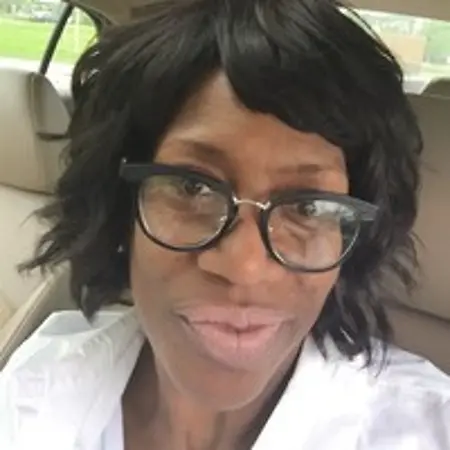
Tuesday Glover is a passionate social work leader and advocate who serves as Director of Culturally Responsive Caregiver Support and Dementia Services at Volunteers of America of Minnesota and Wisconsin. Based in Minneapolis, she oversees a team of social workers and community health workers while leading programs focused on dementia education, caregiver support, brain health awareness, and early detection. Her work spans both community-level outreach and policy advocacy, including directing mobile clinics that provide free health and memory screenings, especially in underserved communities and communities of color where trust in the healthcare system can be limited.
Tuesday’s path into social work began in an unexpected place. Earlier in her career, she and her sister managed a beauty salon, where they organized food drives and toy drives to support their community. Inspired by a promise she made to her mother to return to school, she pursued social work, earning her bachelor’s degree from Metro State University and a Master of Social Work from University of Denver. She joined Volunteers of America in 2014 and steadily advanced from project coordinator to program director, building expertise in dementia care, caregiver services, and community education. Along the way, she has become a trusted voice at the state capitol, advocating for caregiver respite services, brain health funding, and stronger support systems for older adults and families.
Her work is deeply personal as well as professional. In 2021, Tuesday’s husband was diagnosed with early onset dementia, and she became his primary caregiver until he passed away from frontotemporal dementia in 2024. That experience gave her firsthand insight into the emotional, financial, and practical realities families face when navigating dementia. Today, she channels that experience into her mission of helping people where they are, focusing on the whole person rather than just the illness. In addition to her leadership role, Tuesday partners with youth mentorship programs to educate younger generations about brain health, exercise, nutrition, and stress management, believing that early awareness can help prevent or delay dementia later in life.
Her Interview
Ten minutes with Tuesday
01What do you attribute your success to?
I attribute my success to truly listening to the people and communities I serve, setting aside assumptions, and focusing on their real needs rather than simply checking a box. I also believe keeping the promise I made to my mother to return to school gave me the foundation and determination to pursue this path.
02What’s the best career advice you’ve ever received?
The biggest advice that I received was to listen to the person that you're serving. Don't ever assume their need is your need. Put all your biases away, throw them out the window, and really listen to the person in front of you, or the community in front of the community. Really assess and see what the needs are that they need. Don't just get a grant to check the box, but really assess and see what the need is.
03What advice would you give to young women entering your industry?
Follow your heart and make sure it's something that you're passionate about. It's definitely a need, but at the same time, you don't want to do it just because of money or whatever. If it's something that you're passionate about, you'll do well in it and it'll be real.
04What are the biggest challenges or opportunities in your field right now?
Funding is a huge challenge for us. We need funding to be able to create the material, to get the services to the community, and to keep the mobile clinic going. Another big challenge is just getting the word out to the community and really assessing the needs of the community to find out what they are. We work towards language that makes sense to the community members that we serve, and we assess needs annually to offer the services that are needed. There's also a trust issue with the health system in our community of color, so people are adamant about going to the doctor. We're trying to get rid of all barriers for people getting diagnosed. What we're finding with our caregiver program is that we're getting caregivers at younger ages now, caring for their kids, their grandma, and their mom all at once. People are being diagnosed with early onset dementia at younger and younger ages. I told the Alzheimer's Association, I think it's a public health crisis that is going on. The opportunity is in early detection, because there's a medication out there that can really stagnantize the behaviors for dementia. If we get the word out about dementia, we can get more people on the medication where they can live longer with the disease. That's why I'm working with youth in 7th and 8th grade through Big Talks, because if we can get the word out at a younger age about brain health, diet, exercise, stress level, and coping mechanisms, since those are all risk factors for dementia, they can make a change in their life earlier.
05What values are most important to you in your work and personal life?
I'm just real passionate about helping people where they're at, the whole person, not just the chronic illness but the whole person. I'm invested in the community and really focused on getting help to those who need it and advocating for resources, especially for those with early dementia detection and no insurance. The big picture for me is to keep our people in the home for as long as they possibly can with services and with support. I believe in really listening to the person in front of you without assumptions or biases, and truly assessing what their needs are rather than imposing what you think they need.
Join Influential Women and start making an impact. Register now.