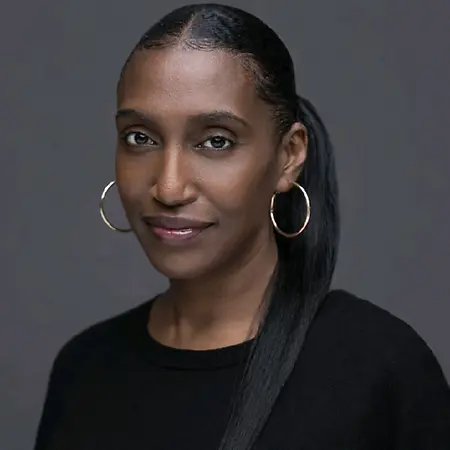
Her Story
About Twyla
Twyla Jackson is the Founder and CEO of Helixis Technology, a civic infrastructure company developing the deployability standard for autonomous and cyber-physical systems.
She is known for identifying the global shift from tools to participants — recognizing that autonomous systems are evolving beyond isolated technologies into active participants within shared human environments. Her work focuses on helping cities, institutions, and infrastructure prepare for this transition through governance, accountability, and deployability frameworks designed for the real world.
Twyla’s mission centers on protecting dignified work, defending the right to remain necessary, and ensuring people remain designed into the future of automation rather than displaced by it. She describes her work as building “the peace treaty between the speed of innovation and the governing capacity of the world it enters.”
Her Interview
Ten minutes with Twyla
01What do you attribute your success to?
My work has always been grounded in people first. I believe technology should expand human relevance, not erase it. That mindset led me to develop frameworks centered on deployability, dignified work, and the right to remain necessary in an increasingly autonomous world.
I also attribute my success to persistence, systems thinking, and the willingness to enter industries where I did not come from traditionally. I learned by studying problems deeply, connecting patterns across infrastructure, technology, governance, and human behavior, and refusing to accept that communities should simply adapt to whatever technology arrives next.
Most importantly, I never viewed innovation as separate from responsibility. The future is not just about building smarter machines — it is about building systems where humanity still has a meaningful place within the world those machines create.
02What’s the best career advice you’ve ever received?
The best career advice I ever received was simple: “Just do it.”
Not when everything is perfect. Not when you have every credential, every connection, or every answer figured out. Just start.
A lot of breakthrough ideas never happen because people wait for permission. Some of the most important work I’ve done came from stepping into spaces I wasn’t traditionally trained for, learning relentlessly, and being willing to build what I believed the world would eventually need.
That advice taught me that vision matters, but execution changes reality.
03What advice would you give to young women entering your industry?
Do not wait for permission to enter rooms you know you are capable of contributing to.
Technology, infrastructure, and emerging industries need more women who are willing to think independently, ask difficult questions, and build solutions that protect people — not just profits. Some of the most important opportunities exist in the problems others overlook.
Learn how systems work. Study business, governance, technology, people, and infrastructure together. The future will belong to those who can connect disciplines, not just specialize in one area.
Also, never allow anyone to convince you that being human-centered makes you less innovative. Some of the most valuable breakthroughs will come from people who understand that the future of technology is not only about capability — it is about responsibility, trust, dignity, and the environments these systems enter.
Most importantly, do not shrink your vision to fit other people’s expectations. Sometimes the industry cannot see what you see yet. Build anyway.
04What are the biggest challenges or opportunities in your field right now?
One of the biggest challenges in autonomous systems and AI right now is that society is deploying technology faster than it is preparing environments to govern it. Most discussions focus on what autonomous systems can do, but not enough attention is being given to whether cities, institutions, infrastructure, and communities are actually prepared for those systems to safely participate within shared human environments.
That creates major challenges around accountability, interoperability, public trust, workforce displacement, liability, and human agency.
At the same time, it creates one of the largest infrastructure opportunities of this generation. The world will need new governance frameworks, deployability standards, infrastructure intelligence systems, and workforce pathways capable of supporting autonomous participation at scale.
I believe the future belongs to organizations that understand autonomy is not just a technology problem — it is an infrastructure, governance, and human systems challenge. The companies and institutions that solve that responsibly will help define how society operates in an increasingly autonomous world.
05What values are most important to you in your work and personal life?
The values most important to me are integrity, responsibility, human dignity, and purpose.
In my work, I believe innovation should improve society without removing humanity from it. I care deeply about protecting dignified work, preserving the right to remain necessary, and ensuring technology develops in ways that strengthen communities instead of displacing them.
I also value courage and independent thinking. Some of the most meaningful work comes from being willing to question assumptions, challenge existing systems, and pursue ideas others may not fully understand yet.
In both my personal life and professional life, I try to lead with service, empathy, and long-term thinking. I believe how we build matters just as much as what we build, especially when creating systems that will shape the future of human environments and everyday life.
Join Influential Women and start making an impact. Register now.