Her Story
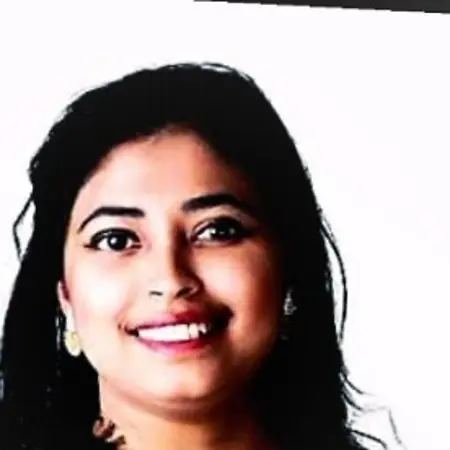
About Urmi
I am a bioprocessing scientist with over a decade of industry experience in microbial upstream and downstream process development across yeast and bacterial platforms, spanning high-throughput micro-fermentation to full manufacturing scale up to 200 m³. I am a named inventor on a granted international patent and am deeply motivated by applying bioprocess engineering to build scalable solutions for a more sustainable planet. Alongside my scientific career, I am a trained Kathak dancer and teacher, Co-Founder of TaalSutra, and a Cultural Board Director of Bay Area Prabasi, where I work to engage the next generation in Indian classical arts and extend arts-based philanthropy to senior communities, including Carlton Senior Living, using movement to support wellness, connection, and dignity across generations.
Her Interview
Ten minutes with Urmi
01What do you attribute your success to?
I attribute my success to a combination of rigor, resilience, and purpose. Scientifically, I am deeply disciplined and data-driven, which has allowed me to build scalable bioprocesses across microbial platforms and translate ideas from the lab to manufacturing reality. Equally important has been my resilience—the willingness to persist through uncertainty, learn from failure, and adapt quickly in fast-paced environments. Finally, purpose anchors everything I do: whether advancing sustainable biotechnology or using classical dance to serve community and well-being, I am motivated by creating work that is meaningful, impactful, and larger than myself.
02What’s the best career advice you’ve ever received?
The best career advice I’ve received is to focus on building depth before chasing titles. Early on, I was encouraged to invest in mastering my craft—understanding the fundamentals deeply, asking hard questions, and owning problems end to end. That depth created credibility, confidence, and long-term opportunity, and it continues to guide how I approach growth, leadership, and impact today.
03What advice would you give to young women entering your industry?
In bioprocessing, my biggest advice is to build depth through hands-on experience. Spend time at the bench and on the floor—run fermentations, follow the process through downstream, learn sampling, instrumentation, cleaning, deviations, and tech transfer. That tactile understanding becomes your superpower when things go wrong.
Second, become exceptional at data discipline and troubleshooting. Don’t just look at plots—do deep dives: mass balances, OUR/CER trends, yield coefficients, feed profiles, off-gas, and variability across runs. Use statistics and DOE to separate signal from noise and to make decisions with confidence. When a process drifts, pause, stay calm, and diagnose before reacting—check the basics, confirm assumptions, and test hypotheses systematically.
Finally, go above and beyond in ownership: document clearly, communicate early, and close the loop with root cause and prevention. In this industry, people quickly remember who can stay steady under pressure, solve hard problems rigorously, and raise the bar for the whole team.
04What are the biggest challenges or opportunities in your field right now?
One of the biggest challenges in bioprocessing today is translating lab-scale success into robust, manufacturable processes at scale. As timelines compress and sustainability expectations rise, teams are being asked to move faster with less margin for error. Variability across microbial systems, raw materials, and scale can quickly compound if processes are not deeply understood and data-driven.
At the same time, this challenge creates a major opportunity. Advances in high-throughput micro-fermentation, scale-down models, advanced analytics, and statistical design of experiments are enabling smarter, faster decision-making earlier in development. There is also growing opportunity to apply rigorous bioprocess engineering to sustainable biomanufacturing, where efficient scale-up, yield optimization, and process robustness directly impact climate and resource outcomes. The field is moving toward deeper integration of biology, engineering, and data—and those who can operate confidently at that intersection will shape the next generation of industrial biotechnology.
05What values are most important to you in your work and personal life?
The values most important to me are integrity, depth, resilience, and service. In my work, integrity means being honest with data, risks, and outcomes, even when timelines are tight. Depth matters deeply to me—I believe real impact comes from understanding problems thoroughly rather than rushing to superficial solutions. Resilience guides how I navigate uncertainty and pressure, while staying calm, thoughtful, and solutions-oriented. In my personal life, service and community are central; whether through mentorship, cultural leadership, or arts-based outreach, I value contributing in ways that create lasting, meaningful impact beyond myself.
Join Influential Women and start making an impact. Register now.