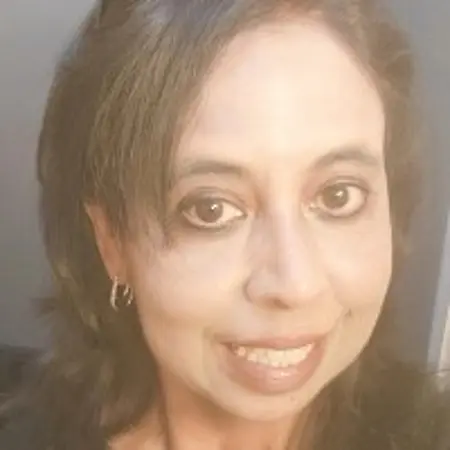
Influential Woman · Healthcare and Academic Research
Usha S Govindarajulu
Associate Professor of Biostatistics, Icahn School of Medicine at Mount Sinai
New York, NY 10029
Her Story
About Usha
Usha G. is an accomplished Associate Professor of Biostatistics at Icahn School of Medicine at Mount Sinai, where she brings more than two decades of experience in academic research, teaching, and statistical consulting. Her work sits at the intersection of healthcare and data science, specializing in areas such as cardiology, allergy and immunology, and radiology. With deep expertise in survival analysis, machine learning, and advanced statistical modeling, Usha collaborates closely with medical investigators to design studies, analyze complex data, and ultimately improve patient outcomes.
Throughout her career, Usha has held roles at leading institutions including SUNY Downstate Medical Center, Brigham and Women's Hospital, and Yale University School of Medicine. In addition to teaching graduate-level biostatistics and epidemiology courses, she has authored more than 75 publications and frequently presents her research at national conferences. Her contributions to the field have earned her consistent recognition, including being featured in Who’s Who of America and honored as a top educator.
Beyond her academic and scientific achievements, Usha brings a uniquely creative dimension to her career. She is an accomplished writer and producer who has created multiple comedy shorts and theatrical productions, often using her platform to support charitable causes. This blend of analytical rigor and creative expression defines her approach—demonstrating that innovation thrives at the intersection of science, education, and storytelling.
Her Interview
Ten minutes with Usha
01What do you attribute your success to?
I think it's important to really stay on top of things, like what's going on and the latest. Also, keeping things aligned, keeping things organized, keeping things going is really important. You need to organize your time to do things while still trying to stay on top of the trends. That's what I would try to recommend to people. I'm learning that too. Originally, I was just trying to avoid AI, and people were like, you know, Usha, you should learn that, and I was like, no, I don't want to. I want to do things how I do them. But now I'm seeing that I'm going to have to keep up, or I'm going to be eliminated.
02What’s the best career advice you’ve ever received?
My father used to tell me that I should always go to seminars and talks, even when I didn't want to because I thought I'd lose time doing my work. He said I should always see what others are doing and try to understand what's out there. That was an important lesson that I learned from him, to always attend those talks and seminars. Whether or not they were a waste of time, that's different, but the principle of staying connected to what's happening in the field was valuable advice.
03What advice would you give to young women entering your industry?
Obviously the field is changing, and now they're going to have to know for sure about all these machine learning algorithms and everything. I try to tell them it's fine, you have to learn all that, but try to still learn about the statistics and the math, because you can never go wrong with knowing math in this field. It's always going to be helpful. So it's not all just about computers and coding. It's also important to really still understand the fundamentals. That part, AI still can't replace right now, so I try to encourage them on that side.
04What are the biggest challenges or opportunities in your field right now?
I think the biggest challenge is AI just coming down the pike. We, as a field, are trying to understand how to deal with it and how to incorporate it. Statistics actually is within machine learning, but machine learning is like statistics on drugs. It's basically taking what we already do and ramped it up like 1,000, 10,000, 100,000 fold. We're trying to understand, like, how do we exist now with AI, the way AI has taken off? So that's a big challenge in my field and on the pike. And I think, actually, honestly, it's a challenge for everything. It's a challenge for comedy, it's a challenge for every single thing that's going on. Right now, I could say it might be helping, but then on the other hand, I think it's also potentially just going to kill our area. I'm not sure. I'm getting worrisome about its potential replacement of humans for things that we were doing.
05What values are most important to you in your work and personal life?
Loyalty is super important to me. I think you should stay loyal to what you agree to. You shouldn't keep changing your mind. Honesty is always important. I try to be straightforward. I think it's important rather than trying to keep things hidden and not tell people. But you have to do things sometimes in a very proper way, so that's also important in your career. How you communicate, communication is number one. How you communicate with others is extremely important, and it makes or breaks your career. If I had time with someone about their career, I would definitely highly recommend working on the communication aspect.
Join Influential Women and start making an impact. Register now.