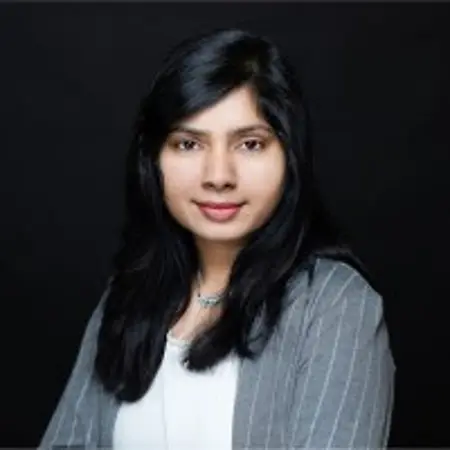
Her Story
About Uzma
Uzma Arjuman is a Founder and engineering leader with approximately 15 years of experience in the technology industry, specializing in AI-powered products, distributed systems, and large-scale cloud services. She began her career at IBM after completing her Bachelor of Engineering, where she spent the early years of her professional journey building foundational technical expertise. She later moved to the United States to pursue a Master of Science in Computer Science at The Ohio State University, completing her graduate studies in 2013 and continuing to build her career across leading global technology organizations. Following her graduate studies, Uzma advanced through engineering roles at major technology companies, most recently serving as a Principal Software Engineering Manager at Microsoft until January of this year. During her tenure, she led multiple cross-organizational initiatives spanning AI and cloud-based products, working closely with diverse engineering, product, and design teams. She is known for strong ownership, a bias for action, and the ability to drive clarity and execution in complex, fast-moving environments. She has also been awarded two patents in the identity space, reflecting key contributions to secure systems and identity management innovation. Currently, Uzma is building an AI-native consumer application, developing both web and mobile experiences across iOS and Android platforms. Her work reflects a deep commitment to combining technical excellence with real-world impact, particularly at the intersection of AI and user-centric design. Coming from an army background and having moved frequently during her upbringing, she developed strong resilience and adaptability early in life. She later made the bold decision to move to the United States independently, without an existing support network, further strengthening her ability to navigate uncertainty and thrive in new environments.
Her Interview
Ten minutes with Uzma
01What do you attribute your success to?
When I look back, I attribute my journey to three main things: resilience, hard work, and great support.
Because I come from an army background, I grew up constantly adapting to new cities and situations. That lifestyle naturally builds resilience and forces you to figure things out on your own. It definitely gave me the courage to move to the U.S. without a built-in support system at the time. In my career, I’ve always been someone who takes full ownership of projects and focuses on getting things done. I’ve worked incredibly hard, but I also know I didn't do it alone. I had a fair bit of luck and some wonderful mentors and sponsors who supported me through major career milestones. It’s really been a combination of that early foundation and the community I built along the way.
02What’s the best career advice you’ve ever received?
The best career advice I ever received didn’t come as a single quote, but rather as a core lesson from a few key mentors: while technical expertise gets you into the room, your ability to understand and work with people is what truly drives long-term impact.
Early in my career, a mentor taught me how to handle difficult conversations by breaking them down and looking at them from multiple angles. It wasn’t just about proving a technical point, it was about truly listening to understand what the other party cared about most. Later, when I transitioned into engineering management, another mentor showed me how to apply that same approach to leading teams. They taught me to learn people’s individual motivations and professional dreams, and then align those personal goals with the business goals of the company. Learning to listen deeply and look at problems through the eyes of others is the best advice I’ve ever put into practice. It completely changed how I plan projects, resolve conflicts, and build engineering teams.
03What advice would you give to young women entering your industry?
It might sound cliché, but it’s a fundamental truth, young women entering tech right now cannot afford to be discouraged by the rapid shifts in the AI landscape. Yes, the market is undeniably tough for recent graduates. When a single job posting pulls in 500 to 1000 applicants, brilliant talent inevitably gets lost in the noise.
But technical evolution has always demanded human resilience. My advice is to aggressively build and double down on your AI skills, but anchor them with core human strengths like perseverance and adaptability. We are navigating a massive transition, but real talent paired with relentless drive will always break through. Don’t be disheartened, keep building, keep learning, and stay the course.
04What are the biggest challenges or opportunities in your field right now?
Right now, our field is facing both a tough challenge and an incredible new opportunity. For people already in the industry, the biggest challenge is adapting to new expectations. AI is a massive amplifier, it helps you get things done incredibly fast. But the hard part is making sure the quality of that work stays high. Anyone can use AI to move quickly, but ensuring that the final product is secure, scalable, and built well is where deep engineering experience becomes critical.
However, that challenge leads right into the biggest opportunity we’ve ever seen. AI makes it possible for a single person to build a real company. Tasks that used to require a whole team can now be done by a solo founder. Look at the recent news about a telehealth app for GLP-1 medications built essentially by a founder and his brother using AI tools, which is now on track for a billion-dollar run rate. That was unthinkable just five years ago.
I saw this shift firsthand a few months ago in a course I took at Stanford. Out of 120 people learning to build applications, only about six of us had a tech background. The technical barrier to entry has completely dropped. The opportunity today is that anyone can build an app, the real challenge is having the skill to do it exceptionally well.
05What values are most important to you in your work and personal life?
For me, it comes down to integrity, honesty, and good relationships with the people you work with. I genuinely believe that technical skills can be learned, but your human strengths are what take you far. Part of that is being honest about your skills, knowing what you’re great at, but also being comfortable saying, 'I don’t know, but I’ll figure it out.'.
Cutting corners or faking expertise might give someone short-term success, but it hurts you and your team long-term. Doing good work means building real connections and always staying true to your word.
Join Influential Women and start making an impact. Register now.