Her Story
About Vicky
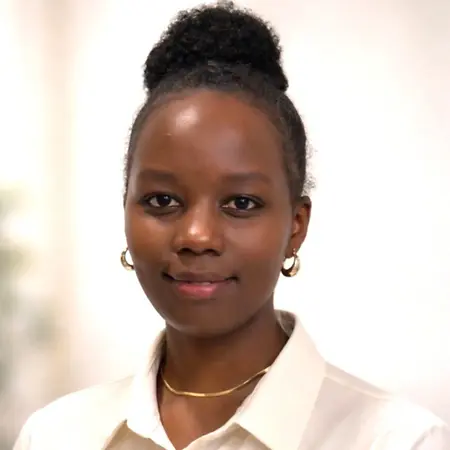
Vicky Chelangat is an engineering graduate research assistant at Villanova University. She earned her undergraduate degree in Chemical Engineering from Villanova University and went on to specialize in energy storage technologies, concentrating in battery materials, electrochemistry, and system-level design through her graduate work. She is experienced in characterization, modeling, and simulation tools that evaluate battery performance, optimize processes for efficiency, and enhance safety. Vicky has applied her expertise to international engineering projects across four continents, contributing to initiatives in decentralized energy integration that bridge energy disparities. Through this work, she designed technical solutions to diverse socio-economic and infrastructural contexts that illuminated the role of sustainable design practices in engineering.
Vicky’s professional goals focus on electrode and electrolyte material selection, performance prediction, and end-of-life management for battery technologies supporting energy applications in electric vehicles, data centers, grid-scale storage, renewable energy systems, and backup power systems. She has collaborated with industry partners such as L3Harris Technologies and Arkema, on projects that optimize battery manufacturing, recycling pathways, and 3D printing processes. As a member of the American Institute of Chemical Engineers (AIChE) and the Electrochemical Society (ECS), she continues to contribute to the advancement of electrochemical energy storage innovations, always seeking to design solutions that enhance energy independence and benefit both local and global communities.
Her Interview
Ten minutes with Vicky
01What do you attribute your success to?
I credit my success to my genuine passion for the field. I truly enjoy all the projects I have been involved with, especially as I gain deeper experience in energy storage systems. I have discovered that while curiosity drives my learning, whether I’m exploring new electrode materials, electrolyte formulations, etc., it is this enthusiasm that engages me to continuously improve both my skills and the solutions I pursue, particularly when working through technical discrepancies and setbacks. I am really appreciative that I have had project partners, mentors, and colleagues to help me traverse those challenging questions that have sharpened my technical depth. It is these strong professional relationships that have sustained my passion and encouraged me to be consistent in building real expertise and pursuing growth opportunities.
02What’s the best career advice you’ve ever received?
It dates back to my first project management role in a small-sized engineering project. It was the first time I had full oversight over the scope, schedule, and budget of an engineering project. Naturally, I started shifting toward high-level framing of presentations and planning. When I sought a mentor for guidance on how to lead in a technical capacity, they told me that an excellent summary slide is great, but what is even more valuable is a thorough spreadsheet that never makes it into the presentation. That stuck with me because it later became very apparent to me that even if you delegate the detailed, brass tacks deliverables, you should understand the underlying mechanics well enough to challenge them because it is that technical grounding that strengthens leadership decisions.
03What advice would you give to young women entering your industry?
Don’t overprepare before you act. When you look at company websites or LinkedIn profiles, everyone looks polished. However, most competence is built through exposure. An analogy that comes to mind, which someone once shared with me, is about learning how to swim. You may read all about water mechanics, buoyancy, water chemistry, etc., but you can’t really learn to swim without actually jumping into the pool. Your hands might shake a little and cause you to be skeptical about your own skills when stepping into higher roles, but do not self-select yourself out of rooms because you think you are not qualified enough. If you have the technical foundation and the willingness to learn, you can grow into bigger responsibilities. Exposure builds competence. Competence builds confidence.
04What are the biggest challenges or opportunities in your field right now?
Numerous research articles I have been reading lately have underscored the massive challenge in the energy storage space as scaling batteries to match the exponentially increasing energy demand from infrastructure like data centers. Currently, lithium-ion chemistries dominate the market, but they come with supply chain bottlenecks, material concentration risks, degradation concerns, and recycling gaps across their life cycles. Therein lies a real opportunity to improve cell design, manufacturing efficiency, and incorporate recycling pathways upstream. The next phase of progress, therefore, leans towards durability, scalability, and circularity, and I'm excited to explore opportunities to contribute to it.
05What values are most important to you in your work and personal life?
The values that matter most to me are rigor and integrity. I like to have both depth and breadth of understanding before making decisions. It is easy to optimize one part of a system without seeing how it affects the whole, so I try to zoom in on material behavior while keeping the system-level consequences in mind. In order to produce models, designs, decisions, and strategies that are in line with both ethical standards and the project's long-term objectives, I try to make all of my data assumptions defensible. This is due to the long-lasting and frequently cascading implications of engineering choices.
Join Influential Women and start making an impact. Register now.