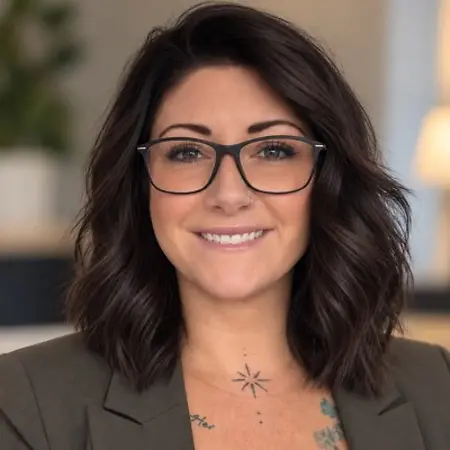
Her Story
About Victoria
Victoria Hesketh serves as Operations and Communication Manager for a behavioral health practice in Milford, Ohio. In this position for the past two years, she manages operations, communications, and business development efforts while ensuring clients have access to appropriate resources through partnerships with hospitals, court systems, probation officers, and other providers. Her six years in behavioral health followed a background in restaurant management, with previous roles including in-home work with children with special needs and intellectual disabilities, qualified mental health specialist at Child's Focus high school program, and behavioral health facilitator on the all-girls residential psychiatric unit at Cincinnati Children's for two years. She earned her undergraduate degree in behavioral health in 2020 after initially studying special education and switching majors, and she is currently pursuing an MBA at Xavier University. Hesketh was a member of the National Honors Society during her time at GCU with a 4.0 GPA. She brings empathy to her client-facing work informed by personal experiences with abuse and recovery, and she has spoken to groups about emotional, verbal, and physical abuse during her divorce period while emphasizing professional boundaries and cultural understanding in behavioral health settings.
Her Interview
Ten minutes with Victoria
01What do you attribute your success to?
I attribute my success to the support of close friends who were really strong for me, especially after cutting ties with my mom and having no relationship with my dad. It was about adjusting, knowing I had to keep moving forward, turning negative childhood experiences into breaking cycles, becoming self-aware, taking accountability for my contributions to negative situations, and learning to accept things and move on while putting effort into positive relationships. I had to navigate being a single mom, financial pressures, and redefining myself after a 12-year marriage.
02What advice would you give to young women entering your industry?
If someone comes into this industry and stops coming to counseling sessions or leaves a sober living house or gets upset and takes anger out, it's not your fault so don't take it personal. Put yourself in their position, understand that their home might be filthy because that's their norm, that yelling is the only way they were taught to communicate. Be open to diversity, explore their upbringings and environments, bring yourself down to their level, put yourself in their shoes to connect. That's the most important thing for behavioral health and substance abuse work.
03What are the biggest challenges or opportunities in your field right now?
One of my biggest challenges career-wise is that on my resume it looks like I job-hopped a lot because my ex-husband was Air Force and we moved around, and after divorce I was chasing a career path while being a single mom supporting my family. The jumps were intentional but forced to support myself. At 39 I'm still figuring out what I want to be when I grow up and where I want to be professionally long-term.
04What values are most important to you in your work and personal life?
In work, my work ethic is extremely important - always making sure even if personal life is going on, I'm at least at 80%, not lazy, whether it's a simple task like cleaning the bathroom or large projects with executives. Good work ethic gives you more chances because people know you'll work through it and learn. In personal life, acceptance is huge - accepting things whether in or out of control, not holding on, learning or letting go.
Join Influential Women and start making an impact. Register now.