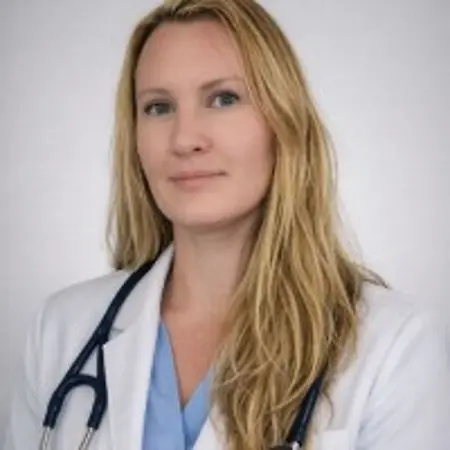
Her Story
About Victoriya
I've been working as a nurse for close to 10 years now, with experience in different fields within nursing. I started as a NICU nurse, then moved into pediatric nursing, and most recently for the past 2 years, I've been working with a family and children's organization that serves kids with autism. This role is incredibly personal to me because my own kids have autism, so I'm able to transfer my personal experience into my work environment. My job involves creating medical safety plans for these children, because many autistic kids have comorbidities like allergies, asthma, and genetic factors. I work to identify what these conditions are and create accurate medical profiles for when they enter school settings or ABA centers, and I train staff to support them in learning environments. Part of my role is helping families navigate resources and services in the community, recommending different therapies and medications. Speaking from personal experience, I know how overwhelming it can be when families are first presented with an autism diagnosis and don't know where to turn. Being able to provide that listening shoulder and reassurance to parents is incredibly rewarding for me, knowing that I can help other families not feel alone in this process. I completed my Bachelor of Science in Nursing in 2016 from the University of New Brunswick through Humber College in Ontario, and I'm excited to be starting my Master's program this fall to become a family nurse practitioner.
Her Interview
Ten minutes with Victoriya
01What do you attribute your success to?
It's a hard question because obviously my educational success is on me, but I find a lot of my success comes from my kids. They've made me more confident and helped me learn to set boundaries, which was difficult for me originally because I was very shy and had trouble saying no to things. Through them, I've gained confidence in myself and realized that I do have something good going on here with my autism exposure and my role as a nurse. I think my biggest success comes from my internal resilience, my motivation, and my perfectionism in a way - always wanting to learn more and do more. For me, there's no end to learning everything about autism and related conditions, and that drive is where my success comes from.
02What’s the best career advice you’ve ever received?
I still remember it - it was in my first year of nursing school when my preceptor told me to challenge myself. I never really thought about it critically like that before, because challenging yourself means different things to different people. She told me that if I'm shy about presenting to other people, for example, I should immerse myself in that experience, expose myself to different things, and I will succeed. That's what I took with me all throughout nursing school and now my nursing career. It still stays with me - every day I try to challenge myself just by a little bit. Over these 10 years, I feel like I've improved a lot, learned a lot, and accomplished a lot of things. There's no end to that, so every day, if you can challenge yourself, you can go somewhere far.
03What advice would you give to young women entering your industry?
I would say to be courageous and not to look back. If you're already thinking of doing something and you feel that it's going to create an impact, just go with it. A lot of times we're self-doubting ourselves and thinking we're not good enough, or there are other people who are more established and more influential. But you just have to realize that all those people came from somewhere, and it wasn't from a place of doubt. Maybe they were doubting themselves at some point, but they just took the risk and went for it. I think it's important, especially for us as women, to empower each other. This is why I love what Influential Women magazine is doing - it's the first step to empower each other, to say yes, you are good enough, yes, you are doing important work, and yes, we see you. I think everybody just wants to be seen at the end.
04What are the biggest challenges or opportunities in your field right now?
I feel like there's not enough providers who really know what autism is and how to help different profiles. Everything seems very generic to me in my field. For example, if you go to ABA centers, there's only one type of behavioral approach that the organization is following, and it's really hard to start convincing other people that actually there are multiple approaches and we can try different ways. These establishments have been following certain protocols and rules for decades, so making that change is not going to happen overnight. From my research, I've found that there are more opportunities and more forward-thinking in the States, where research and innovation is welcome, as opposed to just sticking with the old principles and following the same routine. That goes for not only ABA centers, but speech and language, physiotherapy, and occupational therapy - everybody's kind of stuck in the same way of approaching a problem without realizing that there are other avenues that we could take.
05What values are most important to you in your work and personal life?
For me, number one thing is always family. No matter what is going on, I always try to set some time aside to spend with the kids, because if you have a happy household, that means that happiness and contentment translates to your work. You can talk calmly with others, share experiences - so always ground yourself in the family life first. Make sure that the household is taken care of, and then your overall mental state will also be more positive, and you can approach other people in a more positive way and help them. Because if you can't help yourself, then you cannot help anybody else, right? That's why mental health is huge for me.
Join Influential Women and start making an impact. Register now.