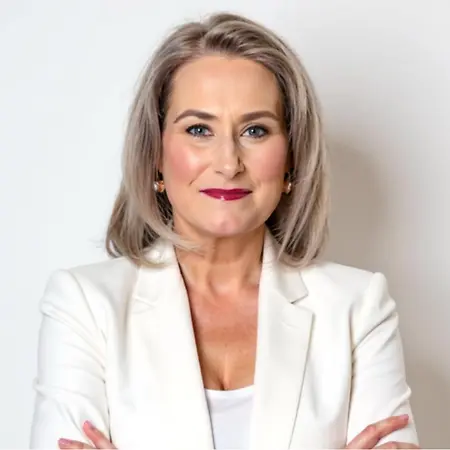
Her Story
About Violet
Violet Crabb is an executive-level nonprofit leader and the Executive Director of the American Academy for Oral & Systemic Health (AAOSH), based in the Dallas–Fort Worth Metroplex. In her current role, she oversees national strategy, operations, and growth initiatives for the organization, with a strong focus on advancing oral-systemic health education and medical-dental integration. She leads large-scale continuing education programs, national conferences, and interdisciplinary collaboration efforts designed to improve patient outcomes across healthcare disciplines. Her work also includes executive management, marketing operations, strategic partnerships, and organizational development within the nonprofit healthcare sector.
Prior to her executive leadership at AAOSH, Violet built an extensive career in healthcare marketing, nonprofit management, and brand strategy across multiple organizations. She has held senior roles including Senior Marketing Manager, Director of Marketing, and Digital Brand Manager, where she led cross-functional teams, managed multi-million-dollar budgets, and developed large-scale marketing and event initiatives. She is recognized for her expertise in event operations, marketing systems, membership growth strategies, and digital engagement. Her academic foundation includes a Bachelor of Arts in History from Lincoln Memorial University, where she was actively involved in leadership and academic honors societies.
Violet’s professional journey is deeply shaped by her personal resilience and lived experiences. Raised in rural Appalachia in a low-income household, she entered the workforce early and developed a strong foundation of self-reliance and determination. She is also a survivor of long-term domestic violence and has openly used her experience to advocate for awareness, empowerment, and interdisciplinary support systems in healthcare and related industries. After undergoing significant personal health transformation, she now incorporates a strong emphasis on holistic well-being into her leadership philosophy. Across her career, she is known for combining strategic executive leadership with empathetic, people-centered advocacy in healthcare innovation and nonprofit growth.
Her Interview
Ten minutes with Violet
01What do you attribute your success to?
I attribute my success to never giving up and absolutely refusing to believe that the end is the end. Growing up poor in rural Appalachia, just like Dolly Parton, I learned that when things seemed like I couldn't overcome them, I had to refuse to believe that and find a way around it. Dolly always said that if you look at things as the end without seeing the beginning, you're literally cheating yourself out of what could be a beautiful opportunity to see the light rather than darkness. I refuse to see darkness. I see that behind me is closure, and maybe that door has closed, but I see a ton of opportunities in front of me, and I'm going to go open every single door until I find what that next opportunity is. I could have chosen darkness many times through years of domestic violence, through seeing my ex-husband spend us out of house and home because of his gambling addiction, when I weighed 408 pounds. But I refused to give up. You have to see one opportunity ending and another opportunity with tons of doors and windows in front of you. It's just the choice of getting up every day and saying, you know what, I woke up today, I am refusing to give up. When the journey gets long, I'm just going to get up and understand that there's light and joy.
02What’s the best career advice you’ve ever received?
The best career advice I've ever received is don't ever give up on your dreams, and that was from my mother. She always told me that, you know, dream as big as you want, and don't ever give up on those dreams. I have always carried that with me my entire life. You can never...you can always dream bigger, but small dreams will get you nowhere in life. You dream as big as you want to dream, and don't ever give up on it. I think people look at dreams and say, well, a little kid says, I want to be President of the United States. Well, let that kid dream that, because while they may not end up being President of the United States, they may end up being president of a massive company, or president of the American Cancer Society and lead an organization to doing something that may find a cure for a cancer that we never thought we'd find a cure for. Let kids dream. Let them dream what they want. Even within an organization, if somebody says they're in the mailroom and they say, I'm going to be president of this organization one day, give them the pathway to do that. Don't ever, ever have, within an organization, no pathway for growth, no pathway for succession, because that person sitting in that mailroom that's coming in every day at 6 AM, that's dedicated, needs to have a pathway to get there. And don't ever, ever think that because you've reached a certain pinnacle, that you're not replaceable, and that you don't need to keep dreaming, because you do need to keep dreaming.
03What advice would you give to young women entering your industry?
I think some of the best advice comes from a song from Jimmy Buffett, one of the last songs he wrote called Bubbles Up. He compared it to when you're scuba diving or deep diving, the bubbles that come up always float to the top of water, and they always tell you that's the surface. If you're too far down and you don't know where you are and the water's dark around you, you follow the bubbles and they will show you where to go. If you are in a dark place, or you feel like you've got nowhere to go, that you've just started your journey and it looks so dark, and you've tried every job opportunity in this world and it doesn't seem like you're finding any light or there's no way to go, look for those bubbles that are going to show you that no matter how deep or how far you are under the surface of that water, just follow those bubbles. Follow what you know is your truth. Find your truth in life. You know your own truth, you know your own tenacity, you know your own purpose, and you know what you're good at. So start following your bubbles up. They're going to point you toward home, they're going to get you where you need to go, they're going to get you to that surface, they're going to give you a purpose. And before you know it, you're going to see that light again, and you're going to find out that there's more opportunity out there. Just give yourself time. Don't ever, ever give up. You know what you're capable of, so get up and do it. And get up every day with the same tenacity that says, I can do this. Have the mental toughness and the confidence in yourself to know who you are, what you are, and don't let anyone ever strip that away from you.
04What are the biggest challenges or opportunities in your field right now?
I think the biggest challenges right now is that a lot of folks want to concentrate on being good at one thing, and I would say be good at a thousand things. For me, as a leader of a small nonprofit, I do bookkeeping, finance, HR, hiring, managing of employees, managing of donors, managing of partnerships, and I plan our events. Get out there and learn as many things as you can. It's great to concentrate on one particular thing, but if you're good at a number of things, it makes you more marketable. The way that you do that is start reading, start learning. Artificial intelligence is becoming a huge part of the nonprofit industry. Don't be afraid of it. I've seen so many videos of college students, the minute that AI is mentioned in a commencement speech, they start to boo or hiss or complain. You have to embrace change. And the way that you embrace change is to learn and understand that your standard of life is based solely on what you are willing to get out and learn on your own. Education is fantastic, but hands-on learning is what you need, because all the education in the world will not replace you being able to say, I led a team of 10, I literally was the one who did all the hands-on work to create this event. Get out and get hands-on, because that's what you need to do. The biggest challenge today is having all this education and no experience. Get out there and get that hands-on experience. Find an employer who wants to literally put you not only to dive headfirst into a task, but you could dive headfirst, swim in that water, and come out soaking wet, and then dive back in again and do it 6 more times.
05What values are most important to you in your work and personal life?
I think that compassion is huge for me. Having been a survivor of domestic violence, I have a great amount of compassion for others, because a lot of times it wasn't shown to me. You have to have a great amount of compassion for people. I think being empathetic and understanding that people won't always be 100% every single day is critical. You have to be compassionate and say, hey, what's going on? And then, when you ask that question, actually listen, and then say, what can I do to help? If somebody needs some time to get their life put together, have people trained to step in to do what they need to do to take over for a few days, so that person can go out and do what they need to do, so they can come back and be 100%. If you can't be empathetic in your role as a leader, then you're not a leader, because you've not taken the steps to allow people to be able to step away and do what they need to do in their life, because your work shouldn't define you, it should be a part of what defines you. The other thing that I value most is being a transformational leader. You can do transactions all day long with people and just say, I need you to do A, B, and C, and then not come back around and say, how are you doing with A, B, and C? What is your plan? How can I help you achieve that plan? A transformational leader is building people up so that one day they can step into your shoes, so that you can move on to whatever your next transformation is. Those are the three things that I value most: being compassionate, empathetic, and transformational in what you do every day as a leader in your organization and just as a human being. My husband and I, that's the reason why our marriage works so well, is that we have compassion for each other, there's empathy, we're not going to be 100% every day, and we're transformational with each other.
Join Influential Women and start making an impact. Register now.