Discover how coordinated infrastructure and sustained support systems empower entrepreneurs, particularly women veterans, to build thriving businesses that survive and scale beyond the critical early years.

Influential Woman · Business Support Organization
VR Small
Founder/Chief Executive Officer, Veteran Women's Enterprise Center (VWEC)
Dallas Metroplex, TX 75223
9Years experience
1Article published
10Awards received
In Conversation
VR Small for Bold. Brilliant. Unstoppable.
Read the transcript
VR Small: Hello. I'm VR Small, founder and CEO of the Veteran Women's Enterprise Center, better known as VWEC. I'm truly honored to be among the women of influence. Because I don't take the word influence lightly. For me, Influence has never been about titles or recognition. It's about what happened. Because you show up. It's about opening doors, creating opportunities, strengthening our communities. And using what I've learned to help others move forward. My journey through entrepreneurship, service, and leadership has taught me that influence is something. Or rather, it's not something we possess. It's something that's entrusted to us to use well. I'm grateful to be included among women whose leadership and contributions are making a real impact. I also know I didn't get here alone. I carry with me the encouragement of mentors, partners, colleagues, entrepreneurs, and communities who have helped shape the work and the woman I am. Thank you, Women of influence for this opportunity. I'm truly humbled by the recognition and committed to making the influence I have count.
What's one piece of advice you would give to younger women chasing their dreams?
VR Small: Wow. What's one piece of advice I would give to younger women chasing their dreams? Hm. First, Don't ever try to fit into someone else's expectation of who you should be. Dream boldly. Learn endlessly. Ask questions. Take the opportunity before you feel completely ready. Be risky. And when the door does not open. Build another one. Know you will make mistakes. And you will have moments. When you question yourself and everything around you. But keep going. Your journey does not have to look like anybody else's. In order for you to be valuable. You were born with purpose. Your voice matters. Your ideas matter. Your story matters. So don't be afraid to shout it from the rooftop. And when you finally get where you're going. Remember. Reach back. And bring another woman with you. Because I don't believe we rise to be seen I believe we rise so others can see what's truly possible. Keep dreaming, ladies. Because they do come true.
Full transcript available
Her Story
About VR
Beyond VWEC: VR served as the Director for University Health & Medical Services (UHMS), and the visionary for its redesign to the Center for Healthy Living at Long Island University (LIU) Brooklyn. Beginning in 2009, her five-year tour at LIU sparked a renewed interest in education beyond her well-known zeal for teaching. Applying her expertise in organizational development, change management, community relations, customer service, and social marketing, she produced the momentous transformation of UHMS, re-establishing campus confidence in compliance, broadening internal/external collaborative opportunities and highlighting the Center’s campus/community relevance.
No stranger to leadership, VR is the former President/CEO for Small Industries’ Organizational Success Strategies (SIOSS), recognized as a top-notch regional consulting resource with clients such as Brooklyn Borough Hall, Community Services Society, Brooklyn’s American Heart Association, and the US Chamber’s Institute for Organizational Management. Sought out for her unique networking and career development strategies, VR was a keynote speaker for Pace University’s Alumni, Long Island University’s School of Business, New York Society of Association Executives, New York Public Libraries, and other community, women, and business organizations.
Clients and colleagues identify Ms. Small as a “master project manager.” One year after launching her business, she found and was the Executive Director for the Brooklyn Executive Business Women’s Association (BEBWA), the local network for the National Association for Female Executives (NAFE). Under VR’s leadership, the Association’s membership grew from its original twenty-five members to more than 150 members in less than two years, resulting in recognition in NAFE’s national magazine and later receipt of BEBWA’s prestigious Community Leadership Award.
As a leader with a vision for growth and development, VR joined the New York Society of Association Executives (NYSAE). She received the coveted American Society of Association Executives (ASAE) “Diversity Executive Leadership Program” (DELP) Scholarship, which selects only ten scholars nationally within the association industry. VR was also honored with NYSAE’s New Star Award and appointed Chair of the Professional Development Committee.
VR spent several years in senior nonprofit management supporting children and families through foster care, kinship, mental health, prenatal networks, and homeless services—committing the majority of her career to serving and effectively connecting others. During this period, she remained committed to others and made community services and advocacy a daily ritual in her life.
Less than one year after starting her company, VR was elected to the Brooklyn Chamber of Commerce’s Board of Directors, where she served on their Finance and Government Affairs Committees. She maintains a keen insight and commitment to compliance and equity in government contracting with minority and small businesses, the basis for her invitation from the U.S. Chamber of Commerce, Small Business Council, where she served on their Government Contracting Subcommittee.
One year later, she was elected to the Boy Scouts of America, Brooklyn Council Board of Directors, and was honored as one of their Women of Achievement. As an active board member, she worked with the District Council’s Training Committee. VR’s organization development skills were tapped through an invitation to join the US Chamber’s Accreditation Board during their program’s reorganization. She was also selected as an instructor with the U.S. Chamber of Commerce, Institute for Organizational Management, Northeast-Summer Session.
VR completed Boardroom Bound’s Pipeline Seminar for corporate board placement and was a Team Leader for their NYC Friends Program. She is also a proud alumna of Lincoln University’s Master of Human Services.
Her Interview
Ten minutes with VR
01What do you attribute your success to?
I attribute my success to staying grounded in my values, remaining teachable, and having the courage to evolve.
Every season of my life and career has taught me something different. I've learned that what gets you where you are today won't necessarily get you where you're meant to go tomorrow. Success requires a willingness to keep learning, adapt to change, and sometimes challenge the way you've always done things.
I've also learned that ideas, by themselves, don't create impact. Execution does. That's why I've always believed that information is only valuable when it's applied. Whether I'm mentoring an entrepreneur or leading an organization, my focus has always been on building systems, relationships, and opportunities that help people achieve meaningful, measurable results.
I've never been afraid to ask for an opportunity or to hear "no." Some of the most meaningful opportunities in my life began with a simple question. Rejection has never defined my future. It has refined my perspective and strengthened my resolve.
Most importantly, my faith and my values have kept me grounded. They remind me that leadership isn't about recognition. It's about stewardship. It's about using the opportunities I've been given to create opportunities for others.
If there's one thing I hope people take away from my journey, it's that success isn't measured by what we accomplish for ourselves. It's measured by the lives we help change and the opportunities we create for others.
"I've learned that success isn't something you achieve. It's something you steward."~VR Small
02What’s the best career advice you’ve ever received?
The best career advice I ever received was simple: Ask for what you want.
Years ago, a mentor told me, "If you don't ask for what you want, you're never going to get it." That advice changed the trajectory of my career.
People often ask me how I secured opportunities for VWEC, from space for our center to speakers, sponsors, strategic partners, and so much more. My answer is always the same:
I asked.
I remember wanting to launch a major initiative here in Dallas. Everyone around me said it would never happen. They told me it was too big, too ambitious, and unrealistic. Then, just a few months later, I watched someone else do exactly what I had envisioned.
Do you know the difference?
They asked.
In that moment, I made a promise to myself: Never again will I allow someone else's doubt to keep me from pursuing what I believe is possible.
The worst thing that can happen is someone says no. If they do, you've gained clarity, and you can redirect your energy toward the next opportunity.
But they might say yes.
That realization was a reawakening for me.
Never stop asking for what you want. Don't allow fear or the opinions of others to deter you from reaching for the stars. Be bold enough to hear the "no" for yourself, because every "no" builds the confidence, resilience, and courage to ask again.
And eventually...
That "yes" will come.
So keep asking. Keep believing. Keep showing up.
Your next "yes" may be just one question away
03What advice would you give to young women entering your industry?
Get connected and stay connected.
One of the biggest misconceptions about entrepreneurship is that you have to build your business alone. You don't.
Business is not something you want to do by yourself, it's not something you have to do by yourself, and it's certainly not something you should do by yourself.
We are surrounded by resources, mentors, and organizations designed to help entrepreneurs succeed. Many are already funded by your tax dollars, and many others are completely free. Especially in the early stages of business, use every resource available. Being resourceful is one of the smartest financial strategies you can have.
One of the greatest lessons I've learned is this: You don't know what you don't know.
Before founding the Veteran Women's Enterprise Center, I served in executive leadership roles and had experience managing a nonprofit. I was confident I understood what it would take. Then I discovered that nonprofit finance, budgeting, and forecasting operated very differently than what I had learned throughout my career.
That experience humbled me and reminded me that expertise in one area doesn't automatically translate into another.
That's why I constantly encourage entrepreneurs to do their homework. Understand your industry. Conduct meaningful market research. Validate your assumptions before making major investments.
One of the leading reasons businesses fail isn't because entrepreneurs lack passion. It's because they build something the market doesn't actually need, or they price it in a way the market won't support.
Test your ideas. Listen to your customers. Refine your approach before scaling.
And throughout that journey, stay connected.
Find your village. Invest in those relationships. Learn from those who've gone before you, and don't be afraid to ask for help.
Success isn't built in isolation. It's built in community.
"Expertise may open the door, but humility is what keeps you growing."~VR Small
04What are the biggest challenges or opportunities in your field right now?
I believe our biggest challenge is also our greatest opportunity: transforming how we lead and do business in a rapidly changing world.
As leaders, we have to stay aligned with our industries while having the courage to innovate and, when necessary, disrupt the way we've always done things. AI is part of that future, but only if we use it intentionally to maximize both our time and our impact.
At VWEC, we used to track client performance manually. Today, we're building an AI-enabled platform that allows us to see, in real time, how entrepreneurs are progressing. We can identify where they're succeeding, where they're struggling, and which specific concepts need reinforcement. Instead of asking someone to repeat an entire course, we can focus on the exact area where they need support.
More importantly, AI helps us become better mentors. Sometimes entrepreneurs don't ask for help because they're embarrassed by what they don't know. Our performance data allows us to start those conversations with confidence, removing the burden from the client and ensuring they receive the support they need.
As a national organization, this transformation will allow us to serve significantly more women without sacrificing what makes VWEC different.
We will never become a "check-the-box" organization that measures success by how many people log into a platform. We measure success by outcomes.
Technology should never replace relationships. It should strengthen them.
That's why one-on-one mentoring will always remain at the heart of our work. AI helps us work smarter, but it's the human connection, accountability, and application that drive lasting results.
At VWEC, we don't just deliver information. We ensure it's applied. We do the work, because impact matters.
05What values are most important to you in your work and personal life?
This question is especially meaningful to me because it speaks to the values that have shaped both my life and my leadership.
I joined the Navy at 17, and I truly embraced its core values of Honor, Courage, and Commitment. Combined with my spiritual foundation, those principles became more than words. They became the standard by which I try to live and lead.
To me, Honor means doing what's right, treating people with respect, and giving credit where it's due.
Courage means standing firm in your convictions, even when it's difficult, when others disagree, or when doing the right thing comes at a personal cost.
And Commitment means staying the course. When challenges arise, it's easy to walk away. Real leadership requires resilience, grit, and the determination to keep moving forward, especially when the path isn't easy.
Those values took root early in my life, and over time I realized they aligned perfectly with my faith. They weren't competing philosophies. They reinforced one another.
One lesson I've carried with me is that integrity isn't tested when everything is going well. It's tested when someone has treated you unfairly and you still choose to do what's right.
We can't control how others behave, but we can always control how we respond.
For me, that's what Honor, Courage, and Commitment ultimately represent.
It's integrity in action.
"Your character is revealed not by how you treat people who support you, but by how you treat people who don't."~VR Small
Her Content Hub
Articles by VR
Entrepreneurs Don’t Lack Support. They Lack Infrastructure.
How Strong Systems and Strategic Partnerships Are Transforming Support for Women Veteran Entrepreneurs
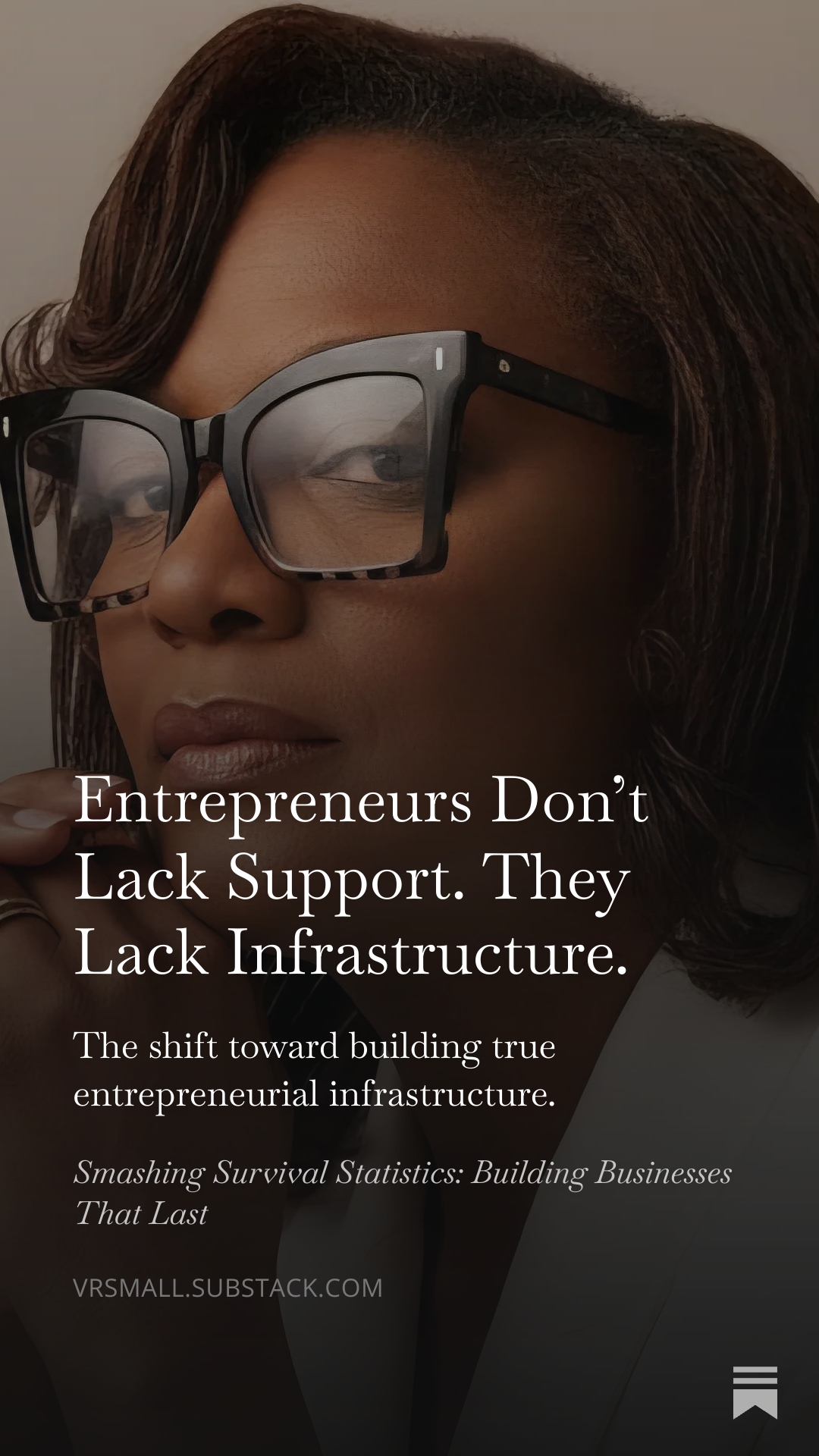
Building the Infrastructure Entrepreneurs Need to Succeed
For years, conversations about small business success have focused on the resilience of entrepreneurs. But far less attention has been paid to the strength of the systems meant to support them.
Every year, thousands of entrepreneurs launch businesses with determination, skill, and a willingness to take risks. Yet the statistics tell a sobering story: many of those businesses will not survive their early years.
Across the country, entrepreneurs have access to a wide range of support: training programs, mentorship, capital initiatives, technical assistance, and networking organizations.
Yet many founders still struggle to find the right resources, at the right time, and in the right sequence. The challenge isn't the absence of support.
It's that these resources often operate independently, leaving entrepreneurs to navigate a fragmented landscape that was never designed to function as a coordinated system.
The problem is not availability; it is alignment.
Many of these resources operate in parallel rather than in partnership, creating a system that is difficult to navigate and even harder for entrepreneurs to use effectively.
Access to Programs Does Not Automatically Translate Into Outcomes
But after years of working directly with women veteran entrepreneurs through the Veteran Women's Enterprise Center (VWEC), I can attest that entrepreneurs don't fail for lack of support.
They fail because the systems designed to support them are fragmented.
Training programs often exist without implementation resources. Mentorship is offered without clear pathways to capital. Support organizations work hard but frequently in isolation rather than as part of a coordinated ecosystem.
Entrepreneurs are often told to navigate these gaps through determination alone.
But Resilience Cannot Replace Infrastructure
If we genuinely want to strengthen small business outcomes, we must focus not only on preparing entrepreneurs but also on strengthening the ecosystem around them.
That insight continues to shape the evolution of VWEC and our commitment to "Empowering HER Success." For us, that phrase represents more than a theme. It reflects a commitment to supporting women veteran entrepreneurs throughout the entire life of their businesses, from the earliest stages of development to growth, sustainability, and long-term impact.
Because empowerment requires more than inspiration and information.
It Requires Systems That Work.
One of the earliest priorities for VWEC was ensuring that entrepreneurs participating in our programs had access not only to intentional technical assistance but also to implementation funding. To this end, every NLBT Fellow received a grant to implement their business growth strategy, bridging the gap between information and application.
Over time, we doubled that funding amount.
Because when you work closely with entrepreneurs, especially those building businesses while navigating barriers most people never see, you begin to understand something important: access alone is not enough. Opportunity alone is not enough.
What they need is infrastructure that truly works for them.
Building That Kind of Model Requires Belief and Investment
In the earliest years of VWEC, that belief included a personal investment. For the first four years, I funded the work myself—not just the mission, but the job. In the years that followed, compensation remained intentionally below industry standards so that more resources could be directed toward implementation funding for our entrepreneurs.
This story isn't about personal sacrifice.
It's about setting organizational priorities.
If we expect investors to believe in entrepreneurs, leaders in this work must also demonstrate belief in the outcomes we commit to achieving beyond words.
To be clear, I am not suggesting that personal investment should be the model for sustaining nonprofit impact.
Sustainable Outcomes Require Sustainable Funding
Nonprofits working to strengthen entrepreneurial ecosystems must be resourced to build strong systems, maintain operational discipline, and provide consistent programming—not reinvent themselves every year to align with short-term funding cycles.
When organizations can focus on outcomes instead of survival, the results can be transformative.
That is the next phase of our work.
At VWEC, our transformation is grounded in two commitments:
Smashing Survival Statistics
Too many businesses fail not because founders lack talent or vision, but because they lack sustained, aligned support.
Building Businesses That Last
Entrepreneurship should focus less on how many businesses start and more on how many successfully scale, retain employees, and strengthen their communities over time.
These commitments represent a shift toward building true entrepreneurial infrastructure: the systems, partnerships, and capital-readiness strategies that allow businesses to move beyond survival into sustainability.
Our entrepreneurs have already served their country. When they transition into business ownership, they bring the same dedication and resilience that defined their military service.
What they need in return is an ecosystem prepared to support their success, not just at the beginning of their journey, but throughout the life of their business.
That is the deeper meaning behind Empowering HER Success.
It is a commitment that our support does not end when a program concludes. It continues as entrepreneurs grow, expand, and build businesses that strengthen their communities.
Entrepreneurship Is Often Described as a Journey
But Journeys Are Easier When the Road Itself Is Well Built.
I understand how the nonprofit sector operates.
I understand the language, the expectations, and the systems that sustain it. But I also believe in something deeply:
When You Know Better, You Must Do Better.
Too often, the nonprofit sector becomes comfortable telling the story of transformation without holding itself accountable for internal transformation. The narrative becomes the focus rather than the results.
That's not the path we're choosing.
If we are committed to empowering entrepreneurs, supporting communities, and building lasting economic opportunity, then we must hold ourselves to the same standard of growth and excellence we ask of the people we serve.
Transformation cannot only be external.
It must be internal, too.
That is why we are taking VWEC to the next level—not by simply expanding programs, but by strengthening the systems, discipline, and accountability that make impact sustainable.
Because the entrepreneurs we serve deserve organizations that are just as committed to improvement as they are.
At VWEC, we believe no one is more deserving of access to the American Dream than those who volunteered to keep that dream alive and continue serving their communities through business ownership.
We're committed to ensuring they have access to an infrastructure that provides the resources they need to succeed.
Many organizations are doing great work in the small business arena, but until that work is reflected in our overall business survival statistics, we still have work to do.
Join Influential Women and start making an impact. Register now.