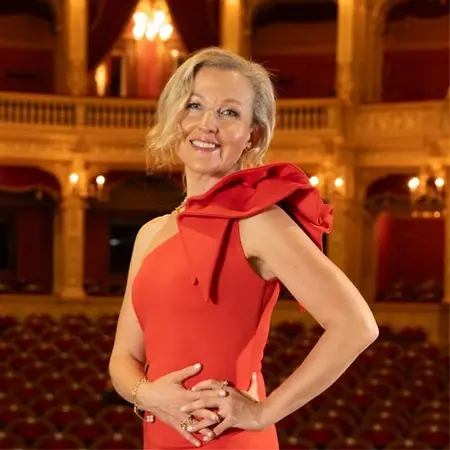
Influential Woman · Music
Yelena Dudochkin
Soprano, Artistic Director, Innovator www.yelenadudochkin.com, Dudochkin Berry Initiative www.dudochkinberry.org
Boston, MA 02467
Her Story
About Yelena
Yelena Dudochkin is an internationally acclaimed soprano, artistic director, and crossover innovator based in Boston, Massachusetts. Known for her expressive vocal artistry and magnetic stage presence, she performs across opera, classical, jazz, and contemporary genres. Her career highlights include sold-out arena performances of up to 20,000 people alongside global artists such as Plácido Domingo, Plácido Domingo Jr., and Dimash Qudaibergen, as well as appearances at prestigious venues including Carnegie Hall, Alice Tully Hall, Jordan Hall, and Symphony Hall. Critics have praised her as “a true pearl of opera” and recognized her dramatic intelligence and versatility on stage.
Her operatic repertoire spans leading roles such as Violetta in La Traviata, Gilda in Rigoletto, Iolanta in Iolanta, Norina in Don Pasquale, and Manon in Manon. She has performed with institutions including Opera Boston and the Mariinsky Opera Young Artists Program, and contributed to award-winning productions such as Magic Mirror, which received the American Prize in Opera. Alongside her performance career, she serves as Artistic Director of the Chamber Music Foundation of New England, where she works to expand access to chamber music and foster international collaboration through festivals and competitions.
Beyond the stage, Yelena is a strong advocate for the role of music in education, wellness, and cultural connection. She frequently speaks on the cognitive and societal benefits of musical training and leads initiatives that bridge classical traditions with modern audiences through interdisciplinary performance and innovation. Earlier in her career, she also worked on Wall Street in emerging markets strategy and financial analytics, experiences that inform her strategic and entrepreneurial approach to building sustainable arts organizations and expanding the impact of music globally.
Her Interview
Ten minutes with Yelena
01What do you attribute your success to?
I attribute my success to having the courage to pursue both of my passions rather than choosing between them, even when the music industry didn't take me seriously because I had a Wall Street career. As an immigrant from Ukraine, I felt a deep responsibility to my parents who sacrificed so much for my education, and to use my brain and talents to make the world a better place. My piano teacher's words stuck with me when she asked if I really wanted to graduate and go wait tables in New York, which made me realize I needed to build financial stability while continuing to develop my artistry. It took tremendous courage to maintain this dual existence for years, taking night classes at Juilliard while working at Morgan Stanley, going to Broadway Dance theater instead of the gym, and building my music career on the side. When I finally landed a principal role at a major opera company, I had to make a choice and jump off that cliff, leaving my successful finance career behind. The pivotal moment at the World Economic Forum, when I heard that major banks were no longer funding the arts, scared me deeply for the future of music and society. Having the courage to speak up and sing Summertime a cappella at 9am in Switzerland, despite jet lag and no preparation, opened doors for me to deliver this critical message at the highest levels. Since COVID, I've found the courage to come out of the closet, as it were, and embrace my full identity as both a finance professional and performing artist. I'm in a truly unique position because no full-time musician is equipped to speak to business leaders, run organizations financially responsibly, or advocate effectively at global conferences the way I can. I've been blessed with the ability to perform for 20,000 people with Placido Domingo and also to present and make things happen in the business world. My success comes from recognizing this unique responsibility and using my combined expertise to save our culture and humanity by ensuring music remains valued, funded, and accessible to future generations.
02What’s the best career advice you’ve ever received?
The most impactful advice I received came from my piano teacher at Juilliard, who told me: 'Yelena, you have a brain, and you have... you owe to yourself and to everybody else to actually use it. Do you really want to graduate, you know, the music side of things and go wait tables in New York?' That statement stuck with me because it was a sticky reality check about the challenges musicians face when they graduate. It made me realize that I could honor both my intellectual abilities and my artistic passion rather than limiting myself to one path. This advice shaped my entire career trajectory, giving me permission to pursue excellence in finance while continuing to develop my music on the side. It taught me that I didn't have to choose between using my brain and following my heart, and that building financial stability and business acumen would ultimately position me to make a greater impact in the music world. Now I share similar advice with young musicians, encouraging them not to limit themselves to one narrow career path but to think about how they can contribute and deliver music in whatever way they believe is important to society.
03What advice would you give to young women entering your industry?
The most important thing about coming into music today is to find your own voice with your instrument and discover what you're passionate about. Performance is one thing, but music is so multifaceted, and some of the most brilliant musicians who studied in dual degree programs or conservatories end up as doctors or heads of the Federal Reserve Bank. You don't limit yourself to anything. Pursue music and your instrument very passionately, but make sure that you contribute and deliver music in whatever way you believe is important in society, because it's not about having one narrow career road. It's about what you can do to make a difference with your art. It takes time to figure that out, but in addition to pursuing excellence in performing, make sure that you are in tune with your community. Learn how to teach, learn how to heal, and learn how to create unique and important concerts. We grew up with this blue book called The Art of the Song Recital, and it's so funny because it needs to be burned. While it's important to recognize how music fits together from a musicology standpoint, the real art of the song recital is finding out what is going to make a concert memorable. What pieces are going to resonate with people, and how are you going to put that together in something that is unforgettable, so that you're not just standing up there doing a little recital for the sake of having learned these pieces. There's no need for that. You should have a reason for why you're presenting something that's going to make that concert special and memorable to every person, so that when they walk out of there, they're going to remember that as unforgettable. Maybe they'll remember their childhood, maybe they'll fall in love with their dates, maybe their children are going to want to study music. There has to be something that you're doing that's important and special with what you do.
04What are the biggest challenges or opportunities in your field right now?
The biggest challenge facing music today is the declining financial support from major institutions. At the World Economic Forum, I heard a CEO of one of the top three banks speak about how they no longer allocated their money for donations to the arts and to music because they wanted to only focus on problems like water and environment, and they didn't think that music was important or thought it was like a premium luxury. That really scared me, not only for the future of music, but for the future of our society, because music is what makes us human. It's core to our early childhood education, community building, and there's really important, underfunded research that has proved so many times over and over again that you can fix dementia, help Alzheimer's, and treat people for pain with music therapy, yet none of these programs are being really seriously funded or researched. I realized there was a real problem in America especially of lack of awareness amongst the leadership, the people who have the power to make really important decisions to allocate funds and support programs. What's failing is not music itself but the music industry and its financially irresponsible leadership. The Metropolitan Opera, for example, is losing money not because donations are down, they're actually at an all-time high, but because the person in charge is overspending and making very risky, bad bets on productions that cost millions of dollars that audiences don't like and don't come back to see. First-time opera attendance is up 80% according to Opera America statistics, but people don't come back because what they see doesn't match their expectations. At the same time, there are tremendous opportunities. There are over 100 small opera companies in the US who make really financially responsible choices, they just don't have the scale or funding. The opportunity is to educate people at the highest levels about the power of music, develop music therapy career paths so graduating musicians don't have to wait tables, create crossover productions that blend classical opera with pop and jazz to dispel the perception that classical music is stuffy and elitist, and bring business acumen to arts organizations so they can be run responsibly while staying true to their mission.
05What values are most important to you in your work and personal life?
The values most important to me are courage, responsibility, and the deep belief that music is what makes us human. As an immigrant from Ukraine, I felt a strong sense of responsibility to my parents who sacrificed so much to give me my education, and to use my talents to make the world a better place. I believe music is not a luxury or premium, it's fundamental to our humanity, essential for early childhood education, community building, and has proven therapeutic benefits for conditions like dementia, Alzheimer's, and pain management. I'm driven by the conviction that we need to preserve and protect music for future generations, especially in America where there's a dangerous lack of awareness among leaders about its importance. I value financial responsibility and believe that nonprofit organizations serving a mission should still be run as sound businesses, not failing enterprises. I'm passionate about breaking down elitist perceptions and making music accessible to everyone through crossover productions that bring together classical opera, pop, and jazz. I believe in the power of education, not just for children but for educating the educators and leaders who make funding decisions. I value authenticity and courage, which is why I've finally embraced my full identity as both a finance professional and performing artist rather than hiding one side. Most importantly, I believe in using whatever unique talents and position you have to make a meaningful difference in society. I'm working with Harvard's new Institute of Happiness because I believe music has the power to build happiness, connection, and community in an age where we're becoming increasingly disconnected due to AI and the digital pace of life. My work is about ensuring that music continues to be valued, funded, and accessible so it can fulfill its essential role in strengthening our humanity and bringing people together.
Join Influential Women and start making an impact. Register now.