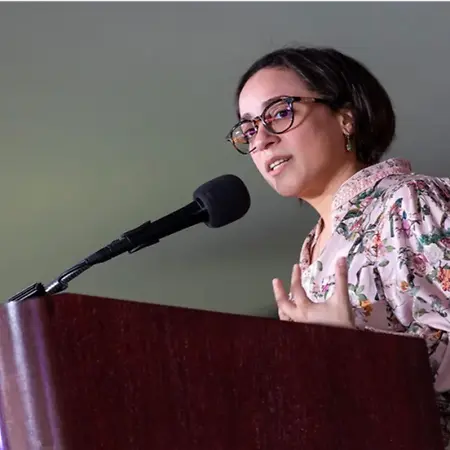
Influential Woman · Education & Public Engagement
Yesenia Pérez, EdM
Ed.M.
Senior Informal Education and Outreach Specialist, Space Telescope Science Institute
Baltimore, PA 21210
Her Story
About Yesenia
Yesenia Pérez, Ed.M., is an education strategist, program leader, and science engagement professional at the Space Telescope Science Institute, where she works across education, public engagement, partnership development, audience strategy, and program design for NASA-connected initiatives involving the Hubble, James Webb, and Nancy Grace Roman space telescopes and NASA’s Universe of Learning.
Her work is centered on a deceptively difficult question: how do institutions translate extraordinary knowledge into experiences that people can actually enter, understand, question, and make meaningful?
At STScI, Pérez has helped build and sustain national networks of museums, science centers, libraries, and informal learning organizations; supported engagement strategies around major NASA missions and discoveries; advised the development of educational and interpretive resources; and helped teams use audience research and evaluation to strengthen how complex scientific ideas are communicated.
Before entering the space-science community, Pérez built her career in museums, including roles at the Worcester Art Museum and Allentown Art Museum. Her work included educator and docent development, bilingual programming, community partnerships, program management, interpretation, and learning experience design. That background continues to shape her approach to science engagement and her belief that learning is not simply the transfer of information, but the creation of conditions in which curiosity, rigor, belonging, and discovery can coexist.
Her interdisciplinary path spans art history, museums, education, the humanities, science communication, and institutional strategy. Across each of these settings, she has been drawn to work that crosses traditional boundaries and asks how organizations can make complex ideas more accessible without making them less complex.
Her Interview
Ten minutes with Yesenia
01What do you attribute your success to?
I attribute much of my success to curiosity, persistence, and the people who made room for my questions before I fully understood where those questions might lead. My father first sparked my fascination with the stars, while teachers and experiences like Star Academy at Lehigh University helped me see learning as something expansive rather than fixed.
My path has not been linear. It has moved through art history, museums, community education, science communication, and institutional strategy. What once looked like unrelated interests eventually became the foundation of my work. I learned that curiosity does not always arrive neatly packaged as a career plan.
I have also learned a great deal from failure, uncertainty, and having to try again. Success, for me, has been less about knowing exactly where I was going and more about continuing to ask good questions, remaining open to unexpected connections, and being willing to grow into opportunities before I felt entirely ready for them.
02What’s the best career advice you’ve ever received?
The best career advice I’ve received is to keep going, but I have come to understand that differently over time. Persistence does not mean following one path indefinitely. Sometimes it means staying curious enough to change direction.
Careers rarely make perfect sense while you are living them. Experiences that seem unrelated can become enormously valuable later. Museum education taught me things I now use in science communication. Studying the humanities shaped how I think about institutions. Working with communities changed how I think about leadership.
So my version of “keep going” is really this: keep learning, keep asking better questions, and do not underestimate the usefulness of what you have already lived.
03What advice would you give to young women entering your industry?
Do not wait until you feel completely qualified before allowing yourself to participate. Ask the question in the meeting. Apply for the role that stretches you. Learn the vocabulary you do not yet know. Find people who are generous with what they have learned, and be generous with what you learn in return.
I would also tell young women not to confuse expertise with certainty. Some of the strongest people I know are comfortable saying, “I don’t know yet, but I know how to find out.” Curiosity is not evidence that you are unprepared. It is often evidence that you are paying attention.
And protect the parts of yourself that do not fit neatly into your job description. Your unusual combination of interests may eventually become the very thing that distinguishes your work.
04What are the biggest challenges or opportunities in your field right now?
One of the greatest opportunities in education and public engagement is also one of its greatest challenges: people now have unprecedented access to information, but access to information is not the same as access to understanding.
Scientific discovery is moving extraordinarily quickly. New missions, emerging technologies, artificial intelligence, changing media environments, and shifting public expectations are reshaping how people encounter knowledge. The challenge for educators and institutions is no longer simply to provide information. It is to help people navigate complexity, evaluate evidence, remain curious, and understand why discovery matters to their lives.
That requires us to think differently about engagement. Audiences should not be treated as passive recipients at the end of a communication pipeline. They are participants in meaning-making. The institutions that understand that will build stronger, more durable relationships with the communities they serve.
05What values are most important to you in your work and personal life?
Curiosity, rigor, generosity, and accountability are central to how I try to move through both my work and my life.
Curiosity keeps me asking questions. Rigor asks me to take those questions seriously. Generosity reminds me that knowledge becomes more valuable when it is shared. Accountability requires me to remain willing to examine my own assumptions and change when the evidence asks me to.
I also care deeply about creating spaces where people feel that discovery belongs to them. Whether I am working with scientists, educators, museum professionals, students, or communities, I want people to leave an experience feeling not simply that they learned something, but that they were invited into the process of learning itself.
Join Influential Women and start making an impact. Register now.