Influential Woman · Education
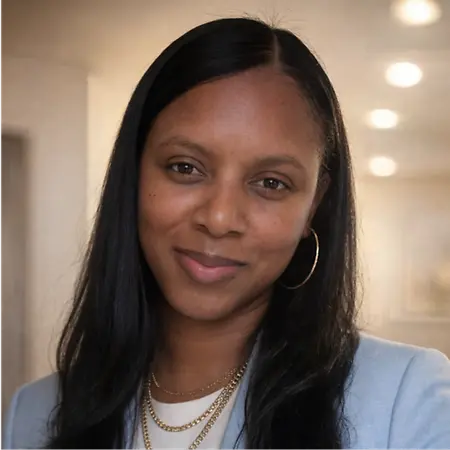
Yolonda Williams, Ed.D.
Professor of Business / AAS and AMBAS Business Program Chair, Tacoma Community College
Tacoma, WA 98466
The strongest decisions only need to make sense to you. Your life isn't a group project, and others' approval is not verification of your worth.
Yolonda Williams, Ed.D. · In Her Own Words
Her Story
About Yolonda
Dr. Yolonda Williams, Ed.D., is a tenured Professor of Business and Program Chair for the Associate of Applied Science and Bachelor of Applied Management programs at Tacoma Community College in Tacoma, Washington. With over a decade of experience at the institution, she plays a key leadership role in curriculum development, program assessment, and faculty supervision. Her academic work focuses on strengthening business education through workforce-aligned course design, including the development of programs in Social Media for Business and Project Management.
In addition to her leadership responsibilities, Dr. Williams is deeply engaged in classroom instruction and student success initiatives. She teaches a wide range of business and management courses such as leadership, human relations, marketing, customer service, and organizational behavior. Known for her application-based teaching style, she integrates real-world scenarios and current industry trends to prepare students for professional success while emphasizing accessibility, persistence, and holistic academic support.
Beyond teaching, Dr. Williams is committed to educational leadership and institutional development. She actively mentors students through academic advising and career planning while also contributing to faculty development and college-wide initiatives. Her professional background in student services, communications, and business education informs her collaborative approach to building strong academic programs that connect students, faculty, and the broader community.
Her Interview
Ten minutes with Yolonda
01What do you attribute your success to?
Finishing my doctorate was hard because I stopped after my husband passed away in 2023, and then I tried to keep going, but it was difficult because all the words and the readings seemed foreign to me. I couldn't grasp the concepts anymore, so I stopped altogether. But I knew I needed to finish because I needed to show my son that he can't quit when things get hard - he was and still is my driving force for finishing everything I start. In general, I knew education was one of the ways to improve my life from a really young age. The Cosby Show was so much more than just a TV show to me - I wanted to aspire to that level of greatness. It wasn't just about being called doctor, because now I don't even like people to say that, but it was the achievement. I started something, and I finished it - that process was what drove me. People say obtaining a doctorate will be hard, and I understand that, but I just kept telling myself - I got it, I can do it, I'm gonna finish it, because God never brings me to anything he hasn't already prepared me to complete. I believe that. The growth that takes place along the journey is also a driving force for me. I want to be the best version of myself, and that is why I go so hard. I had no blueprint for this academic journey, as I was a first-generation college student. I am proud to say I have younger family members whom I can now help, and they have gone to school and graduated, which is great. I feel like I was put in positions to go through things first so that I could be helpful to other people.
02What’s the best career advice you’ve ever received?
The best career advice I ever received is probably when I came home from Eastern Washington University and was working down at Bates Technical College. One of the people whom I considered to be somebody that I could look up to told me that there was no way that I could work full-time and finish my bachelor's degree. She said, "There's no way you can do that." And I remember just kind of being taken aback by her comment, because of who I thought she was and all her accomplishments. I thought she would have been more encouraging to me. I took that, and I dedicated myself to finishing my program on time, with no delays. And I did complete my degree and am extremely proud of it because it was the toughest one to earn, with life throwing life your way, studying became very difficult for me. I think that was the best advice that I ever received, because I always go back to that - remembering that I would never allow someone to tell me what I can't do. That's the advice that I hold onto, even though it's kind of negative, but it constantly pushes me to keep going. I'm really goal-oriented, so if I set a goal, I'm going to continue to work until I reach it, whatever that is - whether that's training for a run, finishing a program, or learning policies and assessment for my position, I'm going to figure it out. That is what drives me.
03What advice would you give to young women entering your industry?
I would say connect with someone who's doing something that you want to do, and not just LinkedIn friendships. I'm talking about meeting with them, talking to them, sharing what you want. No one knows what you want to do but you, and so you have to communicate those things, but you have to have the verbiage to do it. You also have to see yourself in the position you want or envision where you aspire to be. I never saw anyone who resembled me much in the classroom - I had three black teachers my entire life. One was in second grade, one in high school, and the other was in college. If you don't see yourself in different spaces, you can't imagine yourself in those places. You gotta be comfortable being the only or the first, you know, hopefully that doesn't last, but you have to be comfortable with it, and understand that you belong there, so take up space and embrace your intelligence, curiosity, and resilience each day.
04What are the biggest challenges or opportunities in your field right now?
I think the biggest challenge is AI, and not AI itself, because that's not new - we've had calculators and Siri and cell phones - but it's the way that it's being used, and the ramifications of its use. There are environmental issues surrounding AI and its data centers, and where they're being placed, that is a huge problem that more folks should be talking about. But people tend to show more concern when the issues directly impact them in one way or another. Until then, it's a blip on the screen of other people's problems, which is unfortunate, because we all live on this planet together. When things affect one, they should impact everyone else. Academically, it's about how students are using it. Is it the institution's responsibility to show students how to use it responsibly, or try to prevent them from using it altogether, which we know isn't going to work? Right now, every school is trying to come up with guidelines for AI use. For me its been a struggle. I've completely gone away from discussions because you just get a whole bunch of regurgitated information from ChatGPT or similar platforms. Students are losing their voice in the process, and I don't think they understand the importance of their voices. We're already dealing with COVID kids who are used to being in the house and not outside, and there are so many layers to what happened in those couple of years. We still haven't caught back up, and so trying to figure out ways to help them continue to learn and be comfortable in that struggle of critical thinking - that's the challenge. The biggest opportunity is just continued growth. I'm big on continuous improvement - I'm always trying to learn a new tool, or my son hips me onto new software that I can use in my classes. I'm always looking for new, creative ways to educate. Being well aware of the privilege I have and the space I take up in academic institutions that were not created for me or people that look like me, and working hard to change that narrative. Anyone looking to enter the education profession must understand that change is constant, and adaptability will be your best friend. Don't be the person who lands the job and then gets comfortable. Be the person who seeks knowledge and wants to leave a lasting impact on your students long after they graduate. Putting yourself in positions to learn something new every day.
05What values are most important to you in your work and personal life?
I'd say honesty is one of the most important ones. Being consistent in all things - with your word, be consistent, your actions, your behaviors. Because when you start changing up on people and situations, it doesn't look right. Your integrity is all have at the end of the day. So I'm very conscious of the words and the language that I choose to use. That's valuable to me. Family's valuable to me. My health, my faith - all of those things mean a lot. Being considerate, being kind, those things cost us nothing, but mean so very much. And Effort above all else, never allowing yourself to get too comfortable, because growth takes place in the pain of progress.
Join Influential Women and start making an impact. Register now.