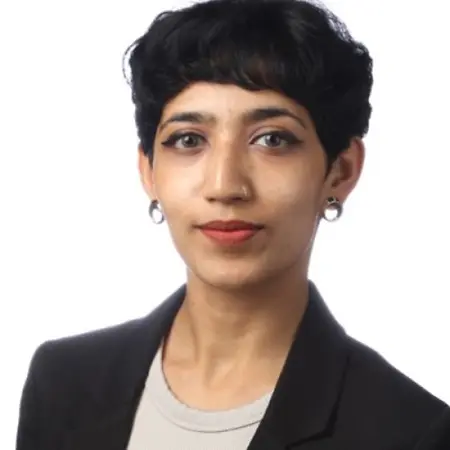
Her Story
About Zunaira
My journey in science has been incredibly diverse and fulfilling. I started with a bachelor's degree in biotechnology from the International Islamic University of Islamabad in 2013, then pursued my master's at Sheffield Hallam University in the UK, graduating in spring 2015. After that, I returned to Pakistan and worked at the National Agricultural Research Center in the capital city for around 3 years, where I managed large-scale data collection and processing in a role that bridged industry and academia with real-world implications. I then shifted into oncology for my PhD at the University of Illinois at Champaign, which I completed in December 2025. My PhD work was a collaborative effort across Veterinary Science and Bioengineering, focusing on bone sarcoma and how the tissue microenvironment shapes cancer progression. I led two main projects: one examining how tissue structure in bone, like stiffness and structure, affects cancer stemness and chemotherapy resistance, and another studying how metastatic cancer cells in the lungs interact with cells like fibroblasts to increase tumor area and how different therapies might inhibit that interaction. One of my biggest accomplishments was identifying niches in the tissue environment that were more conducive for cancer stem cells, which is crucial for understanding how to target chemotherapy-resistant cancer. I also have a peer-reviewed review paper with more than 200 citations that I'm really proud of. Currently, I'm doing my postdoc at the University of Illinois in the same department, working on immune cell profiling and studying how macrophages shift in their activation profile and function in different genetically modified animals to understand susceptibility or resistance to infections. A typical day involves literature review to learn more about immune profiling, experimental planning, ordering reagents, managing grad students and undergrads, and presenting results to my supervisor.
Her Interview
Ten minutes with Zunaira
01What do you attribute your success to?
I attribute my success to resilience and endurance, which I think is my strongest trait. In science, you face more failures than successes, so I've learned that failure is not the end but actually a redirection, and you just have to keep going. I've developed the ability to approach problems in different ways when they're not working. Instead of taking setbacks personally, I try to understand what I'm looking at and stay rooted in my own direction and values. The biggest thing I learned during my PhD was how to think independently and be creative with my ideas, pushing the boundaries of what we already have and looking at patterns in non-conventional ways. I've learned to keep going no matter what the situation is, staying focused on what I value and what I can control.
02What’s the best career advice you’ve ever received?
The best advice I've ever received came from my parents, especially my dad who was in the Air Force. He told me something that has always stuck with me: don't be afraid of the opposing wind, because the stronger it is, the higher it lifts you. He explained this using the physics of how airplanes work, that lift is higher when the opposing wind is stronger, so planes can't lift off if there's no wind. This advice has always given me strength and reminded me not to be afraid, or even if I am afraid, to do it anyway, because I'm capable of things I don't know of yet. If there is opposition in life, whatever it may be, it's not for me to stop but something for me to gain traction from. My parents always told me I'm capable of things I don't know of, and that any opposition I face is an opportunity to gain momentum.
03What advice would you give to young women entering your industry?
I would say definitely stay connected to what you want, to your values, to your goals, and to your direction. Sometimes you won't be able to see that it's happening, but I always say right direction before right outcome. Just keep going towards the path that calls to you, and then things will happen. It's easy to get pulled into expectations from society and people around you, but the most meaningful work will come from clarity about what matters to you. Be very careful where you put your energy, and just stay rooted in yourself. Don't let external pressures dictate your path, because when you're clear about your own values and direction, that's when the most meaningful work emerges.
04What are the biggest challenges or opportunities in your field right now?
There are several major challenges in my field right now. One is external, related to the funding cuts happening in science, which is hitting researchers very harshly. A lot of researchers lost funding and didn't know how to proceed, and many labs shut down. That's a challenge more related to the political climate. Beyond that, I think science communication could be much better. Scientists need to learn how to translate what they're doing into simple terms for people who are not in science, so we can rebuild trust in science. We don't want to hoard information, we want to tell people, but scientists really don't know how to make it accessible to non-science people, to laymen. Some organizations are working on science communication, but more effort is needed, including courses for scientists to learn how to present their findings to the general public. We need more outreach to make people believe and trust in science again. It's up to us as scientists to make that happen, to make it accessible and easy to understand.
05What values are most important to you in your work and personal life?
In both my personal and professional relationships, respect and transparency need to be there 100%. There cannot be good science if you cannot question each other respectfully and exchange ideas respectfully. A lot of academic institutions have hierarchical roles, and sometimes it can become intimidating where you're scared of speaking up to someone who's your senior and telling them that maybe we can try looking at a problem differently. But I feel like there needs to be openness, and that goes the same way in personal relationships. There needs to be an open line of communication, so good communication, transparency, and respect for each other are the values I look for whenever I enter a workplace. I want to know how willing they are to listen to other people's ideas. It's important to be a team player and to collaborate and listen to ideas, especially from people outside of your field. I also believe in having different types of people around so you're not stuck in an echo chamber. Collaboration and working with people in different fields is so important. I value workplaces where different opinions will be respected, there's good communication, and we kind of move forward together.
Join Influential Women and start making an impact. Register now.