
Navigate corporate reorganizations with strategic calm and emotional intelligence. Learn how to protect your career, build your value, and make empowered decisions when your company changes.
“
I became what I needed. If there is lack, like resources, support, or obstacles, I will literally become what I need. It's the bedrock of what I created and continue to build.
Tracy Allen · In Her Own Words
Her Story
About Tracy
Tracy Allen | Founder & Behavioral Strategist
The Architect of Adaptability
Tracy Allen doesn’t just manage change; she masters it as a high-performance skill. As the founder of Changecology and Changecologist, Tracy operates at the vital intersection of behavioral science, elite sales strategy, and artificial intelligence. With over two decades spent navigating the high-stakes corridors of AT&T, HP, Sony, Oracle, and T-Mobile, she possesses a peerless understanding of the friction between human psychology and technological evolution.
In 2016, Tracy pioneered a methodology to transform "change" from an abstract concept into a measurable, trainable asset. Today, she is the definitive voice for professionals and sales teams navigating the digital age. Her flagship keynote, "Is Your AI Strategy Missing a Punchline?", delivers a high-impact, humorous, and interactive wake-up call to organizations—bridging the gap between technical AI implementation and the human mindset required to leverage it.
Mastery of the Reset
Tracy’s work is dedicated to dismantling Mental Gridlock—the paralyzing state of overwhelm that stalls progress. To combat the modern epidemic of choice overload, she offers her "house specialty": The 60-Minute Decision Reset™. This targeted intervention is designed to sharpen decision-making under pressure for leaders facing high-stakes forks in the road, providing an immediate breakthrough when clarity is non-negotiable.
Why Tracy?
With a Master of Arts in Behavioral Science and a storied career in tech-sector sales and marketing, Tracy brings a rare blend of academic depth and "in-the-trenches" pragmatism. Whether she is addressing an audience of thousands or coaching an executive through a volatile transition, her mission remains the same: to provide the behavioral tools necessary to move from mental fatigue to decisive, effective action.
Her Interview
Ten minutes with Tracy
01What do you attribute your success to?
I attribute my success to a deep desire to live a meaningful and impactful life. While I recognize that a more traditional and predictable path may have been easier, I have always been driven to do work that feels significant and purposeful. From a young age, I knew I wanted more than an average life—I wanted to contribute something lasting, be remembered for the impact I made, and connect with others in a way that leaves a positive and memorable impression.
02What’s the best career advice you’ve ever received?
Always be nice to everyone- you never know who you'll meet on the way up or on the way down.
Your career is a journey, not a destination.
03What advice would you give to young women entering your industry?
Advice to Young Women Entering the Workforce
Know yourself—deeply and honestly.
Your self-awareness is your greatest advantage. Trust your instincts about people and situations, and build the intellectual confidence to stand behind your perceptions. When you second-guess yourself, others will often sense that hesitation and use it as an opening. Clarity within yourself closes that gap.
At the same time, don’t rely on intuition alone—strengthen it with capability. Focus on building practical, transferable skills alongside your education so you graduate with real, usable competence. The world doesn’t reward potential nearly as much as it rewards applied skill.
Be intentional about what you actually want. Too many people feel pressured to organize their entire life around a single “passion.” In reality, work and fulfillment don’t always come from the same place—and that’s okay. Define success on your own terms instead of inheriting someone else’s version of it.
Most importantly, commit to radical self-awareness. Understand your strengths, your patterns, your decision-making tendencies, and your blind spots. Be honest with yourself, even when it’s uncomfortable. That honesty is what allows you to make decisions that truly align with who you are—and ultimately, it’s what creates a career and life that feel right, not just look rig
04What are the biggest challenges or opportunities in your field right now?
Biggest Challenge—and Opportunity in the Industry
The biggest challenge in this industry is also its greatest opportunity: companies urgently need an objective third party to come in and reset how they think and operate—but they consistently resist it.
Organizations, both large and small, convince themselves they can replicate this internally. On paper, it feels efficient. In practice, it’s ineffective. Internal teams are too close to the problem, too influenced by existing dynamics, and too incentivized to protect the current system. What gets labeled as transformation quickly turns into another internal initiative—something that adds dialogue to a résumé, but rarely drives real change.
Someone embedded in the same culture will almost always bring a homogeneous lens to the problem—reinforcing the very thinking that created a stifled environment and an underdeveloped, misunderstood skill set.
At the same time, sales teams are under increasing pressure to deliver results while being bogged down by excessive reporting, internal noise, and competing priorities that slow execution. Then comes the AI surge—an influx of tools, information, and urgency that has organizations scrambling to keep up. People enroll in endless courses, consuming fragmented knowledge, hoping it will translate into performance.
It doesn’t.
More information isn’t the solution—it’s the distraction.
What companies actually need is not more input, but intervention. They need synthesis. They need someone who can cut through the noise, challenge assumptions, and translate complexity into clear, decisive action.
That’s the opportunity: not to add more, but to create clarity—and accelerate the ability to act on it.
05What values are most important to you in your work and personal life?
What Matters Most to Me
Two lines from Auntie Mame have long shaped my perspective: “Knowledge is power,” and “Life is a banquet and most poor suckers are starving to death.” Together, they reflect a core belief—that opportunity is abundant, but only for those equipped with the awareness and capability to recognize and act on it.
In both my professional and personal life, I am guided by four core values: truth, meaningful impact, ambition, and self-knowledge.
Truth underpins how I think, communicate, and make decisions. I prioritize clarity, intellectual honesty, and a direct approach to problem-solving—particularly in complex or high-stakes environments where ambiguity can hinder progress.
Meaningful impact is a consistent benchmark for my work. I focus on outcomes that create tangible, lasting value rather than short-term or surface-level results. This means aligning strategy with execution in a way that drives measurable change.
Ambition fuels continuous growth and high standards. I am motivated not only by achievement, but by the pursuit of improvement—challenging assumptions, expanding capabilities, and consistently raising the bar.
Equally important is self-knowledge. A clear understanding of one’s strengths, patterns, and decision-making tendencies enables better judgment, stronger leadership, and more intentional action. It ensures that ambition is directed effectively and remains aligned with long-term objectives.
At a foundational level, I believe success comes from the combination of awareness and execution—knowing what matters and having the discipline to act on it with clarity and purpose.
Her Content Hub
Articles by Tracy
How to Survive an Ugly Corporate Reorganization Without Losing Your Power
How to Survive Corporate Change Without Losing Your Footing
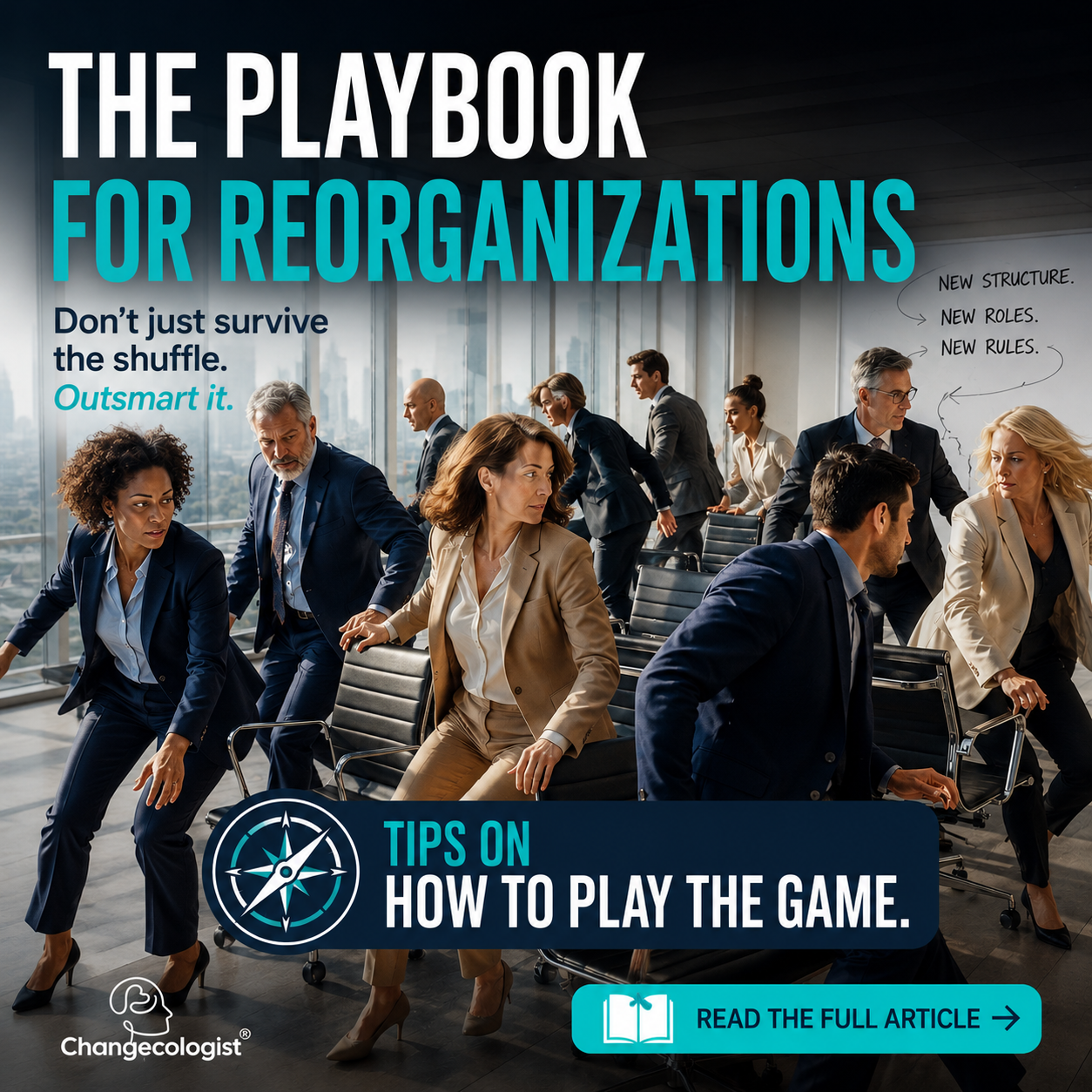
When the Company You Knew Leaves the Building
There is nothing quite like walking into work on a Monday and realizing the company you knew has apparently left the building.
Maybe your company was acquired. Maybe there is a reorganization. Maybe a new leadership team has arrived, carrying spreadsheets, restructuring plans, and the unmistakable energy of people who have never met a pleasantry they couldn't eliminate.
Suddenly, everything is different. The new leadership wants to "optimize."
Translation? Increase revenue. Reduce expenses. Squeeze more out of the existing customer base. Standardize everything. Question everything. And, if possible, eliminate anything that isn't absolutely necessary—including the nice coffee, the comfortable chairs, and possibly your remaining sense of emotional stability.
You try to be professional. You introduce yourself. You communicate that you're adaptable, trainable, and willing to help.
And you get...nothing. The corporate equivalent of cryotherapy.
Cold. Very cold.
Conversations become transactional. You provide the information they request, only to be told it's wrong. You correct it. Still wrong.
Eventually, you realize this may not actually be about the spreadsheet. And suddenly, a place where you once felt secure feels completely unwelcoming.
You start wondering: Will the dust settle?
Maybe. But you don't know when. And you can't build your career around waiting for someone else to decide when the dust settles.
Here's the Part Nobody Likes to Say Out Loud
Sometimes companies don't have to fire you to get you to leave. They can change the environment.
New policies. New expectations. New leadership. Return-to-office mandates. Reduced flexibility. Increased workloads. Less autonomy.
Some employees adapt. Some don't. And some leave voluntarily.
That doesn't mean every reorganization or return-to-office policy is secretly designed to force employees out. Sometimes companies genuinely believe these changes are necessary.
But you don't need to debate management's motives. You need to understand the consequences for you.
If the new environment no longer works for you, that's information. Use it.
Don't Make a Permanent Decision From a Temporary Emotional State
This is where people make one of their biggest mistakes. They call me after they've reached the end of their rope.
"I think I'm just going to quit."
That's when I know the pressure has gotten to them. They're not necessarily making a career decision. They're trying to make the discomfort stop.
There is a difference.
Quitting may eventually be the right answer. But quitting because you're angry, frightened, humiliated, or exhausted puts the other side in control of the decision. Move from strength instead.
You don't have to love what's happening. You don't even have to agree with it. But you do need to remain strategically calm.
Remember: This Is a Business Transaction—Not a Verdict on Your Worth
A reorganization can feel deeply personal. It isn't necessarily personal.
New leadership may be evaluating departments, expenses, revenue streams, technology, headcount, and organizational structure. Their priorities may be completely different from those of the leadership team that hired you. That doesn't mean you've suddenly become incompetent.
It means the game changed.
And when the game changes, you change your strategy.
This is where emotional intelligence becomes a career survival skill. The person who remains calm while everyone else is panicking has an enormous advantage—not because they don't feel pressure, but because they know how to operate while under it.
Stop Looking for Reassurance
You may desperately want someone to tell you:
"You're doing a great job."
"Your position is safe."
"We value you."
During a major reorganization, you may not get that reassurance. So, build your own evidence.
Document your accomplishments. Track revenue influenced, customers retained, problems solved, efficiencies created, projects completed, and relationships you own. Don't assume everyone knows your value.
Make your value measurable.
Tighten Up Your Professional Game
This is not the moment to become sloppy because you're unhappy. Quite the opposite. Become exceptionally professional.
Communicate clearly. Meet deadlines. Document decisions. Ask intelligent questions. Don't gossip. Don't participate in the office panic Olympics.
And whatever you do, don't send the angry email. Don't make the sarcastic comment in a meeting that feels fantastic for eight seconds and terrible for the next six months.
When the environment becomes chaotic:
Become the calmest person in the room.
That's leadership.
Do More With Less—But Pay Attention to the Math
Reorganizations frequently mean fewer resources and greater expectations. You may be asked to do more with less.
Fine. Show that you can adapt.
But adaptation does not mean unlimited sacrifice. Pay attention to workload, expectations, resources, and results. If the organization continually demands extraordinary output while shrinking the resources required to deliver it, that's a signal.
Don't complain about the signal.
Read it.
Quietly Prepare Your Exit While You're Still Employed
One of the most important rules I give people is simple:
Don't wait until you need a job to start looking for one.
Update your résumé. Polish your LinkedIn profile. Reconnect with your network. Research the market. Identify companies where your experience has value.
And keep doing your current job well.
There is tremendous psychological power in knowing you have options. You don't have to resign. You don't have to announce anything. You don't even have to decide yet.
You're simply creating options.
And options are strength.
Don't Confuse Discomfort With Failure
An unfamiliar or hostile workplace can make you question yourself.
Don't let it.
You may be experiencing organizational instability—not personal failure.
Sometimes a reorganization forces you to see something you weren't willing to see before.
Maybe you've outgrown the role. Maybe the company has changed. Maybe your values and the organization's values no longer align. Or maybe there is an opportunity somewhere else that you would never have pursued if you hadn't become uncomfortable where you were.
That doesn't mean the reorganization was good.
It means you can use it.
Your Career Is Bigger Than This One Organization
This may be the most important thing to remember.
Your company is not your career.
Your title is not your identity.
Your current manager is not the final authority on your professional value. And one ugly chapter does not determine the ending of the book.
So, breathe.
Stop catastrophizing. Stop trying to decode every facial expression in the hallway. Stop waiting for someone else to make you feel secure.
Look at the facts.
Protect your reputation. Increase your value. Build your network.
Create options.
And then decide:
From strength.
Because the goal isn't simply to survive the reorganization. The goal is to emerge from it smarter, calmer, and more valuable than you were when it started.
And if you eventually walk into a new organization where your experience is appreciated, your contribution is valued, and you don't have to spend your day wondering whether the corporate temperature has dropped another five degrees?
You'll be glad you didn't quit from a place of panic.
You left from a place of power.
That's the game.
Play it well.
About the Author
Tracy Allen is the founder of Changecology, a consulting firm that helps organizations think faster, adapt smarter, and navigate change with greater clarity.
A career spanning AT&T, HP, Oracle, Sony, and T-Mobile exposed her to market booms, crashes, layoffs, reinvention, and technological disruption. Those experiences shaped a simple philosophy: the greatest risk facing organizations isn't technology—it's institutional thinking.
Today, Tracy helps leaders challenge outdated assumptions, strengthen decision-making, and build cultures capable of genuine innovation.
Discover how entrepreneurs face intellectual property theft in corporate settings and learn practical strategies to protect your original ideas without costly litigation.
The Psychology of Innovation
Why the biggest threat to your business isn't competition—it's the person in your conference room taking notes.

The Hidden Challenge of Entrepreneurship: Protecting Intellectual Property
One of the questions I'm asked most often is:
"What's the biggest challenge of owning your own business?"
Most people expect me to say cash flow, marketing, or finding clients.
No.
Intellectual property theft.
Not the Hollywood version involving hackers in dark hoodies. I'm talking about something far more polished—conference rooms, catered lunches, and executives taking meticulous notes.
Picture This
After months of networking, emails, follow-ups, and calendar gymnastics, you've finally landed a meeting with a large organization.
Around the table sit six leaders whose combined salaries easily exceed a million dollars a year.
I'm there to introduce one of my interactive microlearning sessions on change and adaptability. It's affordable, engaging, and designed to help employees think differently—not just work differently.
Then comes the request.
"Can you walk us through the session so we can determine whether it's a good fit?"
Reasonable enough.
Until it isn't.
As I explain how I developed the methodology, I stop watching my slides and start watching the room. Some people lean in. Others lean back with crossed arms.
Then someone inevitably says:
"I absolutely love what you've created. I've always wanted to do something like this."
The meeting isn't over, but in my mind, it is. Because I've heard that sentence before.
There's a good chance I won't get the business.
Instead, someone inside the organization will form an internal committee, repackage my concepts, change a few words, add a corporate logo, and unveil it six months later as the company's newest initiative.
Changing the Font Qualifies as Innovation
Apparently, changing the font qualifies as innovation.
The irony is almost poetic. Organizations invest millions trying to become more innovative while simultaneously teaching themselves that copying is an acceptable substitute for creating.
Here's what they missed:
The entire purpose of my work is helping people develop original thinking. You cannot build a culture of innovation using derivative ideas.
Calling pot roast and mashed potatoes "Executive Beef Goulash" doesn't make you a chef. It makes you good at branding leftovers.
What fascinates me isn't that this happens.
It's why.
For some people, borrowing someone else's work provides the emotional payoff of entrepreneurship without the financial risk.
They get the recognition.
They get the LinkedIn announcement.
They get to lead the initiative.
They get to feel innovative without ever experiencing the uncertainty that comes with inventing something original.
Innovation becomes performance art.
The scary part?
This isn't a one-time decision.
It's a mindset.
People don't suddenly wake up on a Tuesday and decide to appropriate someone else's intellectual property. They've been borrowing ideas, taking shortcuts, and relabeling other people's work for years.
Eventually, it becomes organizational culture.
Ironically, these same companies often wonder why employees don't bring them more creative ideas.
Because creativity isn't something you announce.
It's something you practice.
How Do You Protect Yourself?
People often ask me:
"How do you protect yourself?"
Most expect me to launch into a discussion about copyrights, trademarks, contracts, and lawyers.
Those things matter.
But here's the uncomfortable truth:
Your legal protections are only as valuable as your willingness—and financial ability—to enforce them.
Litigation is expensive.
Time-consuming.
Emotionally exhausting.
For many entrepreneurs, winning the case can cost more than losing the client.
So my advice is surprisingly simple:
Be selective.
If you wouldn't trust someone with your ideas over a handshake, don't trust them simply because they're sitting in a beautiful conference room.
Set expectations before the meeting. Know exactly how much of your methodology you're willing to reveal during the sales process.
If discovery starts feeling more like an interrogation than a conversation, pay attention.
And don't be afraid to charge for strategy sessions.
Organizations that are serious about solving business problems rarely object to paying for expertise.
Those looking for free consulting usually disappear.
Innovation Isn't Measured by the Number of Ideas You Collect
There's one final irony.
Every company proudly lists innovation as a corporate value. Few stop to ask whether their behaviors actually support it.
Innovation isn't measured by the number of ideas you collect.
It's measured by the number of original ideas you're willing to create.
There's a profound difference.
One builds companies.
The other builds PowerPoint presentations.
About the Author
Tracy Allen is the founder of Changecology, a consulting firm that helps organizations think faster, adapt smarter, and navigate change with greater clarity.
A career spanning AT&T, HP, Oracle, Sony, and T-Mobile exposed her to market booms, crashes, layoffs, reinvention, and technological disruption. Those experiences shaped a simple philosophy: the greatest risk facing organizations isn't technology—it’s institutional thinking.
Today, Tracy helps leaders challenge outdated assumptions, strengthen decision-making, and build cultures capable of genuine innovation.
Organizations rush to adopt AI without alignment, creating security risks and wasted efforts. This article explores the AI Alignment Gap and why governance, education, and shared expectations matter more than technology itself.
AI Is Moving at Supersonic Speed. Is Your Organization Ready?
Why organizational alignment matters more than AI adoption speed.

Artificial Intelligence Is Moving Faster Than Most Organizations Are Ready For
Artificial intelligence is moving at a speed most organizations have never experienced before.
Every morning, my LinkedIn feed greets me with another avalanche of "essential" AI content-color-coded comparison charts, 47-step prompt frameworks, and enough "ultimate guides" to require their own AI to summarize them.
Ironically, all this information that's supposed to reduce overwhelm often does the exact opposite.
Instead of creating clarity, it creates panic.
During my microlearning sessions with organizations, I hear the same question over and over:
"Where do we even begin?"
The problem isn't a lack of enthusiasm. It's a lack of alignment.
I call it the AI Alignment Gap.
After working with executives, directors, sales teams, and frontline employees, I've noticed something fascinating.
Executive teams are busy developing enterprise AI strategies with consultants. They're talking about productivity, efficiency, competitive advantage, and digital transformation.
Middle managers are trying to introduce AI into daily workflows while juggling compliance, deadlines, and the reality that half their team is experimenting with tools they've never heard of.
Meanwhile, individual contributors are doing what humans do best when they're afraid of being left behind: signing up for every free AI course they can find and learning from YouTube, Reddit, LinkedIn influencers, and that guy who promises to make them an AI millionaire before lunch.
Imagine entering Category 5 whitewater rapids with a boat full of enthusiastic paddlers, each convinced they're steering correctly.
Everyone is rowing.
Just not in the same direction.
That's not innovation.
That's cardio.
The Risk Nobody Wants to Talk About
Most AI conversations focus on productivity, automation, and ROI.
Far fewer focus on what employees are accidentally sharing.
Every day, well-intentioned professionals paste client information, pricing strategies, meeting notes, contracts, and proprietary business knowledge into public AI platforms-not because they're careless, but because they're trying to work faster.
Consider a common sales scenario:
A salesperson finishes an important client meeting and wants help polishing a proposal. They paste their discovery notes into a free AI tool, complete with client names, pricing discussions, competitive intelligence, and strategic objectives.
Their intention is excellent.
Their judgment may not be.
Without realizing it, they may have exposed confidential information outside the company's approved security environment.
This isn't malicious behavior.
It's uninformed behavior.
And those are two very different problems.
Technology Isn't the Hard Part
Organizations spend enormous amounts of time choosing the right AI platform.
They spend far less time teaching people how to think about AI.
Software is easy to buy.
Judgment takes practice.
Successful AI adoption requires more than licenses and logins. It requires governance, education, and shared expectations.
Every organization should be able to answer a few simple questions:
- Which AI tools are approved?
- What information should never be entered into public AI platforms?
- How do employees verify AI-generated content?
- Who owns AI-created work?
- Has everyone received practical AI training-not just a policy document buried on the intranet?
If employees don't know the rules, they'll create their own.
And homemade AI policies rarely end well.
Policy Before Prompts
Before chasing the newest model, plugin, or prompt library, organizations need something much less glamorous:
A clear AI policy.
Good governance protects intellectual property, preserves client trust, reduces risk, and gives employees the confidence to innovate responsibly.
The companies that will win the AI race won't necessarily be the first to adopt every shiny new tool.
They'll be the ones whose people are moving in the same direction.
Because AI isn't just a technology challenge.
It's a human alignment challenge.
So here's one question worth asking:
Does everyone in your organization understand not only how to use AI-but when, where, and why they should?
If that question makes you even slightly uncomfortable, you may have discovered your AI Alignment Gap.
Fortunately, that's a much easier problem to fix than explaining to your biggest client why their confidential strategy just became part of someone else's prompt.
If you're ready to replace AI anxiety with AI alignment, Changecology helps organizations build practical AI strategies, governance, and workforce confidence-before enthusiasm turns into exposure.
Join Influential Women and start making an impact. Register now.