Stories Are Our Survival Guides
You Are Not What Happened To You, You Are The Garden You Grow From It

Stories Are Our Survival Guides: You Are Not What Happened to You, You Are the Garden You Grow From It
Before I was Professor Oden or an English Ph.D. Student, I became a mother. I carry that part of my world in everything I do, and all the dreams I have were born from the life I want for my children. I believe that the greatest gift that I can impart to them is to lead them to, by way of example, a meaningful life filled with purpose, driven by passion and intellectual stimulation. That is the garden that I grew from the rubble of my old life. In 2018, as we celebrated the addition of our second child, my beloved daughter, Dakota Grace, I found myself mourning for a brain that I would never again recover. My second pregnancy brought forth an immense personal struggle that would leave me permanently altered from the life that I had previously enjoyed. In December of 2018, I was diagnosed with postpartum related psychosis, a symptom stemming from a condition recognized as Bipolar 1 disorder. The psychosis broke with medication, though Bipolar 1 disorder will remain my challenge to manage for the rest of my life.
My first conscious thought after hearing my diagnosis was “how will I ever get into a graduate program with a broken brain?”—a fear that struck me like ice as I stared at the falling snow outside of a large hospital floor window. As a disability studies researcher today, I now realize what a gift it is to have such clarity of purpose and to honor those who came before me while paving the way for those to follow. To be silent is to be compliant with a history of oppression and ableism from a system that was not designed for individuals like me, among many others, whose voices must be centered if we are to overcome the anti-intellectualism movement of the present moment. In her 1926 essay “On Being Ill,” Virginia Woolf (1882-1941), a pioneering feminist writer of fiction and nonfiction alike, pens into existence: “It becomes strange indeed that illness has not taken its place with love, battle, and jealousy among the prime themes of literature.” One certainty of the human condition, and a connecting thread across time and space, is our encounters with illness, and those experiences are woven into our identities through the stories we tell.
In my daily life, I think about and remain attuned to representations of illness. I derive such fulfillment from my research, which follows the trace of a disability aesthetic expressed in the literary period known as Modernism extending through to more contemporary 20th century texts, all sharing the commonality that they are written by women who have encountered illness. My first engagement with Virginia Woolf was through Mrs. Dalloway, which I read as a Sophomore at Stonehill College during a period of illness in my life. I was, at that time, consumed by the ebbs and flows of an eating disorder, and I immediately recognized aspects of my struggles in Woolf’s words on the page. I read the entire novel in one sitting. That was the moment in my life when I knew without any shadow of a doubt that I wanted to become an English Professor, and I never wavered from this dream. After a hiatus from school during the time in which my husband and I built our family and addressed my postpartum mental health struggles, in early 2022, I applied to the University of Rhode Island’s English M.A. program. I spent much time researching programs to which I could reasonably commute, having settled in with my family and being unable to relocate. When I discovered my now Dissertation Advisor, Dr. Stephen M. Barber, an expert on Virginia Woolf who has since become my greatest confidant and one of my dearest friends, I could not believe how the fates aligned. I completed my work for the M.A. program in 2024 after defending my portfolio and continued straight through to the Ph.D. program thereafter.
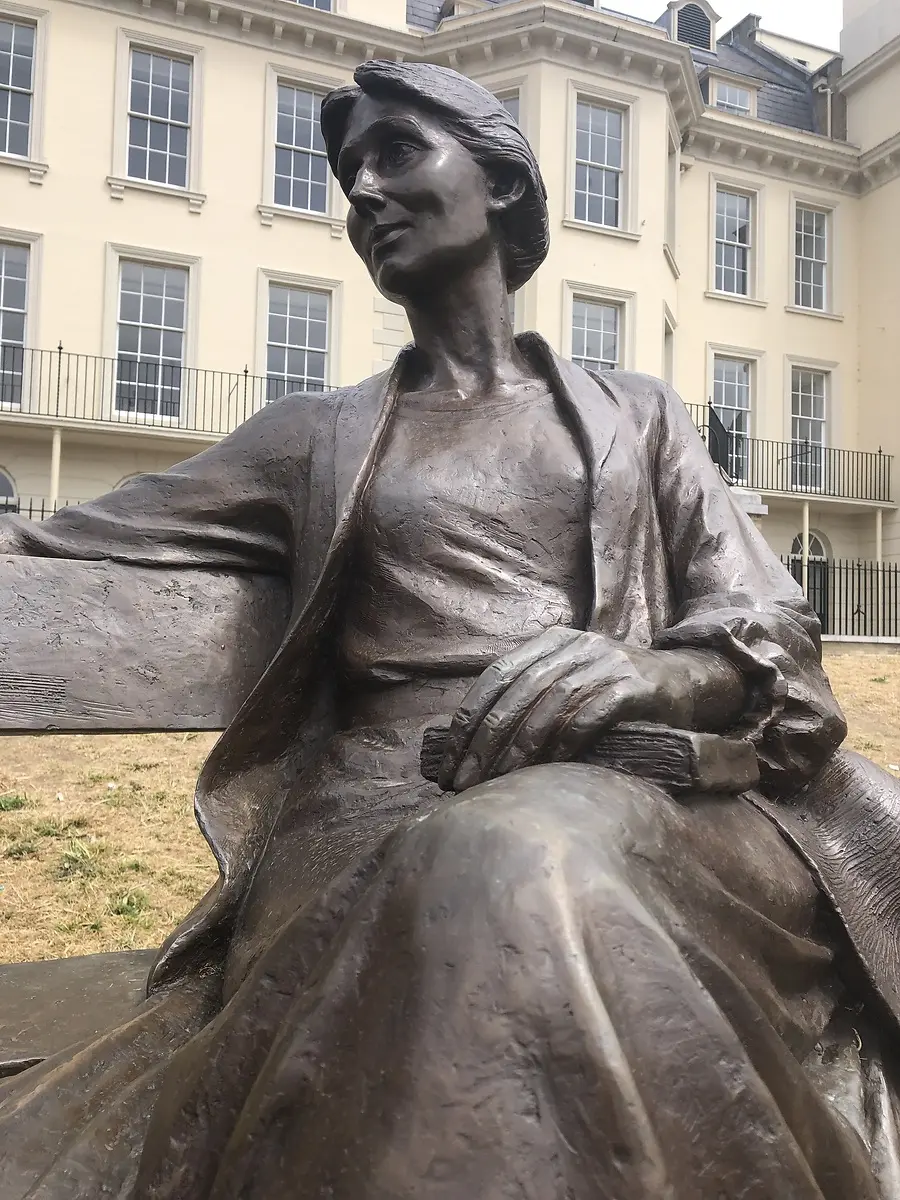
In July of 2025, I had the joy of presenting my research paper, “The Large Bloomsbury Window and The Yellow Wallpaper: Dissenting the ‘Rest Cure’ in Virginia Woolf and Charlotte Perkins Gilman” at the 34th Annual International Conference on Virginia Woolf at the University of Sussex. I followed in the footsteps of Woolf’s characters in Mrs. Dalloway from Bond Street to Regent’s Park in London. I also walked through the airy rooms of Monk’s house, which Woolf purchased with her husband, Leonard, in 1919 and where she took residence during the time of her death in 1941, sending my loving intentions to honor the stone archway on the property that I was informed she passed through on the last walk of her life. I felt firsthand the magic of Charleston house, where Woolf’s sister Vanessa Bell lived, and a major artistic hub of the Bloomsbury group of intellectuals, moved to tears to see the artist represented in her final portrait in 1961 two decades after the death of her sister. I took photographs with the Virginia Woolf Statue and Bench in Richmond, paying homage to her legacy with a bouquet of Mrs. Dalloway flowers and a copy of my favorite novel that traveled with me across the pond. To say that I am living a life beyond my wildest dreams does no justice to the sense of wonder with which I live my life and the spirit of curiosity that I bring to my engagements with those around me.
An essential aspect of the ecosystem of my metaphorical garden is the passion I hold for my vocation as an educator. I began my teaching career as a creative writing teacher for a day respite center for intellectually disabled adults, a position that I maintained while completing my bachelor’s degree. When my firstborn child, my son, Colby, was little, I was privileged to stay at home with him during the baby and toddler years, as I worked virtually for a Shanghai-based English as a Second Language (ESL) company, teaching students from 5 to 12 years of age. Those early teaching experiences set the foundation for all that I know to be true in education, that learning is a fundamental human right, our pedagogical strategies must center accessibility, and that students learn far more effectively with nurture than coercion. I bring to the field the earnest recognition that learning involves an exchange of knowledge and that my vocation as an educator calls me to be available to my students as a safe professional who knows when to listen and when to lecture. My hope for my students is that they can always discern the bird’s eye view from the forest through the trees, seeing through the particular details of their lives and connecting them to the universal human impulses that we share of love, survival, and empowerment. We need to hear their voices, and we all must speak up for the world that we want to leave for future generations.
The blooms that continue to blossom in my garden far outweigh the pain, shame, and guilt that I felt when I was first diagnosed. These feelings thrive in silence, and I have only ever felt closer to my community and a renewed sense of catharsis in sharing what I have learned from the trials and tribulations of my life with others. It was a sobering reality that the real physical and mental sensations that I had experienced in psychosis were revealed to be consequences of my postpartum mental health disorder. I confronted a crisis of identity after my diagnosis and came to the recognition that my experiential truth is woven into the fabric of my reality. The divide between in/sanity is hard to communicate to anyone who has not personally endured it. It is easy to question every thought that passes through my mind and wonder if they truly reflect who I hold myself to be or whether they are products of my disorder. Today, I know that I can say with full certainty that I again recognize my face in the mirror. I have achieved a level of resilience that cannot be taken from me and the knowledge that it only makes me a better, more informed advocate for my children.
When you think about a garden, there are many factors that influence the conditions for growth. In my metaphorical garden, those factors include medication, proper sleep and diet, time for nurturing my passions, physical activity, emotional connection, and reflective journaling. I remember the days where I could hardly shower or leave the couch, and through it all my mom came over daily to help me care for my children and for myself. When I think about how different my days look now from the early days of my diagnosis, I am proud of myself for doing it scared. It took what felt like a million baby steps, each inching me closer to the sense of self I have attained now, over a long period of time. Everyday I pushed myself to do something that scared me. This started as pushing the double stroller on walks down the street, playing in the yard with bubbles and sidewalk chalk when Winter yielded to Spring, and returning to work as an ESL teacher after my medical leave. Another strategy that helped me to move forward in those early days of paralysis was a mental exercise: I pushed myself to give as much priority of thought to being triumphant and overcoming my struggles as I did my catastrophic fears of failure. By considering a reality in which everything works out with sincerity, I found that over time my fears eventually gave way to hope.
Symptoms of psychosis are always an emergency. If you or someone you know are experiencing symptoms of psychosis, you should immediately go to your local emergency department. For those struggling with specifically postpartum related mental health disorder symptoms or complications, Postpartum Support International (PSI) is a wealth of knowledge and has a directory of psychiatric care providers with which they are affiliated: https://www.postpartum.net/get-help/provider-directory/. As a peer-to-peer support group facilitator with PSI, I can personally attest to the community of care and support that they provide to mothers and birthing people struggling in the postpartum and perinatal period. You are not your symptoms, and you are never alone. You deserve access to the help that you need. Your story of triumph will become a survival guide for those who follow in your footsteps. We must be vulnerable and share our stories if we are to leave behind a lasting impression. The gardens that we grow from our pain give meaning to our struggles and create new expressions of what it means to be human, for all our similarities and our differences.