The Great Lobotomy: How AI is Quietly Killing the Human Mind
How AI is silently eroding the essence of human creativity, knowledge, and moral responsibility.

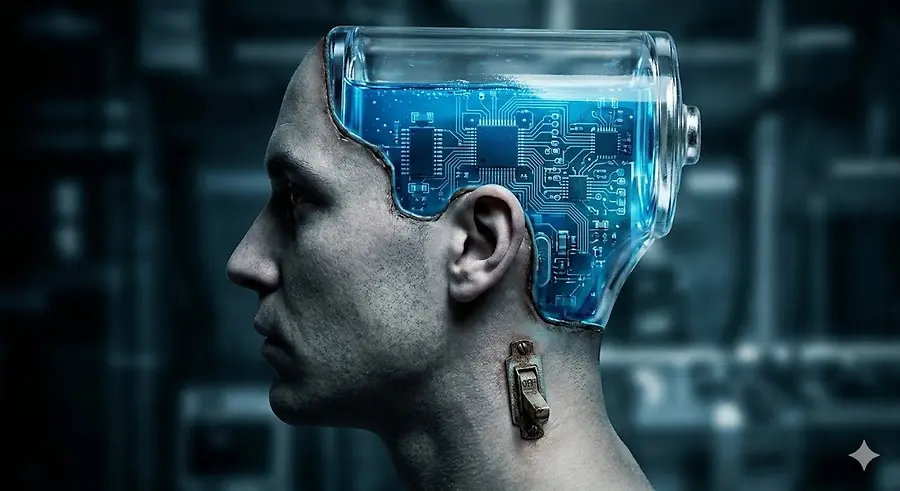
I. The End of the “Aha!” Moment
For centuries, human progress was driven by struggle—the difficult process of research, trial, and error. AI has turned that struggle into a “Submit” button. When an algorithm writes your essays, creates your art, and solves your code, the neural pathways responsible for deep problem-solving begin to wither. We are trading the “muscle” of our brains for the “crutch” of a processor.
II. The Echo Chamber of the Soulless
AI doesn’t create; it regurgitates. It scans billions of human-made data points and averages them into a “safe,” “acceptable” output. By relying on AI for our culture, we risk trapping ourselves in a feedback loop of mediocrity.
The danger: We are losing the “edge” of human weirdness, dissent, and radical originality in favor of a mathematically optimized middle ground.
III. The Morality of the Machine
We are increasingly allowing AI to make “minor” moral choices—who gets a loan, who is deemed a “risk” to society, or what news we should see. The controversy lies in the loss of accountability. When a machine makes a biased or life-altering decision, there is no soul to hold responsible. We are creating a “bureaucracy of math” that is immune to shame or reform.
IV. The Death of Memory
Why remember history when you can search it? Why learn a language when you can translate it? We are becoming a species with “infinite access” but “limited internal knowledge.” If the servers went dark tomorrow, we would find ourselves in a new Dark Age—not because the information is gone, but because we no longer know how to process it without a digital intermediary.
The Final Verdict
The threat of AI isn’t a robot uprising; it’s the quiet, comfortable surrender of the qualities that make us human. We risk becoming the “pets” of our own creations—well-fed, entertained, and increasingly incapable of functioning without them.
Is a world without struggle still a world for humans, or are we simply biological data points waiting to be optimized out of existence?