
Autonomous Site Reliability Engineering (ASRE) powered by agentic AI replaces reactive monitoring dashboards with proactive, context-aware systems that observe, orient, decide, and act—while maintaining strict safety guardrails, durable state, and human oversight at every critical decision point.
Her Story
About Rashi
My success has been a journey of curiosity and a relentless drive to understand how things work from bottom to end to end. I began my career at SanDisk, where I spent my early years building and optimizing supply chain processes. These early years taught me discipline, analytical thinking, and the importance of cross-functional collaboration. I learned that supply chains are not just logistics, they are living ecosystems where engineering, marketing, finance, and operations intersect. I then moved to AWS Amazon, joining the data center planning team where I worked on short-term capacity delivery. My experience reshaped my perspective - instead of optimizing a single product line, I was now helping orchestrate the backbone of the cloud itself. I saw how decisions made months or even years earlier could determine whether capacity was ready when customers needed it. For the past year and a half, I've been at Microsoft as a Senior Technical Program Manager. As the organization matured, I felt a strong pull to understand the earlier stages of data center lifecycle. I'm completely focused on building the data center for Azure Cloud - how we acquire land, how power and fiber are secured. I work on data center delivery and capacity, doing forecasting for the coming 5 years to determine how much power is required. My typical day involves managing the CPM baseline schedule, forecasting budgets and resource loading, monitoring critical paths and risks, conducting delay and impact analysis, and supporting subcontract negotiations and commercial management. I'm grounded in a few principles: I have a growth mindset and don't aim to know everything, but I aim to learn constantly. I believe in collaboration over competition - the best solutions are built together. I focus on customer empathy, knowing that behind every metric is a real need we are solving. I work to eliminate judgment and ambiguity, because complex problems require thoughtful, informed decisions. And I believe in influence without authority - impact comes from trust, and trust is something I always build with my customers.
Her Interview
Ten minutes with Rashi
01What do you attribute your success to?
I attribute my success to a combination of curiosity, ownership, and consistency in solving complex, systems-level problems.
I’ve always been naturally curious about how large-scale systems work, whether in supply chains, cloud infrastructure, or risk management- and that curiosity pushes me to go beyond my immediate role and understand the full end-to-end picture. This has helped me connect dots across functions and identify improvements that aren’t always visible at the surface level.
A strong sense of ownership has also played a key role. I tend to take accountability beyond defined boundaries, especially in ambiguous environments where clarity is still evolving. I’ve learned that real impact often comes from stepping in, structuring the problem, and driving alignment across diverse stakeholders rather than waiting for perfect clarity.
Finally, consistency has been critical. Working in high-scale, high-pressure environments has taught me that meaningful outcomes are built over time through disciplined execution, continuous learning, and iteration. I focus on delivering incremental improvements that compound into larger system-level impact.
Overall, I would say my success comes from combining systems thinking with execution discipline, while continuously learning and adapting as the scope and complexity of work increases.
02What’s the best career advice you’ve ever received?
The best career advice I’ve ever received is: “Don’t just focus on doing your job well- focus on understanding the system your job sits in.”
Early in my career, I used to think success came from executing my responsibilities efficiently within my scope. But over time, I realized that real impact comes from understanding the broader ecosystem- how decisions flow across teams, how upstream inputs shape downstream outcomes, and where the real leverage points are in a system.
This advice completely changed how I approach my work. Instead of optimizing only my own deliverables, I started asking questions like:
- What is driving this problem at the source?
- Which dependencies actually matter versus just appear to matter?
- Where can a small change create outsized impact?
It pushed me to move beyond task execution and start thinking in terms of end-to-end systems- whether in supply chain planning, cloud infrastructure, or enterprise risk management.
Today, I carry this mindset into everything I do. It has helped me work more strategically, influence across teams more effectively, and focus my efforts on changes that truly move the needle rather than just incremental improvements.
03What advice would you give to young women entering your industry?
The advice I would give to young women entering this industry is: don’t wait to feel fully ready before you start leading.
In fields like supply chain, cloud infrastructure, and large-scale program management, the work is often complex and constantly evolving. If you wait for perfect clarity or complete confidence, you’ll always feel one step behind. Instead, focus on building confidence through action.
Early in your career, prioritize understanding how systems work end-to-end. Don’t limit yourself to your immediate tasks- ask questions about upstream decisions, downstream impact, and how different teams connect. The faster you develop systems thinking, the faster you grow from executing tasks to influencing outcomes.
Also, learn to be comfortable with ambiguity. Some of the most meaningful problems don’t come with clear definitions or solutions. In those moments, your ability to structure the problem, communicate clearly, and align people becomes more valuable than having all the answers.
Another important lesson is to own your voice. You don’t need to wait for a title or permission to contribute ideas. Share your perspective, ask questions, and challenge assumptions when needed. Influence is built through consistency, not hierarchy.
Finally, invest in relationships and mentorship. The strongest careers are not built alone, they are shaped by people who challenge you, support you, and open doors you didn’t know existed.
04What are the biggest challenges or opportunities in your field right now?
One of the biggest challenges in my field right now is that systems are scaling faster than visibility, governance, and decision-making frameworks can keep up.
Across cloud infrastructure, data center planning, and enterprise risk management, organizations are investing heavily in AI-driven capacity and digital infrastructure. But the reality is that execution is becoming increasingly complex- driven by constraints in power, supply chains, timelines, and cross-functional dependencies. Recent industry trends also show that data center growth is being slowed by factors like energy availability, construction delays, and supply chain bottlenecks, even as demand continues to accelerate.
At the same time, infrastructure is no longer a background function- it has become a core business driver, especially with AI workloads requiring massive compute, storage, and network scale.
Key challenges I see:
- Late visibility of risk signals: Most systems still identify issues after impact has already started.
- Fragmented decision-making: Data, infrastructure, finance, and engineering often operate in silos.
- Execution uncertainty at scale: Even when plans are strong, translating them into real-world delivery is increasingly difficult due to external constraints like power, supply chain, and regulatory factors.
- Cost and capacity unpredictability: AI workloads are making infrastructure planning more volatile and harder to forecast accurately.
05What values are most important to you in your work and personal life?
The values that guide me most in both my work and personal life are integrity, ownership, curiosity, and empathy.
Integrity is non-negotiable for me. In complex, high-stakes environments, there are always trade-offs and ambiguity, but I believe in being transparent, consistent, and honest in both decisions and communication. Trust is the foundation of any system or relationship, and once it is broken, nothing scales effectively.
Ownership is equally important. I’ve learned that meaningful impact doesn’t come from staying within defined boundaries- it comes from taking responsibility for outcomes, even when things are unclear or outside my direct control. I naturally gravitate toward situations where I can step in, structure problems, and drive them to closure.
Curiosity has shaped my entire career journey. Moving across supply chain, cloud infrastructure, and risk systems wasn’t planned in a linear way- it came from a constant desire to understand how things work end-to-end. Curiosity pushes me to keep learning, ask better questions, and continuously improve systems rather than accept them as they are.
Empathy plays a key role in how I work with people. In cross-functional environments, success depends on understanding different perspectives and constraints. I’ve learned that the most effective solutions come from listening first, aligning second, and executing together.
Together, these values help me stay grounded while working in fast-changing, complex environments. They influence not just how I deliver work, but also how I collaborate, make decisions, and grow over time.
Her Content Hub
Articles by Rashi
The Death of the Dashboard: Engineering Agentic Systems for Autonomous Cloud Operations
From Dashboard Watchers to Autonomous Decision-Makers: Why 2026 Belongs to Agentic AI
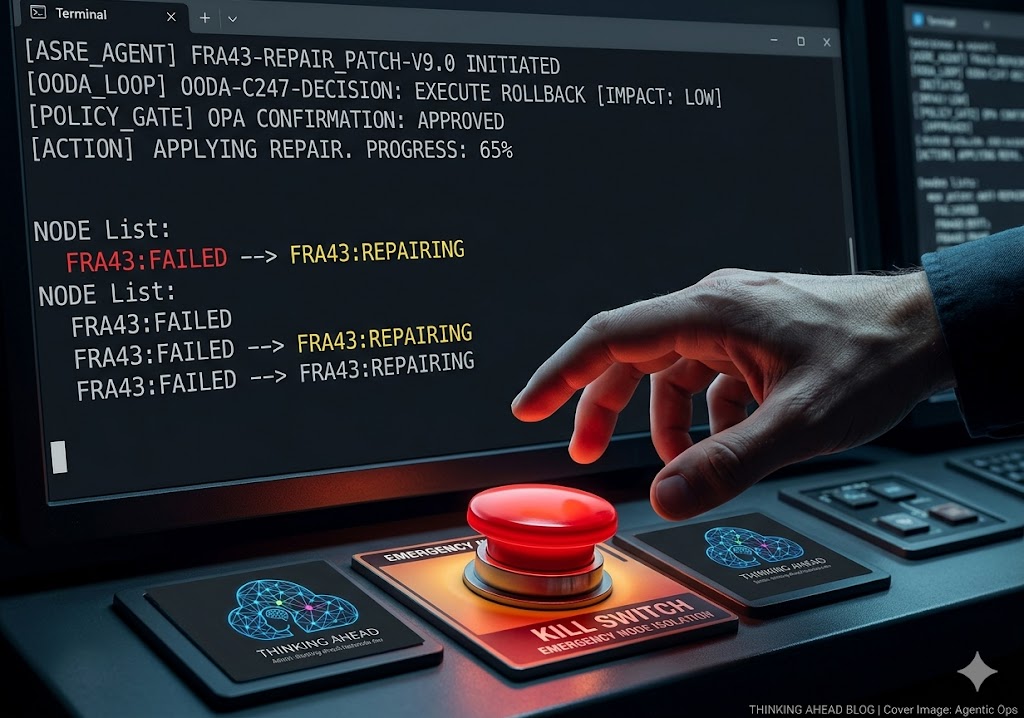
The Monitoring Trap
We’ve spent the last decade building “perfect” dashboards—4K monitors filled with green lines, waiting for one to turn red so we can jump into a bridge call.
In a world of global data centers and millisecond-latency requirements, relying on a human to watch a graph is a failure of engineering. If a human has to see the problem to fix it, you’re already behind.
The trend for 2026 isn’t just AI in the IDE—it’s agentic AI in the control plane.
1. The Technical Shift: From “If This, Then That” to OODA Loops
Traditional automation is linear:
If CPU > 90%, then scale.
But infrastructure risk is rarely linear.
To build an Autonomous Site Reliability Engineer (ASRE), we need to move to a circular decision-making architecture inspired by the OODA loop (Observe, Orient, Decide, Act):
- Observe: Go beyond metrics. Ingest unstructured telemetry—logs, Slack conversations, vendor alerts, incident reports.
- Orient: Contextualize signals by correlating them with the current risk register, dependency maps, and even supply chain constraints.
- Decide: Use LLM-based reasoning to simulate potential outcomes, including evaluating the blast radius of different remediation strategies.
- Act: Execute through controlled tool calls—such as Terraform plans, Kubernetes rollouts, or automated remediation scripts.
This is not automation as a script.
This is automation as a system that thinks in context.
2. The “Safety Rail” Architecture (A Risk Perspective)
This is where most “vibe coding” approaches fall apart.
You cannot hand an LLM terminal access and hope for the best.
Production environments demand verified autonomy.
That means designing systems with guardrails that ensure actions are:
- Constrained: Limited scope of execution based on predefined policies and permissions
- Auditable: Every decision and action is logged, traceable, and explainable
- Reversible: Changes can be rolled back automatically if unintended consequences arise
- Validated: Actions are tested or simulated before execution in live environments
Autonomy without control is risk.
Control without autonomy is stagnation.
The goal is not to choose one—it’s to architect both.

3. State Management: The Secret Sauce
The hardest part of building agentic systems isn’t the LLM—it’s state.
When an agent is tasked with a long-running migration—like the multi-year transformations we see in regions such as LON01 or FRA43—it must retain context over time. It needs to remember why it made a decision three weeks ago, not just what it did.
This is where most systems break.
We are moving away from stateless functions toward durable execution engines—systems designed to persist context, track decisions, and maintain continuity across extended timelines.
This is what enables a system to think ahead.
It remembers:
the risks it has already mitigated
the trade-offs it has accepted
the vendor bottlenecks it has worked around
Without state, there is no continuity.
Without continuity, there is no real intelligence.
The Human Shift: From Builder to Orchestrator
There’s a common fear that autonomous systems will make engineers obsolete.
The reality is the opposite.
When the toil—like resolving a site capacity constraint at 2 a.m.—is handled by an agent, the role of the engineer evolves.
You stop being the mechanic.
You become the Architect of Autonomy.
Your focus shifts to:
designing the system’s decision boundaries
defining risk tolerance and escalation paths
orchestrating how intelligence flows across the stack
The goal is not to remove the human.
The goal is to augment the human with systems that can operate at the speed and scale of the cloud.
Because the cloud doesn’t wait.
And neither should your ability to respond to it.
AI adoption in operations faces a critical gap between ambition and reality. While companies promise AI-driven transformation, the reality reveals faster automation without deeper understanding, creating hidden fragility and decision paralysis rather than genuine improvement.
Your “AI Transformation” Is Mostly Theater- And Supply Chains Are Paying the Price
Why AI-Driven Operations Are Creating Faster Systems with Slower Correction Loops
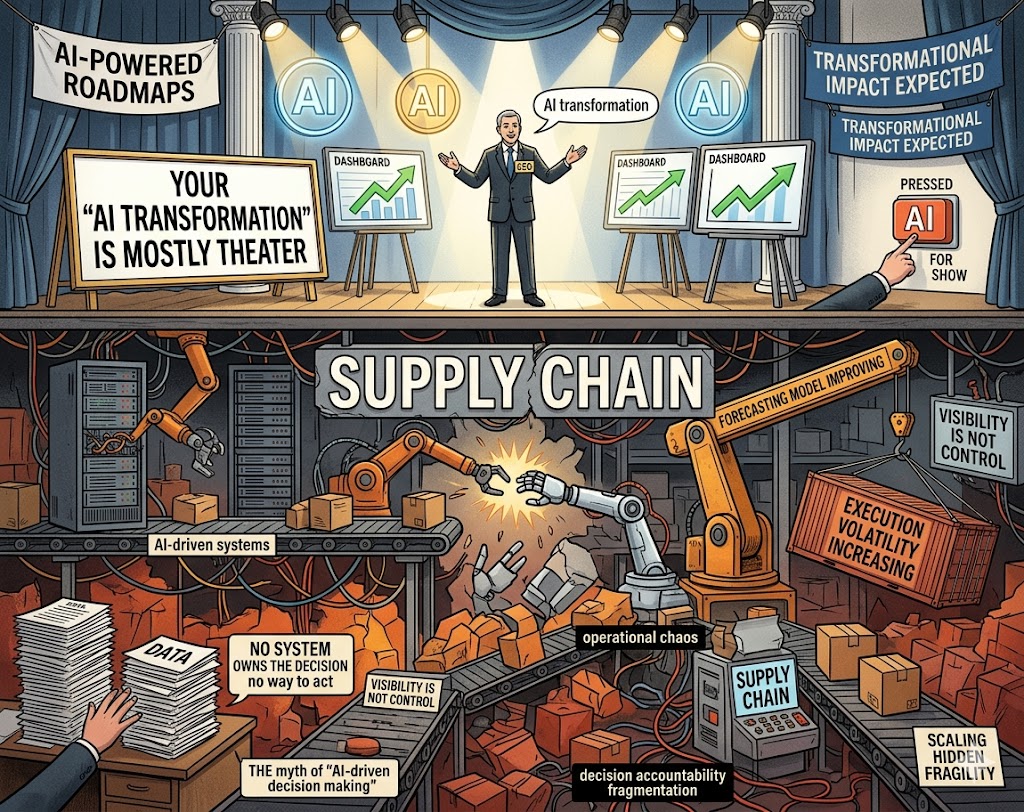
We’ve entered a strange phase of the AI era.
Every company is “AI-powered.” Every roadmap is “AI-first.” Every executive deck includes a slide that says “transformational impact expected.”
But if you look closely at how real systems behave—supply chains, infrastructure networks, data centers, procurement pipelines—a very different story is unfolding:
We are automating decisions faster than we understand the systems we’re breaking.
And the gap between AI ambition and operational reality is widening.
1. The myth of “AI-driven decision-making”
The dominant narrative suggests:
AI will make decisions faster, better, and cheaper than humans.
But in real-world operations—especially in infrastructure-heavy environments like supply chains and data centers—this assumption quickly breaks down.
Why?
Because most systems are not decision problems.
They are constraint problems with incomplete data, delayed feedback loops, and layered organizational ownership.
AI does not remove that complexity. It compresses it.
And compression without understanding produces blind spots—not clarity.
2. The uncomfortable truth: we are scaling hidden fragility
Here is what most dashboards don’t show:
- Forecasting models are improving, but execution volatility is increasing
- Risk signals are detected earlier, but mitigation ownership is slower
- Automation is increasing throughput, but reducing interpretability
- Optimization is happening locally, while fragility is increasing globally
In other words:
We are making systems look more efficient while making them harder to repair.
This is not transformation.
This is opacity at scale.
3. The supply chain illusion: “visibility” is not control
One of the most repeated phrases in operations today is end-to-end visibility.
But visibility is not control.
You can see everything:
- delays
- risks
- dependencies
- constraints
And still be unable to act effectively.
Why?
Because modern supply chains suffer from a silent failure mode:
Too many systems know the truth, but no system owns the decision.
This is where most AI initiatives quietly fail—not in model accuracy, but in fragmented decision accountability.
4. The real bottleneck is not data—it is ownership
There is a growing belief that better data leads to better decisions.
In reality:
Better data without clearer ownership leads to slower decisions.
Because every additional signal introduces:
- more stakeholders
- more validation loops
- more governance layers
- more “alignment” meetings
So instead of accelerating execution, AI often introduces a new layer:
Decision paralysis disguised as intelligence.
5. The contrarian take: we don’t need more AI—we need fewer decision points
This is where most transformation programs become uncomfortable.
The default response to complexity is:
- more models
- more dashboards
- more alerts
- more prediction layers
But the real leverage is the opposite.
High-performing operational systems don’t scale intelligence.
They remove unnecessary decision points.
They:
- collapse handoffs
- pre-authorize decisions
- hard-code thresholds
- clarify ownership
- reduce optionality in execution paths
That is what actually makes systems faster.
Not AI.
6. The real future: AI as constraint manager, not decision-maker
The next evolution of AI in operations will not be autonomous decision-making.
It will be constraint orchestration—not decision replacement.
AI will not decide what to do.
Instead, it will:
- surface constraint conflicts earlier
- simulate downstream impact faster
- expose hidden system coupling
- rank risk under competing priorities
But humans (or governance structures) will still own:
- tradeoffs
- prioritization
- accountability
Because those are not computational problems.
They are organizational contracts.
Final thought
The biggest misconception in today’s AI narrative is that we are building smarter systems.
We are not.
We are building faster systems with slower correction loops.
And until that imbalance is addressed, “AI transformation” will remain what it largely is today:
A powerful story.
With uneven reality underneath.
A critical examination of why traditional personal finance advice fails. This article exposes the structural flaws in modern economies that keep most people stuck, revealing how systemic design—not personal discipline—is the real barrier to financial stability.
You’re Not “Bad With Money”- The System Is Quietly Making You Poor
Why Personal Finance Advice Is Missing the Real Problem

For years, we’ve been told the same story:
Budget better.
Spend less.
Invest early.
Skip the latte.
It’s clean. It’s simple. And it’s mostly wrong.
Because the biggest financial problem today isn’t poor personal discipline.
It’s that the modern economy is structurally designed to keep most people stuck.
And deep down, people are starting to realize it.
The Lie of “Personal Finance”
Scroll through any financial content today and you’ll see the same advice recycled:
- Cut expenses
- Build an emergency fund
- Invest in index funds
None of it is wrong.
But here’s what’s missing:
It assumes you have surplus money to begin with.
Globally, the number one issue people care about right now is the economy and cost of living.
Not investing.
Not wealth building.
Just… survival.
When your rent, groceries, childcare, and healthcare are all rising faster than your income, “budget better” becomes meaningless advice.
Jobs Exist. Good Jobs Don’t.
We keep hearing that unemployment is low.
But that statistic hides the real crisis:
- Entry-level jobs are disappearing
- Stable careers are turning into contract work
- Salaries are not keeping up with inflation
Even global data shows people aren’t just worried about jobs—they’re worried about the quality of jobs.
In other words:
Working harder no longer guarantees stability.
That’s new.
And it’s dangerous.
The System Rewards Survival, Not Progress
Here’s the part no one likes to say out loud:
Most people aren’t failing financially. They’re operating exactly as the system is designed.
Think about it:
- You earn → you spend → you stay dependent
- You take loans → you pay interest → you stay locked in
- You chase promotions → but costs rise with you
This isn’t accidental.
It’s a loop.
And the loop is profitable.
Debt Is No Longer a Phase. It’s a Business Model.
Debt used to be temporary.
Now it’s permanent.
- Student loans stretch for decades
- Credit cards normalize revolving balances
- “Buy now, pay later” makes consumption frictionless
The goal isn’t necessarily to help you get ahead.
The goal is to keep you just solvent enough to keep paying.
Productivity Is Up. Your Life Isn’t.
This is the most frustrating contradiction of all:
We are more productive than any generation before us.
- Faster tools
- Better systems
- Higher output
Yet somehow:
- People feel poorer
- Time feels scarcer
- Stress is higher
If productivity increases but quality of life doesn’t…
Who is capturing the benefit?
The Most Dangerous Myth: “It Will Get Better If You Try Harder”
This is where the narrative becomes harmful.
Because it shifts a structural problem into a personal failure.
If you’re struggling, the system tells you:
- You didn’t try hard enough
- You didn’t optimize enough
- You didn’t sacrifice enough
But what if the game itself has changed?
What if:
- Stability is no longer the default outcome of hard work
- Upward mobility is slowing down
- And “doing everything right” still isn’t enough
The Real Problem No One Wants to Admit
We don’t have a knowledge gap.
We don’t have a discipline gap.
We have a system design problem.
- Wages are disconnected from living costs
- Essential services are increasingly unaffordable
- Economic growth is not translating into individual security
Even global risk reports point to rising instability, distrust, and economic pressure shaping people’s lives right now.
So What Now?
This isn’t a “give up” message.
But it is a wake-up call:
Stop internalizing systemic problems as personal failures.
Because the moment you believe:
“I’m just bad with money,”
you stop questioning the system that benefits from you believing that.
Final Thought
The uncomfortable truth is this:
Most people aren’t one budgeting hack away from financial freedom.
They’re navigating an economic environment that has quietly shifted against them.
And until we start talking about that honestly…
We’ll keep solving the wrong problem.
Join Influential Women and start making an impact. Register now.