Why “Data-Driven” Companies Still Make Bad Decisions
The real competitive advantage isn't data—it's the ability to decide and act faster than your competition.

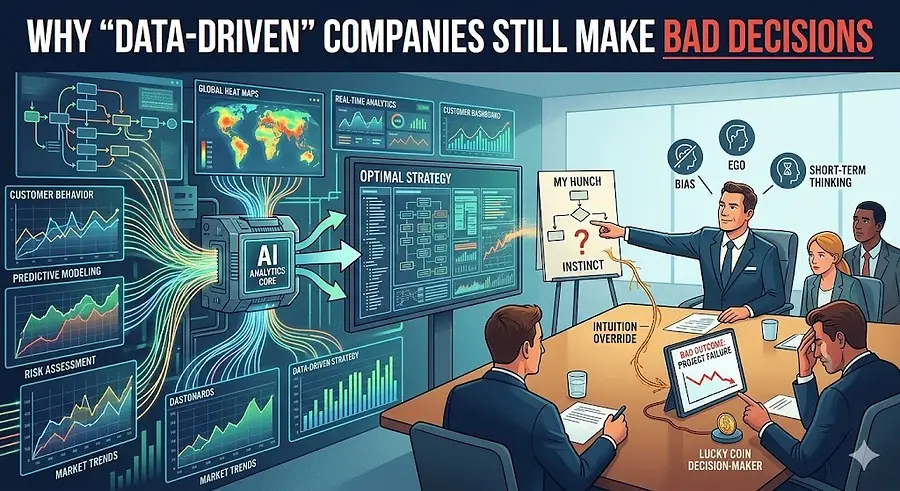
We live in a world obsessed with data.
Dashboards. Metrics. Reports. Real-time tracking.
Every organization claims to be “data-driven.”
But after working across supply chain, cloud infrastructure, and enterprise risk systems, I’ve come to a different conclusion:
Most organizations don’t have a data problem.
They have a decision problem.
The Illusion of Being Data-Driven
In many systems, data is everywhere—but clarity is not.
I’ve seen teams track hundreds of metrics, yet struggle to answer simple questions like:
- What actually matters right now?
- Where should we focus?
- What decision needs to be made today?
Instead of enabling action, data often creates noise.
More dashboards don’t necessarily lead to better outcomes.
Sometimes, they simply create the illusion of control.
I’ve Seen This Pattern Everywhere
In supply chain, we had detailed forecasts, inventory models, and execution plans.
In cloud infrastructure, we had capacity signals, delivery timelines, and performance tracking.
In risk systems, we had structured logs, classifications, and reporting frameworks.
And yet, across all of these:
The biggest challenges didn’t come from missing data.
They came from delayed or unclear decisions.
The Real Problem: Late Interpretation
The issue is not data availability.
It’s timing.
By the time most organizations interpret signals clearly enough to act, the impact has already begun.
A demand signal becomes a supply gap.
A delay becomes a missed milestone.
A risk becomes an escalation.
And then we respond—quickly, urgently, reactively.
But by then, we’re already behind.
Why This Keeps Happening
Because most systems are designed to track outcomes, not enable decisions.
They tell you:
- What happened
- What is happening
But very few are designed to tell you:
- What is about to happen
- What you should do next
That gap is where most inefficiencies—and missed opportunities—live.
What Needs to Change
If we want to build truly effective organizations, we need to rethink how we design systems—not around data collection, but around decision-making.
This means:
- Focusing on fewer, more meaningful signals
- Connecting insights across teams instead of isolating them
- Prioritizing early visibility over perfect accuracy
- Designing systems that guide action, not just reporting
In my current work on enterprise risk intelligence, this shift is already showing impact—improving visibility, strengthening prioritization, and reducing effort across large-scale programs.
More importantly, it is changing how teams think.
The Uncomfortable Truth
Here’s the part we don’t say often enough:
Data doesn’t make organizations smarter.
Better decisions do.
And better decisions don’t come from more information.
They come from:
- Clarity
- Timing
- The ability to focus on what truly matters
Closing Thought
We don’t need more dashboards.
We don’t need more reports.
We don’t even need more data.
What we need are systems that help us decide earlier and act with confidence.
Because in complex environments, the advantage doesn’t go to the organization with the most data.
It goes to the one that knows what to do with it—before it’s too late.


