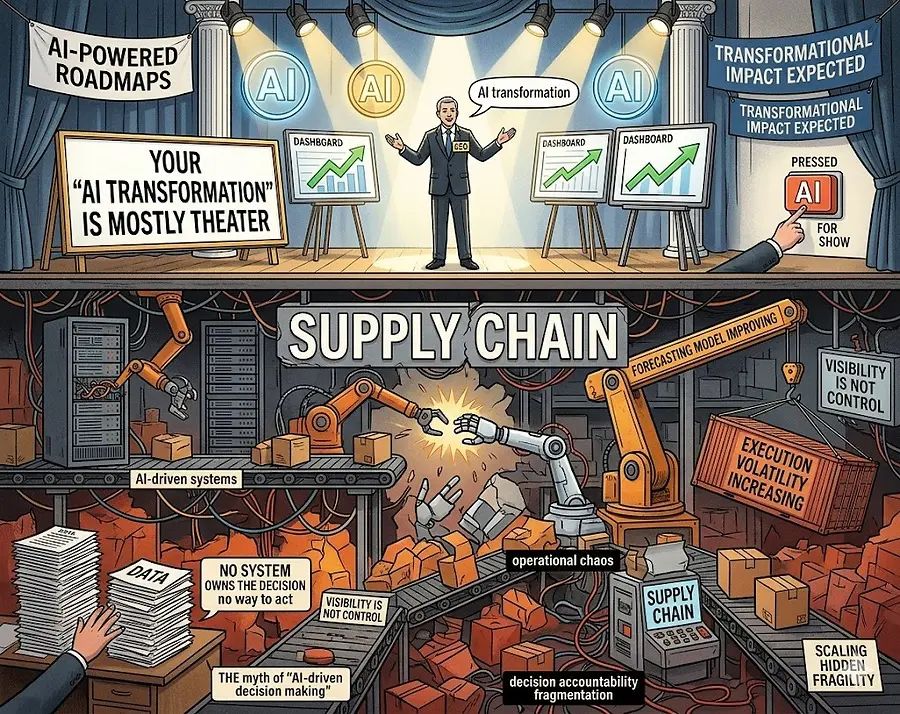
Your “AI Transformation” Is Mostly Theater- And Supply Chains Are Paying the Price
Why AI-Driven Operations Are Creating Faster Systems with Slower Correction Loops

We’ve entered a strange phase of the AI era.
Every company is “AI-powered.” Every roadmap is “AI-first.” Every executive deck includes a slide that says “transformational impact expected.”
But if you look closely at how real systems behave—supply chains, infrastructure networks, data centers, procurement pipelines—a very different story is unfolding:
We are automating decisions faster than we understand the systems we’re breaking.
And the gap between AI ambition and operational reality is widening.
1. The myth of “AI-driven decision-making”
The dominant narrative suggests:
AI will make decisions faster, better, and cheaper than humans.
But in real-world operations—especially in infrastructure-heavy environments like supply chains and data centers—this assumption quickly breaks down.
Why?
Because most systems are not decision problems.
They are constraint problems with incomplete data, delayed feedback loops, and layered organizational ownership.
AI does not remove that complexity. It compresses it.
And compression without understanding produces blind spots—not clarity.
2. The uncomfortable truth: we are scaling hidden fragility
Here is what most dashboards don’t show:
- Forecasting models are improving, but execution volatility is increasing
- Risk signals are detected earlier, but mitigation ownership is slower
- Automation is increasing throughput, but reducing interpretability
- Optimization is happening locally, while fragility is increasing globally
In other words:
We are making systems look more efficient while making them harder to repair.
This is not transformation.
This is opacity at scale.
3. The supply chain illusion: “visibility” is not control
One of the most repeated phrases in operations today is end-to-end visibility.
But visibility is not control.
You can see everything:
- delays
- risks
- dependencies
- constraints
And still be unable to act effectively.
Why?
Because modern supply chains suffer from a silent failure mode:
Too many systems know the truth, but no system owns the decision.
This is where most AI initiatives quietly fail—not in model accuracy, but in fragmented decision accountability.
4. The real bottleneck is not data—it is ownership
There is a growing belief that better data leads to better decisions.
In reality:
Better data without clearer ownership leads to slower decisions.
Because every additional signal introduces:
- more stakeholders
- more validation loops
- more governance layers
- more “alignment” meetings
So instead of accelerating execution, AI often introduces a new layer:
Decision paralysis disguised as intelligence.
5. The contrarian take: we don’t need more AI—we need fewer decision points
This is where most transformation programs become uncomfortable.
The default response to complexity is:
- more models
- more dashboards
- more alerts
- more prediction layers
But the real leverage is the opposite.
High-performing operational systems don’t scale intelligence.
They remove unnecessary decision points.
They:
- collapse handoffs
- pre-authorize decisions
- hard-code thresholds
- clarify ownership
- reduce optionality in execution paths
That is what actually makes systems faster.
Not AI.
6. The real future: AI as constraint manager, not decision-maker
The next evolution of AI in operations will not be autonomous decision-making.
It will be constraint orchestration—not decision replacement.
AI will not decide what to do.
Instead, it will:
- surface constraint conflicts earlier
- simulate downstream impact faster
- expose hidden system coupling
- rank risk under competing priorities
But humans (or governance structures) will still own:
- tradeoffs
- prioritization
- accountability
Because those are not computational problems.
They are organizational contracts.
Final thought
The biggest misconception in today’s AI narrative is that we are building smarter systems.
We are not.
We are building faster systems with slower correction loops.
And until that imbalance is addressed, “AI transformation” will remain what it largely is today:
A powerful story.
With uneven reality underneath.


