The Death of the Dashboard: Engineering Agentic Systems for Autonomous Cloud Operations
From Dashboard Watchers to Autonomous Decision-Makers: Why 2026 Belongs to Agentic AI

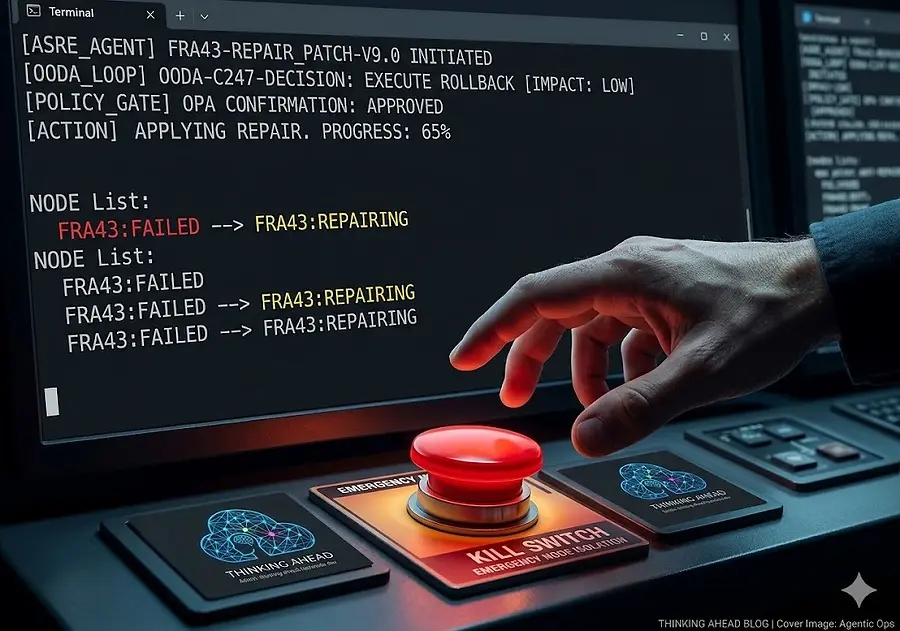
The Monitoring Trap
We’ve spent the last decade building “perfect” dashboards—4K monitors filled with green lines, waiting for one to turn red so we can jump into a bridge call.
In a world of global data centers and millisecond-latency requirements, relying on a human to watch a graph is a failure of engineering. If a human has to see the problem to fix it, you’re already behind.
The trend for 2026 isn’t just AI in the IDE—it’s agentic AI in the control plane.
1. The Technical Shift: From “If This, Then That” to OODA Loops
Traditional automation is linear:
If CPU > 90%, then scale.
But infrastructure risk is rarely linear.
To build an Autonomous Site Reliability Engineer (ASRE), we need to move to a circular decision-making architecture inspired by the OODA loop (Observe, Orient, Decide, Act):
- Observe: Go beyond metrics. Ingest unstructured telemetry—logs, Slack conversations, vendor alerts, incident reports.
- Orient: Contextualize signals by correlating them with the current risk register, dependency maps, and even supply chain constraints.
- Decide: Use LLM-based reasoning to simulate potential outcomes, including evaluating the blast radius of different remediation strategies.
- Act: Execute through controlled tool calls—such as Terraform plans, Kubernetes rollouts, or automated remediation scripts.
This is not automation as a script.
This is automation as a system that thinks in context.
2. The “Safety Rail” Architecture (A Risk Perspective)
This is where most “vibe coding” approaches fall apart.
You cannot hand an LLM terminal access and hope for the best.
Production environments demand verified autonomy.
That means designing systems with guardrails that ensure actions are:
- Constrained: Limited scope of execution based on predefined policies and permissions
- Auditable: Every decision and action is logged, traceable, and explainable
- Reversible: Changes can be rolled back automatically if unintended consequences arise
- Validated: Actions are tested or simulated before execution in live environments
Autonomy without control is risk.
Control without autonomy is stagnation.
The goal is not to choose one—it’s to architect both.

3. State Management: The Secret Sauce
The hardest part of building agentic systems isn’t the LLM—it’s state.
When an agent is tasked with a long-running migration—like the multi-year transformations we see in regions such as LON01 or FRA43—it must retain context over time. It needs to remember why it made a decision three weeks ago, not just what it did.
This is where most systems break.
We are moving away from stateless functions toward durable execution engines—systems designed to persist context, track decisions, and maintain continuity across extended timelines.
This is what enables a system to think ahead.
It remembers:
the risks it has already mitigated
the trade-offs it has accepted
the vendor bottlenecks it has worked around
Without state, there is no continuity.
Without continuity, there is no real intelligence.
The Human Shift: From Builder to Orchestrator
There’s a common fear that autonomous systems will make engineers obsolete.
The reality is the opposite.
When the toil—like resolving a site capacity constraint at 2 a.m.—is handled by an agent, the role of the engineer evolves.
You stop being the mechanic.
You become the Architect of Autonomy.
Your focus shifts to:
designing the system’s decision boundaries
defining risk tolerance and escalation paths
orchestrating how intelligence flows across the stack
The goal is not to remove the human.
The goal is to augment the human with systems that can operate at the speed and scale of the cloud.
Because the cloud doesn’t wait.
And neither should your ability to respond to it.


