2026: A Turning Point for Climate, Energy, and the Future We Choose
Why nuclear energy is essential to solving the climate crisis in 2026 and beyond.

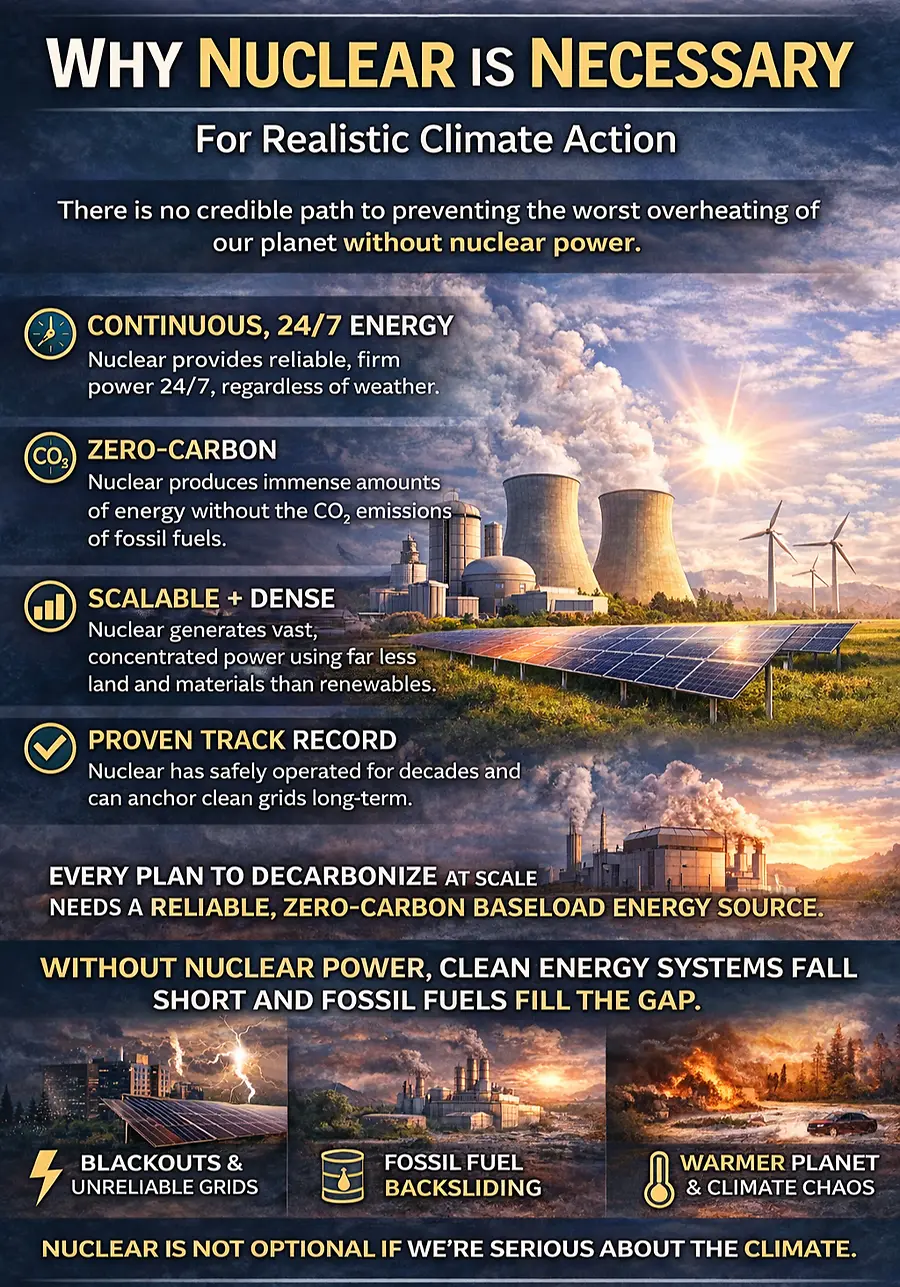
As we step into 2026, the world finds itself at a genuine inflection point. The climate crisis is no longer a distant forecast — it is the lived reality of rising seas, intensifying storms and wildfires, record-breaking heat waves, and electricity systems stretched to their limits. Yet 2026 also brings something we have not always had in abundance: clarity.
We now understand, with remarkable precision, what is driving global warming, what is failing to slow it, and — most importantly — what can still work if we act with urgency, realism, and courage.
The Reality Check: Climate Goals vs. Energy Demand
Global electricity demand is accelerating faster than nearly all previous projections. Electrification of transportation, heating, and industry — combined with the explosive growth of artificial intelligence and data centers — is reshaping energy needs worldwide. By mid-decade, electricity demand growth is outpacing the buildout of reliable, low-carbon supply.
At the same time, climate targets — while necessary and well-intentioned — continue to collide with physical and economic constraints. Wind and solar are growing rapidly, but their intermittency means they cannot power modern economies on their own. Large-scale battery storage, often portrayed as a silver bullet, remains limited by duration, cost, materials, and scalability.
This growing gap between climate ambition and energy reality is not a failure of values. It is a failure of energy honesty.
Why Fossil Fuels Are Heating Our World
The primary driver of global warming is neither complex nor controversial within the scientific community. It is the widespread combustion of fossil fuels — coal, oil, and natural gas — that has powered industrial growth for more than a century.
When burned, fossil fuels release carbon dioxide and other greenhouse gases that trap heat in Earth’s atmosphere, preventing it from escaping back into space. This heat buildup disrupts climate systems, intensifies extreme weather, raises sea levels, and destabilizes ecosystems on which human civilization depends.
What makes fossil fuels particularly dangerous is not only the volume of emissions, but their longevity. Carbon dioxide persists in the atmosphere for centuries, meaning today’s emissions lock in future warming. Even “cleaner-burning” fossil fuels remain incompatible with climate stability. As long as we rely on combustion to meet growing energy demand, global temperatures will continue to rise.
The Good News: Nuclear Energy Changes the Equation
Here is where 2026 looks different — and better.
Nuclear energy breaks the fossil-fuel cycle entirely. It produces electricity without combustion, and therefore without releasing carbon dioxide during operation. Over its full lifecycle — from construction and fuel production to decommissioning — nuclear power’s carbon footprint rivals wind and is lower than solar, while delivering dependable power around the clock.
Just as important is safety. Decades of global data show that nuclear energy is among the safest forms of electricity ever produced when measured by deaths per unit of power generated. Modern reactors are built with multiple layers of engineered and physical safety systems, and advanced designs incorporate passive safety features that rely on fundamental physics — not human intervention or external power — to remain stable under extreme conditions.
Public fear of nuclear energy has long been shaped by rare, high-profile accidents, while the routine and deadly toll of fossil fuels — air pollution, mining accidents, and climate impacts — has been largely normalized. The evidence, however, tells a very different story.
A Scalable Climate Solution We Cannot Afford to Ignore
What truly distinguishes nuclear energy is its ability to scale at the speed and magnitude climate action demands. Climate change is not a marginal problem — it is a systems problem. We must replace vast amounts of fossil-fuel generation while meeting rising demand from electrification, digital infrastructure, and economic growth.
Nuclear energy is one of the few clean technologies capable of delivering large quantities of reliable, carbon-free power day and night, in every season, without vast land use or dependence on weather. This is why nuclear power is increasingly recognized not as a competitor to renewables, but as their essential partner.
Investment Is Following the Physics
Capital flows are reinforcing this reality. Clean energy investment now rivals — and in some regions surpasses — fossil-fuel spending. Within that shift, nuclear energy is attracting renewed attention from governments, utilities, and investors who understand that reliability matters just as much as emissions reductions.
In 2026, we are likely to see continued momentum in life-extension projects for existing reactors, early deployments of advanced and small modular reactors, and broader recognition that energy security and climate security are inseparable.
This is not ideology. It is systems thinking.
A Reason for Hope — Grounded in Reality
Hope divorced from facts is fragile. But hope grounded in science, engineering, and experience is resilient.
The outlook for 2026 is not one of easy fixes or instant victories. Climate change remains the defining challenge of our time. But we are finally having more honest conversations — about scale, timelines, trade-offs, and what it truly takes to power a modern world without destroying the planet that sustains us.
We know what works.
We know what doesn’t.
And we still have time — if we choose wisely.
For readers who want a deeper, science-based exploration of why nuclear energy must be part of the climate solution, my award-winning book ATOMIC GREEN: Nuclear Power Can Stop Climate Change lays out the science, the myths, and the path forward in clear, accessible terms. It is written for concerned citizens, policymakers, parents, and anyone invested in the future we will be leaving behind.
2026 can be remembered as the year we stopped arguing about preferences — and started acting on reality.
The window is still open.
The tools are in our hands.
The choice is ours.