A Team Building Activity in Corporate Settings by Diana Suskind, Ed.D. and Burc Oral Ph.D.
Unlocking Creativity and Connection Through Nature's Simple Elements

Stonework Play©
A Team-Building Activity in Corporate Settings
Diana Suskind, Ed.D., and Burc Oral, Ph.D.
“Stonework Play© is an open invitation
to work with stones…
Its intent is to respond to nature’s power
to enrich the human imagination.
Stones are a kinesthetic medium,
never fixed in their place or meaning,
the ground an endless canvas,
and hands the brushes that move them.”
Background
Stonework Play© was originally developed by Diana Suskind, Ed.D., in response to a request to enrich school curriculum in underserved communities abroad. It has been used with toddlers through adults, adapted for hospital and disaster relief settings, presented publicly in bookshops, libraries, temples, and nursing homes, used as an icebreaker for immigrants, and later adopted as a team-building activity in corporate settings by Burc Oral, Ph.D.
Specifically, it was used in cross-functional team events between Staples and Xerox. These venues were all foreseen in the book Stonework Play: A Guide to Inspire Creativity and Storytelling Through Nature (Suskind, D., & Crandall, L., 2017).
All quotes and photos referenced here are from this book, which may be purchased at:
https://www.stoneworkplay.com/buy-book
You may also inquire with your Stonework Play© Activity Facilitator, who may have copies available.
Purpose
The Stonework Play© Team-Building Activity offers a safe and stimulating medium for team members to learn more about one another beyond the confines of daily work routines and defined roles. It creates opportunities to establish deeper relationships and fosters greater appreciation among colleagues.
Approach
Most team-building activities require collaboration among participants toward solving a problem or achieving a shared outcome. In Stonework Play©, however, each participant works alone, contemplatively, expressing themselves first. Only afterward do they share their experience through visual and narrative storytelling.
Ultimately, colleagues learn more about one another in meaningful — and often dramatic — ways.
Stones are the primary tool. Being elements of nature, they are intrinsically both stimulating and soothing. They are endlessly varied, much like the individuals who use them.
Unlike Lego blocks, stones do not interlock with precision. Their edges are discrete and irregular. This makes them both more challenging and more forgiving. The spaces between them invite imagination and creativity, eventually generating a shared space for unity among individuals.
“The benefits of physically engaging with the real, natural world are significant.”
Process
The simple earth element of stones is used to convey a story through four embodiments:
- A physical representation
- An abstract illustration
- A written artifact
- An oration chosen for sharing
The story becomes the medium for discovering new dimensions of each team member. Like fissures in stones, opportunities emerge to recognize and appreciate one another more deeply.
There is no set topic or theme. It is important that each participant chooses their own story so that inspiration — even awe — may manifest.
Tools
- Stones: Various kinds, sizes, colors, and shapes. Sharp edges should be avoided for safety. An assortment is generally provided by the Stonework Play© Facilitator at a selection station. Alternatively, stones may be collected from nature as an expanded activity. (Stones may both be provided and brought by participants.)
- One piece of plain paper and pencil per participant (for Step III)
- One piece of lined paper and pencil per participant (for Step IV)
Setup
Provide a station for each participant where they can comfortably work with stones. These spaces should be flat and unpatterned; circumscribing them with a stable mat is an added benefit. Allocate a minimum area of 4' x 4' per station.
Ground-level setups are preferable, as they allow easy expansion into the space and closeness to nature when outdoors. Alternatively, conference room tables may be used, provided there is ample room for independent and uninterrupted work.
Spreading out and having larger personal space promotes focus and ensures deeper engagement. The entire activity typically takes 2–3 hours or longer.
Instructions
There are five steps in the Stonework Play© Team-Building Activity:
I. Gathering: Collect stones
II. Constructing: Arrange stones to depict a story
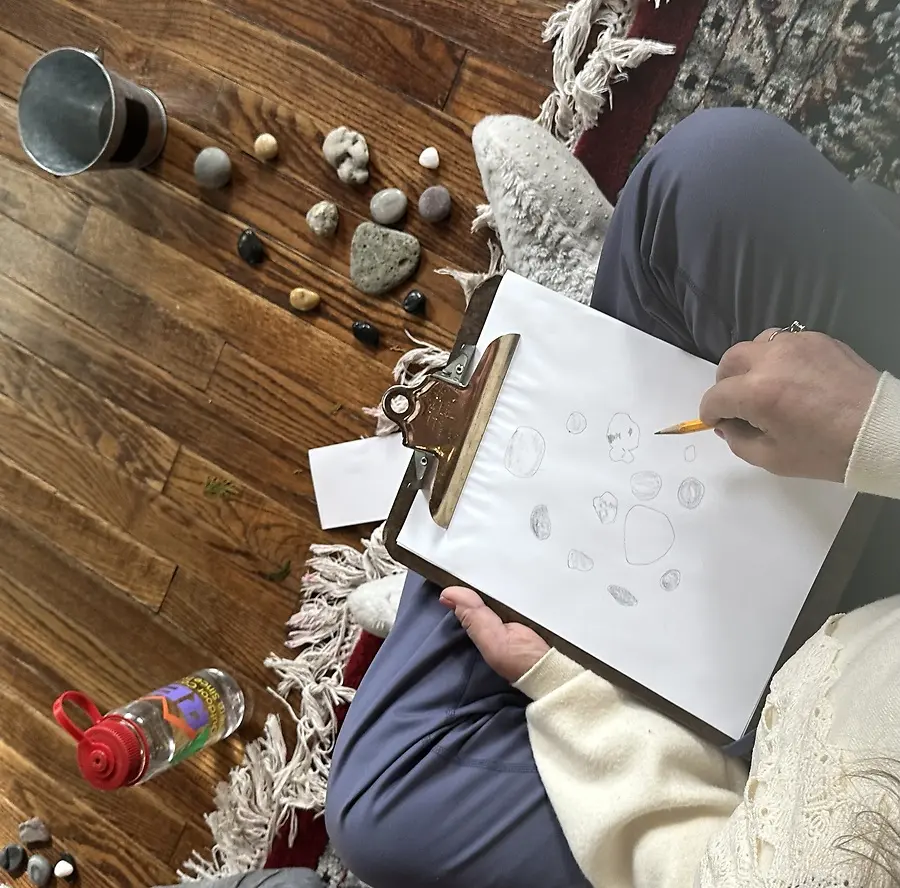
III. Rendering: Draw a picture of the stone construction
IV. Narrating: Write the story in words
V. Sharing: Tell the story to the group
Instructions should be clear and adhere to the Stonework Play© structure. It is essential that the Activity Facilitator complete a trial run of all five steps before leading a group to ensure a smooth and enjoyable experience.
Step I: Gathering
Participants are guided to the selection station to collect stones. They are free to select stones at their leisure, with ample opportunity to hold, feel, and examine them closely.
Unhurried time — or “Tarry Time” — is essential to the Stonework Play© experience. This step may take 5–15 minutes or longer.
“Tarry Time,” coined by Dr. Suskind, refers to the silence between interactions:
“This silent space is fertile ground for creativity, and Stonework Play© categorically facilitates it… (it) is well known to be inspired by nature.”
Step II: Constructing
Participants create a visual representation of a story using their chosen stones. As each stone is placed creatively, its discrete form merges into a unified display.
The simple, natural beauty of stones ignites imagination — an effect they have had on humans since Stonehenge.
Participants may return for additional stones if needed. There is no rush. Moving or adding stones may enhance the evolving story. This step is completed in solitude, without outside input, to preserve immersion.
Time: 15–20 minutes or longer.
Step III: Rendering
Participants draw their stone construction on paper. Shading and detail add further dimension to the story.
Stones are then returned to their source as a symbol of impermanence, while the drawing becomes the more permanent documentation of the experience.
Time: 15–20 minutes or longer.
Step IV: Narrating
Participants express their visualization in descriptive written form, including a title.
Writing challenges them to organize and clarify their thoughts and determine how they wish to share their experience with the group.
Time: 15–20 minutes or longer.
Step V: Sharing
This final step is conducted as a group activity. The facilitator guides participants to visit each individual’s station in succession.
One participant at a time shares the story embodied in their stones. This is conducted as a “Museum Walk-and-Talk,” as described in the book. Participants observe each display and listen as if visiting an exhibit.
This is the moment of awe.
The variety of expression among participants — all working with the same natural medium — is remarkable. Questions are encouraged, and discussion often develops as participants experience a “…widening exposure to the breadth of creativity.”
Time: 5–10 minutes or more per participant.