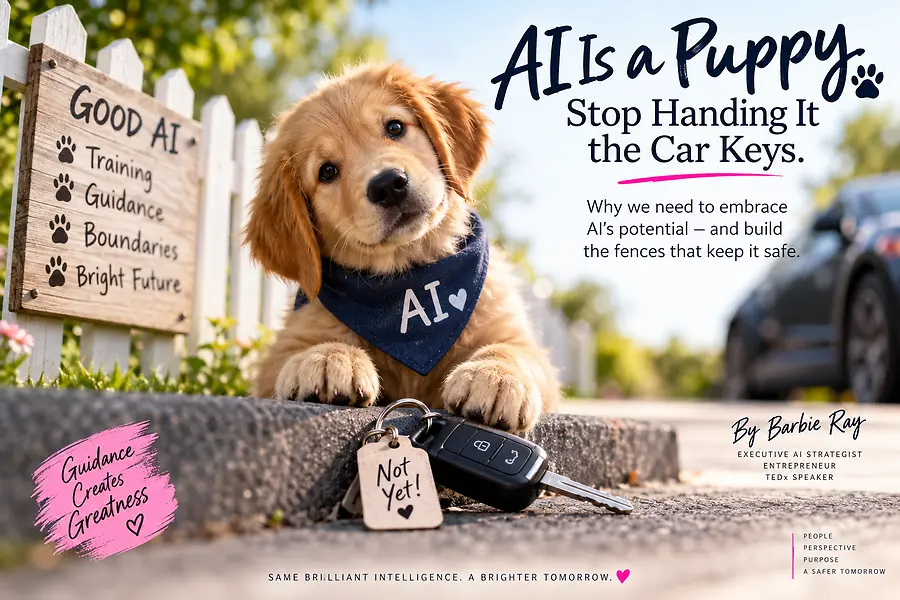
AI Is a Puppy. Stop Handing It the Car Keys.
Why AI governance matters more than raw capability—and how leaders can build responsible guardrails for powerful technology.

I think I had my first troll.
I realize this is not traditionally considered a professional milestone, but apparently, I have arrived.
The post was about my TEDx talk and the role human adaptability plays in the age of Artificial Intelligence. Based on the comments, I was fairly certain this gentleman had not actually watched the talk.
But he had opinions. Lots of opinions.
And apparently, because I teach Artificial Intelligence, I had somehow become personally responsible for everything AI has ever done, might someday do, or is currently plotting in a server farm somewhere.
For the record, I did not invent AI. I don't own AI. I'm not even its publicist.
I tried to thank him for his comments and start a conversation. After his third statement, I realized we weren't having a conversation. He wanted to tell me why I was wrong.
Epic fail.
But the exchange made something very clear to me.
We desperately need to have these conversations.
Not arguments.
Not fearmongering.
Not blind enthusiasm.
Conversations.
Because I understand the frustration surrounding Artificial Intelligence.
AI is here, and businesses that refuse to understand it risk falling behind those learning how to use it effectively. I spend much of my professional life helping leaders understand how to work with AI as a strategic thinking partner, rather than treating it as either a novelty or a replacement for human intelligence.
But there's another side to that conversation that is equally important.
If we blindly embrace this technology without questioning where it's going, what we're giving it access to, what decisions we're letting it influence, and where humans need to remain firmly in control, we could create problems we never intended.
And that doesn't mean AI is evil.
It means AI is powerful.
There is a difference.
AI Is Like a Puppy
When I teach Artificial Intelligence, I often compare it to a puppy.
A puppy can be smart. It can learn astonishingly quickly. It watches what you do. It recognizes patterns. It figures out which behaviors get rewarded. And sometimes it eats the couch.
Not because the puppy has developed an elaborate vendetta against Ethan Allen.
It simply hasn't learned the boundaries yet.
That's why responsible puppy owners provide training, guidance, and fences.
AI needs fences, too. Those fences are governance.
They are the rules organizations establish around what information AI can access, what it can do with that information, where it can be used, what decisions require human oversight, and who is ultimately accountable for the outcome.
The more capable AI becomes, the more important those fences become.
Yet much of the conversation around Artificial Intelligence still seems obsessed with one question:
How powerful can we make it?
I think leaders need to be asking another question at exactly the same time:
What should we allow it to do?
Those are not the same question.
Capability Is Not Permission
Human beings understand this concept everywhere else.
We don't hand a six-year-old the keys to the family car and say, "You're incredibly smart. Go see what you can discover today."
The child may be brilliant.
The car may have incredible technology.
Neither of those things makes handing over the keys a good idea.
We create boundaries based not only on capability, but on judgment, experience, risk, and consequence.
AI deserves the same scrutiny.
As AI systems become increasingly capable of analyzing information, identifying vulnerabilities, generating code, recommending actions, and interacting with other technologies, organizations need to think carefully about access and authority.
What happens when an AI system can perform an action but shouldn't?
Who establishes that boundary?
Who monitors it?
Who takes responsibility when something goes wrong?
And perhaps most importantly:
Are we asking those questions before we deploy the technology—or after something happens?
That isn't anti-AI.
That's leadership.
The Two Extremes Aren't Helping Us
One of the biggest problems in today's AI conversation is that we keep drifting toward extremes.
On one side:
AI IS GOING TO DESTROY HUMANITY!
On the other:
AI IS AMAZING! PUT IT EVERYWHERE!
Neither position requires much thinking. The harder position lives somewhere in the middle.
Artificial Intelligence has extraordinary potential. It can help leaders analyze information, challenge assumptions, identify patterns, prepare decisions, streamline repetitive work, and reclaim time.
I believe businesses should be learning how to use it.
I also believe humans need to remain actively engaged in deciding how it is used.
Those ideas are not contradictory. They're responsible.
I've said many times that AI should be a thinking partner, not the thinker.
The moment we stop questioning its output because the machine sounds confident, we have surrendered something far more important than efficiency. We've surrendered judgment. And judgment is still a human responsibility.
This Is a Leadership Conversation
AI governance can sound intimidating, particularly to smaller organizations. It conjures images of enormous corporations, legal departments, cybersecurity teams, and 147-page policies nobody reads.
It doesn't have to be that complicated.
Start with basic questions.
What AI tools are we using?
What information are employees putting into them?
What information should never go into them?
Which decisions can AI assist with?
Which decisions must remain human-led?
Who is responsible for reviewing AI-generated work?
What happens when the technology gets something wrong?
Those questions aren't about slowing innovation. They're about making innovation sustainable.
A fence doesn't prevent the puppy from playing.
It prevents the puppy from running into traffic.
Maybe My Troll Had a Point
Not necessarily the point he thought he was making.
But underneath the hostility was something worth discussing.
People are nervous.
They're watching technology advance at a pace most of us have never experienced before. They're wondering what happens to their jobs, their privacy, their businesses, and their ability to control systems that are becoming increasingly capable.
Those concerns shouldn't be mocked.
They should be discussed.
And those of us excited about AI need to be just as willing to join those conversations as those who fear it.
Because the future of Artificial Intelligence shouldn't belong exclusively to the people who can build the most powerful technology.
It should belong to the leaders, employees, educators, policymakers, and ordinary human beings willing to ask:
Where should the fences be?
The next evolution of AI is more powerful and more autonomous. The time to build the fences should never be after a crisis.
So, yes.
I think I had my first troll.
I'm strangely proud.
Because he reminded me of something important.
This isn't the time to shout across the internet at one another.
It's the time to talk.
It's the time to challenge assumptions.
It's the time to embrace extraordinary technology without surrendering ordinary common sense.
We don't need to fear the puppy.
But for heaven's sake...
Stop handing it the car keys.
Barbie Ray is a TEDx Speaker, an Executive AI Strategist, entrepreneur, and creator of How to Train Your AI™, where she helps business leaders integrate Artificial Intelligence while keeping human judgment, leadership, and accountability firmly in the driver's seat.
To watch the TEDx that sparked it all, please view: https://www.youtube.com/watch?v=5Vuedk10U6c&t=1s


