AI Is Not Killing Music. It Is Forcing Record Labels to Rethink the Business of Music.
How AI is democratizing music production and reshaping the industry's infrastructure rather than replacing human creativity.

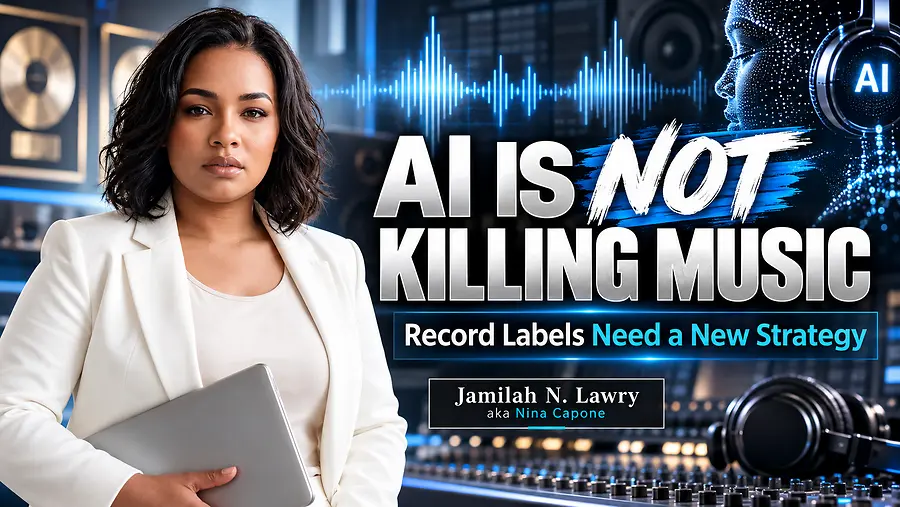
Artificial Intelligence Is Not Killing Music
It is changing who has access to the tools required to make competitive music—and that distinction matters.
As a recording artist, entrepreneur, and technology strategist, I see artificial intelligence very differently from much of the fear-based conversation surrounding it. I do not see AI as a replacement for the artist. I see it as another advancement in the technology artists use to bring what is already in their minds to life.
The bigger disruption may not be to music itself.
It may be to the infrastructure that has traditionally determined who gets to compete.
For decades, professional-quality music required access: access to expensive studios, engineers, producers, session musicians, vocal arrangers, equipment, mixing, mastering, marketing teams, distribution relationships, and capital.
Talent mattered, but access mattered too.
AI is beginning to change that equation.
AI Is Lowering the Cost of Creative Access
An independent artist with an idea can now use technology to enhance vocals, experiment with instrumentation, build arrangements, clean audio, test harmonies, generate reference tracks, improve production quality, organize creative assets, and accelerate portions of the production process.
That does not automatically make the artist talented.
It does not write their life experiences.
It does not give them stage presence.
It does not create their identity.
But it can give a talented artist who lacks a large budget access to capabilities that previously sat behind financial and industry barriers.
That is an important distinction.
We have to stop confusing access to better tools with the disappearance of human creativity.
Technology has been changing music production for decades. Drum machines changed music. Sampling changed music. Auto-Tune changed music. Digital audio workstations changed music. Home studios changed music. Streaming changed distribution.
Every technological shift created discomfort because it changed an existing workflow, business model, or power structure.
AI is simply a much larger technological shift happening much faster.
And speed is what makes it feel threatening.
The Real Question Is Not Whether AI Will Be Used
That question has already been answered.
It will be used.
The more important questions are:
- Who controls it?
- Who gets compensated?
- Who gives consent?
- How is authorship identified?
- How do we distinguish AI-assisted music from fully AI-generated music?
- How should an artist's voice, likeness, recordings, and compositions be protected?
- And how can the music industry build entirely new revenue models around the technology instead of treating every application of AI as the same thing?
Those are infrastructure questions.
And they require strategy.
The industry itself is already beginning to move in that direction. Warner Music Group has entered licensed AI partnerships with companies including Suno and Udio, with principles involving licensed models, compensation, and artist choice regarding uses of their name, image, likeness, voice, and songs.
Universal Music Group has moved aggressively into similar territory, including collaborations with Stability AI and, most recently, a September 2026 multi-year agreement with ElevenLabs to develop licensed AI music experiences and tools for artists and songwriters.
Even the three major music groups—Universal, Sony, and Warner—entered licensing agreements with KLAY around an AI music model designed to operate using licensed music.
That tells us something important.
The future is probably not music versus AI.
The emerging model is more likely to be music plus AI, with rules.
Protecting Copyright and Embracing Technology Are Not Opposites
There are legitimate concerns surrounding artificial intelligence.
Artists should have meaningful control over their voices and identities.
Copyright holders should have mechanisms for licensing and compensation.
Creators should know when and how their work is being used.
Consumers should have transparency.
The music industry's concern about models allegedly being trained on copyrighted recordings without authorization is not unreasonable. Sony, Universal, and other rights holders have pursued litigation over these questions, and significant legal issues surrounding AI training and copyright remain unresolved.
But protecting intellectual property does not require rejecting the underlying technology.
We can protect artists and innovate.
In fact, that distinction is already becoming clearer. In July 2026, music organizations including the RIAA, IFPI, A2IM, and others backed a voluntary framework distinguishing between "AI-Generated" and "AI-Assisted" recordings.
I believe that distinction is critical.
An artist using AI-assisted technology to improve a vocal arrangement is fundamentally different from someone pressing a button and generating an entire synthetic artist.
A producer using intelligent software to explore instrumentation is different from cloning another artist's voice without permission.
An engineer using AI-assisted mastering is different from training a commercial system on copyrighted catalogs without authorization.
If we treat every one of those activities as identical, we will create policies that are too blunt for the technology we are trying to govern.
Record Labels Need an AI Operating Strategy
This is where I believe labels have their largest opportunity.
The answer cannot simply be lawsuits.
It also cannot be unrestricted adoption.
Labels need an AI operating strategy.
That means creating infrastructure that determines where AI belongs throughout the organization.
Imagine AI integrated responsibly across:
- Artist development. Artists could experiment with arrangements, demos, vocal production, and creative concepts before committing major studio resources.
- Production. Producers and engineers could use AI-assisted tools for sound enhancement, restoration, stem separation, vocal processing, instrumentation concepts, mixing assistance, and workflow acceleration.
- A&R. AI can help organize enormous amounts of market information while human executives continue making the cultural and creative judgments algorithms cannot replicate.
- Catalog management. Labels sit on enormous archives of recordings, metadata, and intellectual property. Properly licensed AI could create new ways for catalogs to be discovered, experienced, and monetized.
- Marketing. Teams can use AI to analyze campaigns, develop audience variations, accelerate content production, test messaging, and identify opportunities faster.
- Localization. Technology may allow artists to reach international audiences in entirely new ways while preserving proper authorization and attribution.
- Rights management. AI itself can help identify unauthorized uses, track where material appears, and improve attribution.
- Fan experiences. Licensed remixes, interactive music, personalized experiences, and artist-approved creative environments could become entirely new product categories.
Spotify and Universal Music Group, for example, announced licensing agreements in May 2026 around a generative-AI-powered tool for authorized fan-created covers and remixes, with participating artists and songwriters sharing in the resulting value.
That is much closer to the conversation the industry should be having.
Not simply: How do we stop AI?
But: How do we build the business model around it?
AI Could Actually Expand the Talent Pipeline
There is another part of this conversation that receives far less attention.
AI may allow the industry to discover artists it previously would never have encountered.
A talented songwriter in a small apartment may not have $10,000 to properly produce a record.
A vocalist may have an incredible idea but no access to a vocal producer.
An independent rapper may understand exactly how a record should sound but cannot afford the musicians necessary to experiment with it.
Historically, those limitations could stop a song before it ever reached the marketplace.
AI can narrow that gap.
The artist still has to bring creativity, perspective, taste, judgment, and identity.
But technology can help execute the vision.
That means labels may eventually receive more sophisticated independent music from artists who have never stepped inside a major commercial studio.
Instead of viewing that as a threat, labels should view it as an expanded talent pipeline.
The artist walking through the door may simply be more developed than before.
The Value of Labels Will Have to Evolve Too
This is where AI creates an uncomfortable strategic question for the traditional music business.
If artists can increasingly access production, distribution, marketing, and business technology independently, then labels cannot rely solely on access as their value proposition.
Their value has to become more sophisticated.
- Capital.
- Global infrastructure.
- Brand partnerships.
- Intellectual-property management.
- World-class marketing.
- International distribution.
- Audience development.
- Sync.
- Data intelligence.
- Touring ecosystems.
- Licensing.
- Strategic partnerships.
- Technology.
- Long-term catalog development.
In other words, the label of the future may need to operate less like a gatekeeper and more like a growth infrastructure company for intellectual property and artists.
That is a much more interesting business.
Human Creativity Becomes More Valuable, Not Less
Ironically, the more content technology can generate, the more important authenticity may become.
AI can generate sound.
But an artist creates meaning.
Technology can suggest a chord progression.
It cannot live the heartbreak that inspired the record.
It can create instrumentation.
It cannot stand onstage and build a relationship with an audience.
It can reproduce patterns.
It cannot replace the cultural context, personality, imperfections, memories, relationships, and lived experiences that make people care about an artist.
That is where I believe the industry has been framing the conversation incorrectly.
We should not be asking whether artificial intelligence can create music.
Clearly, it can.
We should be asking what makes people emotionally invest in artists.
Those are two very different questions.
Don't Fight the Tool. Build the Strategy.
The recording industry has experienced technological disruption before.
It will experience it again.
The companies that survive major technological transitions are rarely the organizations that pretend the technology will disappear. They are the organizations that determine how to incorporate it without abandoning the principles that make their business valuable.
For record labels, that means building AI governance alongside AI adoption.
- Protect the masters.
- Protect the compositions.
- Protect the artist's voice and likeness.
- Require consent.
- Create attribution standards.
- Develop licensing frameworks.
- Build compensation models.
- Train employees.
- Give artists approved creative tools.
- Invest in the technology.
- Create new products.
- And, most importantly, invite artists into the conversation.
Because AI does not have to remove artists from the music business.
Used correctly, it could give more artists the ability to participate in it.
The question facing record labels is no longer whether artificial intelligence belongs in music.
It is already here.
The question is whether the industry will spend the next decade fighting technology—or designing the infrastructure that determines how technology works for artists.
I believe the smarter business decision is to design the infrastructure.
Jamilah N. Lawry, professionally known as Nina Capone, is a recording artist, entrepreneur, and technology/business strategist whose work spans music, media, artificial intelligence, and business infrastructure.