
Discover how Intuit democratizes customer research across the organization, empowering every employee to understand and serve customers better through innovative platforms, scalable practices, and a commitment to human-centered empathy.
Her Story
About Navi
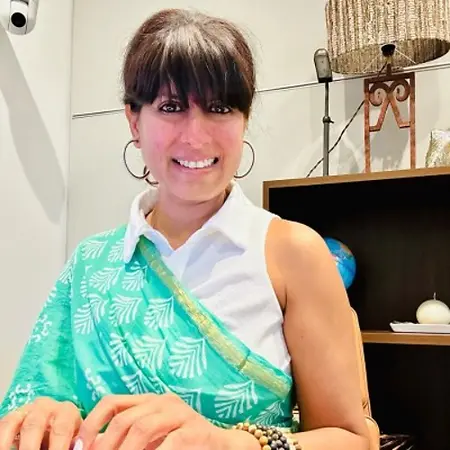
Navi Sekhon is a Global Research Ops Leader at Intuit, where she oversees teams across the United States, Canada, and the United Kingdom. Her team is building an AI-powered global research ecosystem that makes customer insights more accessible, actionable, and scalable — helping employees become more deeply customer obsessed.
But for Navi, understanding people has never been just a job. It’s a way of life.
Having grown up across countries and cultures because of her parents’ work with the United Nations Development Programme (UNDP), Navi learned early to adapt, stay curious, and find common ground. After studying Hotel Management, she began her career with Hyatt Hotels, moved into Executive Hiring and Talent Acquisition, and eventually found her way into Research Operations — an unexpected intersection of people, technology, systems, and problem-solving.
Her leadership philosophy is simple: bring your whole self to work, and give others permission to do the same. As Global Chair of Intuit’s South Asian Network Employee Resource Group, she champions connection, representation, and belonging.
But one of her most meaningful initiatives began at home.
After losing her father during COVID, Navi watched her mother — an accomplished educationist who had spent years caring for her husband — become increasingly withdrawn. She wondered, “If my mom needs this, how many other seniors do too?”
That question led her to help establish a free senior community at her local Sikh temple. The vision was simple: a completely free community where no one has to pay to belong. She wanted to create a space where seniors could stimulate their minds, stay active, socialize, laugh, and build friendships, while the Sikh temple provides a free community meal. There was no grand blueprint — just a belief that every senior, regardless of their financial circumstances, deserves a place to connect, participate, and feel that they still belong. Today, that simple idea has grown into a community of roughly 150 seniors and counting. Their time together includes meditation, yoga and exercise, games, conversation, laughter, and langar — but what happens in those hours goes far beyond the activities themselves. Friendships form. People reconnect. Someone finds a new friend. Someone gets moving. Someone who may have been feeling invisible remembers that they still belong and still matter.
Perhaps the most rewarding part? Her mother now leads the program.
Seeing her mother rediscover connection and purpose strengthened Navi’s belief that people don’t stop having something to give as they grow older. Sometimes, they simply need a place to belong.
It’s a belief that echoes the words her Dad lived by: “Humanity is our race, and love is our religion.”
Outside work, Navi is a fitness junkie, lifelong learner, and unapologetic Turkey enthusiast. She’s learning Turkish, drawn to the country’s rich culture, music, food, and of course, its addictive dizis — preferably enjoyed with a cup of Turkish çay and the promise of “just one more episode.”
After more than 18 years of career twists and reinvention, Navi isn’t leaving corporate life behind. She’s expanding her definition of success — bringing the same energy to strengthening communities that she brings to building customer-focused systems.
From helping employees become customer obsessed to helping seniors feel seen, Navi’s story comes back to one enduring belief: the most meaningful thing we can build is a world where people know they matter.
Because for her, purpose isn't simply about what you achieve. It's about who you serve, who you bring with you, and what you leave stronger than you found it.
Her Interview
Ten minutes with Navi
01What do you attribute your success to?
If I had to pick one thing, I’d say bringing my whole self to work — and giving others permission to do the same. I believe our experiences, cultures, and perspectives make us who we are, and we shouldn’t have to leave any of that at the door.
Growing up across countries because of my father’s work with the UNDP taught me to adapt, stay curious, and learn from everyone I meet. That mindset has carried me through a career spanning hospitality, executive hiring, and Research Operations — not always a straight path, but certainly an interesting one!
I’ve also been fortunate to have mentors who believed in me, and I try to pay that forward.
Ultimately, success isn’t just about what you achieve; it’s about the people you bring along and how you make them feel.
02What’s the best career advice you’ve ever received?
I haven’t had one single mentor who gave me the best advice. Life and the people I’ve worked with have taught me a lot, but one lesson that really stays with me is: “Listen to understand, not to fix.”
As leaders, we’re often quick to jump in with answers. I’m still learning to pause and really listen. In fact, when I feel the urge to interrupt, I take another sip of water! It keeps me hydrated and gives me a few extra seconds to listen.
I’ve learned that people don’t always need you to solve their problems. Sometimes, they just need to feel heard — and that can be more powerful than any advice you give.
03What advice would you give to young women entering your industry?
Start with one question: “What am I solving for?”
It’s the question I come back to whenever things get noisy or complicated. It helps separate what’s urgent from what’s actually important.. Careers can move quickly, and it’s easy to confuse being busy with being impactful. Knowing what you are solving for helps you stay grounded in what actually matters.
I’d also say: don’t wait for permission to lead. You don’t need a title, a big team, or years of experience to make something better, connect people, or turn an idea into action.
And don’t spend your career trying to become someone else’s version of a leader.
Your experiences, your perspective, and even the things that make you different can become your greatest advantage.
04What are the biggest challenges or opportunities in your field right now?
The biggest opportunity — and perhaps the biggest challenge — in Research Operations right now is artificial intelligence.
We are in a race to move faster. Organizations want to 3X, 5X, even 10X productivity. We are using AI to synthesize research, find patterns across thousands of customer conversations, automate workflows, and increasingly even bring in AI moderators to facilitate customer empathy sessions.
And I think there is enormous value in that.
But somewhere in that race to become faster and more efficient, I worry we may be forgetting something fundamental:
Customer empathy cannot — and should not — be outsourced.
AI can help us process information faster. It can help us identify themes, surface patterns, and make insights more accessible. But there is something profoundly human about sitting across from a customer, listening to their story, seeing their reaction, hearing the hesitation in their voice, and understanding not just what they said, but why it mattered to them.
That human connection is where empathy is built.
And this is the paradox I see in our field: we have never had more access to the customer, yet we have to be careful not to become further removed from them.
I believe the opportunity is to use AI to eliminate the work that doesn't require human connection — the manual synthesis, administrative tasks, repetitive processes, and time-consuming analysis — so that people can spend more time doing the work that does.
We should be using AI to help us get closer to customers, not create another layer between us and them.
My vision for Research Operations is therefore not simply about making research faster or cheaper. It's about making customer understanding more accessible, more actionable, and more deeply embedded in how an organization makes decisions.
If AI can help us 10x the speed at which we learn, that's extraordinary.
But I don't want us to 10X the distance between ourselves and the people we're trying to serve.
The future of research isn't human versus AI. It's AI giving humans more capacity to do the deeply human work — curiosity, connection, empathy, and understanding — that technology can't replace.
05What values are most important to you in your work and personal life?
I’d say curiosity and authenticity. I’ve always believed in staying curious, being true to myself, and giving others the space to do the same. We’re stronger together when we embrace our differences and learn from one another.
And my family keeps me grounded and reminds me what really matters. At the end of the day, technology can make us faster, but it’s the people and connections we build that make life meaningful.
Her Content Hub
Articles by Navi
What If Everyone Could Talk to the Customer?
How Intuit is empowering every employee to understand and serve customers at scale.

What if customer research weren't reserved for a handful of specialists but became something every employee could access and use to make better decisions?
At Intuit, that idea is rooted in our DNA.
Our co-founder, Scott Cook, championed a practice called Follow-Me-Home, encouraging employees to observe customers in their own environments and experience their challenges firsthand. The principle was simple: to build better solutions, we must first understand the people we serve.
But how do you turn a powerful philosophy into an everyday practice across a global organization? That question has shaped much of my work in building Intuit's global research ecosystem.
From a Philosophy to a Scalable Practice
At Intuit, customer obsession is everyone's responsibility. Yet connecting with customers traditionally often depended on a small number of research specialists and recruiters. If we wanted every employee to truly understand our customers, we needed to make those connections easier and more accessible.
One way we did this was by bringing Follow-Me-Home to life beyond its original concept. I worked on developing Intuit's Global Follow-Me-Home program, including its website, operating model, governance, participant strategy, and engagement coffee table books. We also published a book to help employees understand and practice the approach, with Scott Cook contributing the foreword.
For me, this was about more than documenting a program. It was about making a foundational part of Intuit's culture easier for employees to embrace, wherever they worked and whatever their role.
Because customer empathy shouldn't depend on your job title or whether you happen to work on a research team.
Democratizing Research Through Technology
Through our team, the Center of Customer Obsession (CoCO), we took that philosophy further, building a global research ecosystem designed to make customer knowledge accessible, actionable, and scalable.
We embraced self-service research through platforms like Great Question, which makes it easier for employees to connect with customers and conduct research without relying on a small, centralized team of research recruiters for every interaction.
By helping extend research access to hundreds of employees across Intuit, we expanded who could participate in understanding our customers. Employees could increasingly take ownership of connecting with customers directly, while our teams focused on providing the tools, expertise, governance, and guardrails that make research responsible and meaningful.
We set out to 10X customer obsession—not simply by doing more research ourselves, but by empowering more people across Intuit to participate in it.
Democratization doesn't mean turning everyone into a professional researcher. It means removing barriers to customer access and making customer understanding a capability everyone can practice.
And this work continues to evolve. Across the United States, Canada, and the United Kingdom, our teams keep improving the ecosystem, the platforms, and the overall experience to make it easier for anyone at Intuit to connect with customers, discover existing insights, and bring the customer perspective into everyday decisions.
Our ambition extends beyond any single tool: to make customer understanding an everyday part of how our organization thinks, builds, and innovates.
Scaling Technology Without Losing Empathy
Artificial intelligence offers exciting opportunities to accelerate research, synthesize information, and make insights easier to discover. I see AI as a force multiplier for our ecosystem, helping us spend less time navigating information and more time understanding customers.
But one principle remains non-negotiable for me: customer empathy cannot be outsourced.
Technology can help us process what customers tell us, but it cannot replace the human responsibility to listen, observe, and understand their experiences. The frustrations, workarounds, and unspoken needs we discover through genuine human connection can shape solutions in ways that data alone may not.
The opportunity isn't to choose between efficiency and empathy. It's to use technology to make human understanding more powerful.
Making Customer Obsession Everyone's Job
For me, leadership begins with a simple question: What are we solving for?
Building a global research ecosystem is ultimately about closing the distance between a company and its customers—between collecting feedback and truly understanding an experience, and between having information and acting on it.
What makes this work meaningful is that customer obsession isn't confined to a department or a team of experts. It belongs to everyone.
I'm proud to be part of building the infrastructure that helps bring Intuit's founding philosophy to life at scale. From making Follow-Me-Home easier to practice to democratizing research through self-service technology, the goal has remained consistent: help more employees understand the people they serve.
Because customer obsession isn't something we simply declare. It's something we build into how we work, the decisions we make, and the experiences we create.
I believe there's still so much more we can do as technology evolves and new possibilities emerge.
If you're building a research ecosystem, democratizing customer insights, or finding new ways to bring the voice of the customer into everyday decisions, I'd love to hear your story and connect. There's so much we can learn from one another.
After all, the more we share what we learn from customers, the better we can serve them.
Join Influential Women and start making an impact. Register now.