America’s Coal Opportunity: How Do We Put One of the Nation’s Greatest Energy Resources Back to Work?

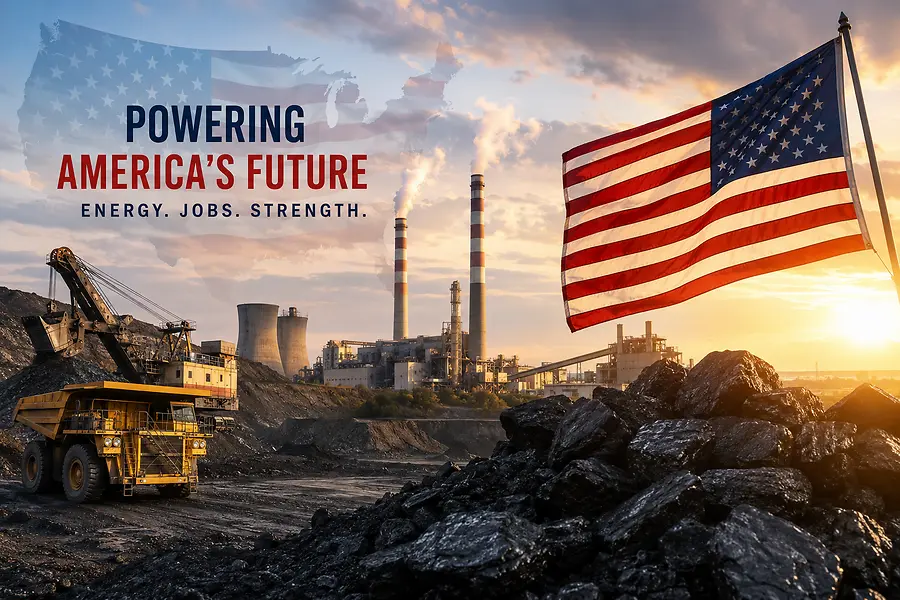
Coal 2.0: Is America's Coal Industry Finished—or Waiting for a New Business Model?
For generations, coal helped power America's industrial growth. It fueled factories, generated electricity, supported railroads, and created thousands of jobs in communities across the country.
Today, however, America's coal industry looks very different.
Coal production has fallen dramatically from its peak. The U.S. produced 578 million short tons in 2023—less than half of the amount produced in 2008. The decline has been driven by competition from natural gas and renewable generation, higher mining costs, and environmental regulations.
But there is an important fact that should not be overlooked:
America still possesses an enormous coal resource.
According to the U.S. Energy Information Administration, the United States had approximately 468 billion short tons of demonstrated coal resources as of January 1, 2025, including an estimated 249.4 billion short tons of recoverable reserves. The EIA notes that, measured by total energy content, U.S. coal resources are larger than the nation's remaining oil and natural gas resources.
That raises an important question:
Is America's Coal Industry Finished—or Is It Waiting for a New Business Model?
The answer may be somewhere in between.
Coal is unlikely to return to the role it held decades ago, when it dominated American electricity generation. In 2025, coal supplied approximately 17% of U.S. utility-scale electricity generation, compared with 41% for natural gas, 24% for renewables, and 18% for nuclear power.
At the same time, America's demand for electricity is changing.
U.S. electricity generation reached a record 4.43 trillion kilowatt-hours in 2025, and the Energy Information Administration expects electricity generation to continue growing in 2026 and 2027. Commercial and industrial demand—including demand associated with data centers and manufacturing—is contributing to that growth.
This creates an intriguing opportunity.
Instead of asking whether coal can simply return to its past, perhaps the better question is:
Can American coal be reinvented for the energy demands of the future?
More Than 17,000 Investors Are Watching
The reported interest of more than 17,000 investors represents an important signal: there is significant attention surrounding the opportunity to put America's domestic energy resources back to work.
But investment interest alone is not enough.
The industry needs capital, technology, experienced management, modern infrastructure, and a realistic strategy for operating profitably in today's energy market.
The goal should not simply be to reopen mines and repeat the past.
The goal should be to build a modern American energy company around an abundant domestic resource.
What Would a Modern Coal Strategy Look Like?
A successful strategy could involve several components.
1. Modernize Existing Mining Operations
Rather than starting from scratch, investors could evaluate existing mines, reserves, transportation infrastructure, leases, and processing facilities.
Modern mining technology can improve productivity, safety, and resource recovery. The objective would be to focus capital on assets with the strongest economics rather than attempting to develop every available deposit.
2. Target High-Value Coal Markets
Not all coal is the same.
Metallurgical coal, for example, remains an important input for steelmaking. U.S. metallurgical coal also has an international market.
The EIA reported that U.S. coal exports totaled 23.7 million short tons during the first quarter of 2026, including 13.3 million short tons of metallurgical coal.
That suggests the future of American coal may involve focusing less on volume alone and more on where coal has the greatest economic value.
3. Invest in Cleaner and More Efficient Technologies
If coal is going to have a long-term role in America's energy mix, technology will be critical.
That could include higher-efficiency generation, carbon-management technologies, improved emissions controls, coal gasification, and other technologies that seek to extract greater value from coal while reducing environmental impacts.
This is where a new generation of energy companies could differentiate itself from traditional mining companies.
4. Build Around America's Growing Electricity Demand
America is entering an era of enormous electricity demand.
Data centers, artificial intelligence, advanced manufacturing, electric transportation, and industrial expansion all require reliable electricity.
That creates an opportunity for energy companies to evaluate coal not simply as a commodity, but as part of a broader baseload and energy-security strategy.
Coal does not have to compete with every other energy source.
Instead, it could potentially complement natural gas, nuclear, hydroelectric, solar, and wind as part of a diversified American energy portfolio.
5. Strengthen American Energy Independence
America's enormous domestic energy resources are an economic and strategic asset.
The United States reached a record 107 quadrillion British thermal units of total energy production in 2025. Coal represented approximately 10% of domestic energy production that year, while total U.S. energy production continued setting records.
The opportunity, therefore, isn't necessarily about choosing coal instead of oil, natural gas, nuclear, or renewables.
It is about asking whether America should maximize the responsible use of all economically viable domestic energy resources.
Who Could Lead the Next American Coal Renaissance?
This may be the most important question.
The company that ultimately succeeds may not be the largest traditional coal producer.
It could be a company with the ability to combine:
- Mining expertise
- Energy infrastructure
- Advanced technology
- Private investment
- Environmental compliance
- Domestic and international marketing
- Power generation
- Long-term capital
- Experienced acquisition management
In other words, the opportunity may require an energy platform, rather than simply a coal company.
A company capable of acquiring undervalued coal assets, modernizing them, developing new markets, and integrating them with electricity generation and energy infrastructure could potentially create far more value than a traditional mine operator focused solely on extracting and selling tons of coal.
The Company That Could Bring Coal Back Shouldn't Simply Bring Back the Past
The phrase "bring coal back to its heyday" sounds appealing, but America's energy market has changed too much for a simple return to the past.
The better objective is to create Coal 2.0.
That means taking one of America's most abundant natural resources and applying 21st-century capital, technology, and management to it.
The opportunity could extend beyond mining.
It could involve:
Coal + Power Generation + Technology + Infrastructure + Manufacturing + Export Markets.
That is a much larger proposition.
A New American Energy Opportunity
America does not have a shortage of energy resources.
The challenge is determining which resources can be developed economically, responsibly, and competitively.
Coal remains a significant part of the American energy landscape. In the first quarter of 2026 alone, the United States produced approximately 131.9 million short tons of coal.
The question is what happens next.
If more than 17,000 investors are truly looking for ways to put America's coal resources back to work, the next step should be more than simply investing in another mine.
It should be identifying the right company, the right assets, the right technology, and the right leadership team to build an American energy platform capable of competing for decades.
The company that succeeds may not be the one that mines the most coal.
It may be the company that figures out how to turn America's vast coal reserves into the foundation of a modern, reliable, and economically competitive energy business.
And that is where the next great American energy opportunity may begin.


