Before the Elk Dogs
The Ancient Blackfeet: Life, Culture, and Survival Before the Arrival of Horses

Chapter Twelve
Before the Elk Dogs
Carbon dating of human remains found on the Blood Reserve in Canada
have dated the occupants as far back as 11,000 years but many suspect
that the Blackfeet have been in the area much longer than that. Theory
considers the Blackfeet having been once a part of the great Algonquin
Nations of the American Middle West in the timber areas of the Great
Lakes region. More adventuresome than their contemporaries, they
traveled west moving towards the ample hunting opportunities of the
plains in prehistoric times. Linguists confer that the Blackfoot language
has enough similarities to the Algonquin to assume they were once a part
of that group, but the Algonquian dialect was the most widely spoken
language and similarities were assimilated through time. The language
experts will admit, though, that Blackfoot differs greatly from all other
Algonquin dialects.
Eventually the Plains Ojibwas, Cheyennes, Plains Crees, Arapahos and
Gros Ventres followed the trail the Blackfeet blazed to the grasslands but
the time line for that migration is not yet understood. It is believed that
the Blackfeet were drawn to the open country in their quest for
expansion perhaps centuries before others followed. Fiercely
independent by nature, they might have discovered that the competition
for hunting grounds was nonexistent the farther west they traveled.
Perhaps smaller groups of Blackfeet journeyed to the lands made
alluring by the upper tributaries of the Missouri and Saskatchewan rivers
at the eastern base of the Rockies and sent scouts back to report their
findings.
Recorded by a fur trapper in 1788, David Thompson, Blackfeet elders
told of their youth made the cooperative efforts with trappers that were
effective in scarce times by sharing rations, and cooperated to hold
strong defenses against interlopers. The horses, or what they originally
called elk dogs, eventually became a part of their culture when they arrived.
When queried as to the origins of their people, they simply pointed to
the North West and named those days "when we used dogs for moving
camp." The grandmothers in Southern Alberta indicated that their people
had no firearms or iron implements in the days of their childhood. Nor
did they even use canoes for travel, only timber barges. They preferred
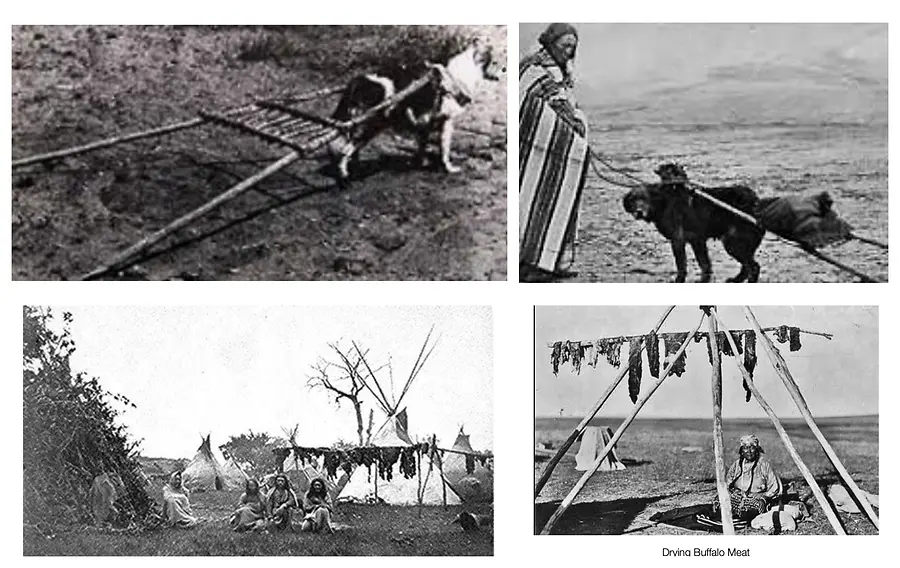
to move by foot over land and gaining the assistance of the canine for
pulling the travois with some of the burdens.
Moving steadily southwest from the northwest, they found the
coniferous forests and grassy valleys covered with buffalo. They chose
to move nomadically within this area of timbered river valleys, pristine
glacier lakes, forested hills and vast prairies full of wild game,
consumable plants and firewood.
The words of the Blood elder, Weasel Tail, described the process he
recalled from his youth. Always the hunt was considered sacred to the
people and ceremony initiated the rite. The holder of the beaver bundle
opened his sacred bundle in his lodge, removed the buffalo stones, and
prayed. He sang the songs that accompanied the stones as well as
smoking the pipe. The words of his song were, "Give me one buffalo or
more. Help me to fell the buffalo, Creator." He was rewarded for his
successful ceremony and prayers by being given the choicest pieces of
buffalo meat, his part not participating in the hunt or processing but
securing the blessings of the spirits.
The acquisition of food in the summer months went as follows: After the
fastest warrior hunters located the herd, the chief instructed the women
to gather their dogs and travois carriers. All the adults proceeded
towards the herd, remaining down wind. The women situated their
travois' upright, secured into the ground with the smaller end upwards.
They were all then tied together to form a circular fence with an
abundant opening into which the bison would be herded. The females
then hid behind the fence while a couple of the swiftest warriors circled
the herd and drove them into the corral.
The other hunters positioned themselves creating a human corridor to
the corral, closing in on them as they moved towards the structure. They
joined the women in shouting to create some confusion for the beasts
whilst the hunters immediately rushed in to kill their prey. The chief
entered the corral and counted the kill, then directed the processing of
the meat and hides. He ensured that equal shares of meat and hides went
o all his clan members. The women did the major portion of the
processing and moving the meat and other needed materials from the
buffalo back to camp. The term for the entire process was known to
them as "surround of the buffalo”
When the cold weather of Canada began to move in, the clans
anticipated the movement of the beasts to the protected wooded areas
and set up camp there. With timber abundant, they used felled trees to
create the corral for the procedure. Weasel Tail described this harvesting
of meat in the fall. Near the bottom of a coulee at the edge of the woods,
the adults created the buffalo corral of wood posts set upright at
approximately a height of seven feet. The posts were connected by cross
pieces of timber tied together with rawhide strips. Stakes were laid over
the lowest cross poles on three sides on the outside of the corral,
projecting three feet at an angle with the sharpened ends extending to the
height of the bison's body. Therefore, if the buffalo tried to escape the
corral, they became impaled on the stakes. At the open end of the corral
the poles emerged into two lines up the hill extended by piles of cut
willow branches about three feet tall and tied together at the top, spaced
at intervals of several feet apart. Just above the opening of the corral,
parallel poles were laid on the ground crosswise of the slope. The
buffalo crossed these poles entering the corral; the poles were covered
with water and manure, which very quickly began to freeze and became
slippery so that the buffalo were unable to escape up the hill by that
means.
Finding the buffalo and moving them towards the corral was a great feat,
often they were some distance away and many times, they caught the
scent of the warriors and evaded them. Nevertheless, when the hunters
were successful, their entrapment ensued when the swiftest warriors
drove them towards the corral, with another warrior at the top of the hill
ready to signal the women and children. Upon his signal, the women and
children emerged from their hiding places behind the brush piles,
shouted, and waved the buffalo forward into the corral. After the warriors
slay the beasts, the butchering began with all participants
enjoying fresh raw liver, brisket, tripe and kidneys as they worked. The
clan shared all they harvested.
There were times when the ground was too rough for the swift warriors
to run for the buffalo due to washouts, cracks and holes. One ingenious
method of acquiring meat was for one warrior to put on a large wolf skin
and sneak out slowly upon a small herd grazing. The silent arrows would
hit their mark in several of the beasts felling them where they stood. One
elder explained that sometimes the huge bulls would smell the blood of
the recently slain and become crazed, running up and licking their blood,
even tossing the dead bodies around. Often a fight between bulls would
result, drawing the attention of other buffalo. The warrior explained that
sometimes when the buffalo became too curious he would howl like a
wolf and they would lose interest. Eventually the activities would end
and the herd would move away, leaving the fresh meat to be processed
and carried back to camp.
Women played a major role in the feeding of the clans as they did in all
elements of Blackfeet life in those days before the elk dogs. They not
only processed the meat and hides, but also created the utensils for
eating, carrying goods, made the clothes and moccasins, made the tipi,
and set it up and dismantled it. She bore and reared the children, tended
to camp movement, (carrying more than her fair share of the burden in
traveling) while keeping her dogs pulling the travois' moving along as
she tended to the children during the journey. No rest for the weary
Blackfeet woman for after a long day of journeying, she had to prepare
meals and tend to the family and dogs. It was the custom for the wife to
bathe, dress and groom her warrior husband as well as the children.
Indeed, she was the true backbone of Blackfeet society.
A buffalo horn would be lined with old moist wood chips and hot coals
were inserted, then the open end plugged with a stopper carved of wood.
Thusly, fire was readily carried from camping place to camping place. A
punk made of the fungus growing on birch trees was inserted
periodically constantly glowing for easy fire ignition when needed until
the campfire was lit. Boys were assigned the task of gathering dry wood
ahead of the group. Several large piles of wood were prepared so that
upon the arrival of the carrier of the "fire horn" the fires were
immediately lit for cooking. The other fires were ignited from burning
sticks from the initial fire and well seasoned before the women arrived to
begin the meal. The women set up the family lodges and ignited the
lodge fires from the outdoor campfires.
Many eating utensils such as dishes, cups bowls and larger food
containers were created from the paunch of the buffalo. The skin was
dried on a hoops made of cherry wood, one on the bottom of the
receptacle to create the round form, and another at the top forming a
bowl or basin. Plates or platters were created from one hoop, which was
sewn onto the skin with handles created of rawhide sewn to the hoop
when necessary. These utensils softened when filled with moist
ingredients and would have to be dried in the sun to become stiff again,
but were flexible when needed to be flattened for carrying. These
utensils were used for the cooler items or dry items whereas hot
ingredients were carried or eaten on utensils made of stone. Pounding
selected clay like rock with a heavier rock was done to hollow out the
pot, plate or kettle, then ground until smooth. When shaped sufficiently,
it was filled with water and set on an open fire and boil to harden the
clay, creating a study vessel. Some vessels were created from carved
wood and spoons or ladles were carved from buffalo or sheep horn.
It has been said that some native tribes were barbaric in that they
abandoned their elderly in those days when they were no longer able to
journey by foot. However, it was the elder who chose not to move
forward anymore, refusing to budge. The clan prepared for them an
encampment in an area most conducive to their survival, leaving them
with as many supplies as possible. Other nomadic clans would tend to
the elder as they passed, replenishing supplies as much as they were
able. The family clan would return on their journeys and tend to them as
well. It was not considered cruel by the elder or the clan; it was just the
most practical form of existence. When the elk dogs came, that practice
ended since the elders could then ride or be pulled in a larger travois.
Warfare was also more challenging before the coming of the elk dogs.
The most aggressive of enemies were the Snake Tribe and the Shoshones
occupying nearby lands. Warfare generally occurred during the plentiful
summer months when the women, children and elder men were left with
ample supplies. Several hundred warriors followed the war chief into
battle, lining in two rows facing one another, just within arrow range.
Kneeling behind large rawhide shields, they shot arrows at each other
from their long bows. Most often, the forces were equal and there were
few casualties, both sides claiming victory at the stalemate. Also smaller
raiding parties journeyed afoot to overcome smaller hunting camps
ending in a destructive way, with more loss of life.
The ancient attire of men included a cap made of animal skins, usually
wolf, coyote, badger or antelope. The head of the creature formed part of
the cap, quite often, giving the essence and power of the animal to the
ambiance of the individual. Other caps were often shaped of the feathers
of a bird such as a duck, owl, swan or prairie chicken. Their clothing
generally consisted of a shirt, breechclout and leggings as well as
moccasins. Both men and women alike wore belts and attached knives,
sheathed, as well as other useful handmade tools.
The women wore long sleeved buffalo skin shirts, secured at the wrists
with rawhide. Long skirts from the same skin with leggings to keep
their legs snug in the cold of winter completed the ensembles. In
summer, a shift or smock with no sleeves of a lighter hide was worn
with moccasins. Other skins used for creating these garments were those
of sheep, antelope, deer or elk. Moccasins were very durable as they
were reinforced in the sole with parfleche. They were often adorned with
designs created with intricate beadwork with porcupine quills or beads.
Jewelry was worn by men, women and children created from bone,
wood, teeth, shells and claws. Elk teeth were carved and used on
women's fancier dresses, making them a highly prized garment worth
trade of as much as two swift steeds.
Eagle feathers were used to decorate and empower shields and other
weapons, war staffs, ceremonial items and headdresses. The scalp locks
of fallen enemies were also used, often attached to smaller bunches of
bird feathers. Grooming was often lengthy with great care to the
combing, braiding and decorating of the long black hair. The Bloods
parted their hair to the side, rather than in the middle and wore two long
braids to each side, sometimes letting it fall unencumbered. Medicine
people wound the hair in front into a huge topknot, which was often
wound with the fur of the otter. Occasionally, the hair was cut in front as
bangs, but combed straight up. For special ceremonies, some created
four braids, two hanging in front of the ears and two behind them.
As is still the case today, the ancient Blackfeet were tall with strong
backs and muscular bodies. Their facial features were aesthetically
pleasing, symmetrical, large dark eyes, with prominent yet well-shaped
noses. Through centuries of walking and running as was necessitated,
their legs were well defined, durable and strong. To this day, the genetic
propensity for excellence in effortless long distance running is carried by
many Kainai individuals.
Due to the coarse winters, the Blackfeet are hardy in cold temperatures.
In the days before the elk dogs, children often played on the ice and in
the snow with scant coverings, returning to the warmth of the tipi and
darting out for more winter fun together.
The family tipi was created with approximately 18 buffalo hides,
carefully cut and sewn together with sinew, creating the triangular shape
by being attached to 18 pine, spruce or ash poles. At the top were two
large flaps, which were moved according to the direction of the wind to
create a draft to draw the smoke up and away from the interior of the
lodge. The circumference was approximately 14 to 16 feet with the
height being from 10 to 12 feet. The lower area of the skins was secured
to wooden pegs placed periodically, usually with some area slightly open
to draw air through in the summer months. In the winter, a warm lining
was attached inside keeping it quite cozy from the warmth of the constant
fire, which was located in the center of the lodge.
Eventually the horses when they arrived, or what they originally called
elk dogs, were a part of their culture. When queried as to the origins of
their people, they simply pointed to the North West and named those
days "when we used dogs for moving camp." The elders in Southern
Alberta indicated that their people had no firearms or iron implements in
the days of their childhood. Nor did they even use canoes for travel, only
timber barges. They preferred to move by foot over land and gaining the
assistance of the canine for pulling the travois with some of the burdens.
Moving steadily southwest from the northwest, they found the
coniferous forests and grassy valleys covered with buffalo. They chose
to move nomadically within this area of timbered river valleys, pristine
glacier lakes, forested hills and vast prairies full of wild game,
consumable plants and firewood.
Besides buffalo, the hunters found an abundance of rabbits, porcupine,
deer, badgers, beavers, foxes, elk and moose. Sub-zero temperatures of
extended winters prevented any type of farming, but the followers of the
buffalo adjusted their habits to those of the great beasts. In the winters,
the Blackfeet camped in the shelter of forested valleys protected by the
hills, ever near their buffalo herds. However in the summers, the buffalo
moved to the vast open plains. Hunting bands were compromised of
approximately two hundred individuals, (family groups), who were
called clans. The efficiency of the hunters encircling the selected group
of bison, or channeling them to a buffalo pound or jump. Then the
women quickly joined them to process the meat and transported it to
camp to share with the clan.


