Before You Buy
A practical guide to mindful purchasing and breaking the cycle of impulse buying.

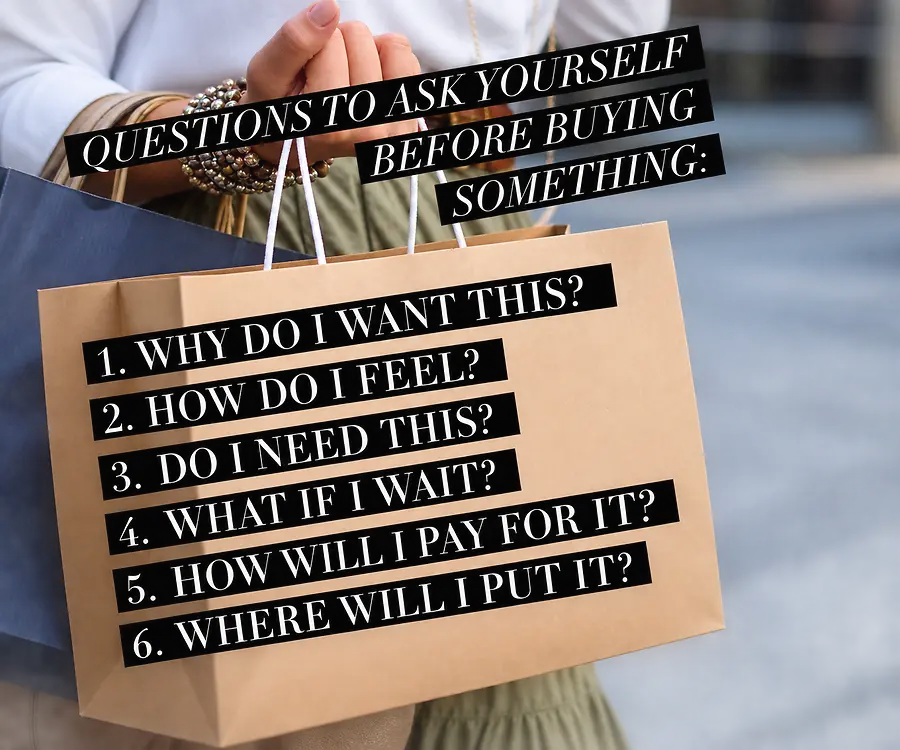
Before You Buy: Six Questions to Ask Yourself Before Adding More to Your Home
We've all done it: You open your phone to check one thing… and twenty minutes later, there's something in your cart.
Be honest: How many packages arrived at your house this week? And how many of them contained something you actually needed?
Shopping in the online era has become extraordinarily frictionless. We can buy something from the couch, in between meetings, while waiting in the school pickup line, or late at night before falling asleep.
How many of us have bought things based on targeted Facebook or Instagram ads? I know I have. Some were useful purchases; others, I regretted later.
The problem isn't necessarily any single purchase. It's the accumulation.
As a professional organizer, I help people decide what to do with things after they've entered their homes.
But one of the most effective organizing strategies happens much earlier:
Before we buy them.
Shopping can become a response to:
- Stress
- Boredom
- Celebration
- Convenience
- Social comparison
- The promise of becoming a slightly different version of ourselves
This last one is a kicker.
Most of us want to exercise more. Most of us want to read the latest books in our fields. So, what do we do? We buy something in the hope that it will get us closer to meeting our goal.
Does it actually get used?
Maybe. Maybe not.
If the answer is no, there may be more here for you to discover.
Chronic shopping isn't simply about owning too much.
It's about buying things to solve an emotional need.
We're constantly being sold solutions: the planner that will finally make us productive, the outfit that will make us feel confident, the storage container that will make us organized, or the kitchen gadget that will make dinner easier.
Sometimes those purchases genuinely help.
And sometimes they become clutter.
Every object we bring home eventually requires something from us—space, maintenance, cleaning, organizing, storing, repairing, deciding, donating, or discarding.
That makes intentional shopping an organizing skill.
Here are six questions from financial therapist Carrie Rattle:
The Six Questions to Ask Before Buying
Question #1: Why Do I Want This?
Am I buying because:
- I genuinely want or need it?
- I'm stressed?
- I'm bored?
- It's on sale?
- Someone else has it?
- I'm imagining the person I'll become once I own it?
We all have a vision of who we want to be. Often, we're not that person yet, but we want to be.
Maybe we want to be the person who exercises every morning before work. Maybe we want to become someone who does fun and interesting art projects with our kids. Maybe we want to take that dream vacation, so we go ahead and buy the perfect outfit…
There's nothing wrong with wanting something. Just understand why you want it.
And make a plan for what you need to do to get there.
Question #2: How Do I Feel?
Let's take your emotional temperature.
Are you satisfied in the current moment? Or are you wanting to change what you're currently feeling?
Shopping can provide novelty, anticipation, control, or a temporary mood boost.
Ask yourself:
What was I feeling before I started shopping?
Stressed? Lonely? Overwhelmed? Tired? Celebratory?
The goal isn't to diagnose or shame the behavior. It's simply to notice patterns.
If you find yourself turning to shopping to solve an emotional need, organizing the resulting possessions addresses the symptom—not the source.
Question #3: Do I Need This?
You don't have to need something to buy it. But you should know whether you're buying a need or a want.
Here are some questions to consider:
- Do I already own something that serves this purpose?
- Am I replacing something or simply adding another?
- How often will I realistically use it?
We all buy things we don't need, but it helps when we're conscious of why we're buying something.
Question #4: What If I Wait?
What if you waited as a way of adding friction back into frictionless shopping?
Consider adopting the following personal timelines for yourself:
24 hours for small purchases
72 hours for larger purchases
30 days for major discretionary purchases
Rather than asking, Can I have this? ask:
Will I still want this later?
Try leaving an item in your online shopping cart or taking a photo of something in a store rather than purchasing it immediately.
Often, the desire passes.
And if it doesn't?
You can still buy it.
Question #5: How Will I Pay for It?
The true "cost" of an item is more than whether there's enough money in the account.
Ask yourself:
- Is this planned spending?
- Am I using credit?
- Does buying this mean giving up something I value more?
- Would I still buy it if it weren't on sale?
Remember: A bargain isn't a bargain if you didn't need or really want the item in the first place.
Money is a resource to use intentionally.
Question #6: Where Will I Put It?
Before buying something, mentally assign it a home.
Where, specifically, will this live?
Not just "in the closet."
Where in the closet?
If there isn't room for something, you may need to leave it at the store.
Our homes have finite capacity. Storage products don't change that.
Your home's square footage doesn't increase every time you click "Add to Cart."
Final Question: What Supports Your Lifestyle?
The goal isn't deprivation.
It's about making sure the things entering your home deserve the space they'll occupy.
Professional women already carry significant physical, emotional, and cognitive loads. Our possessions shouldn't unnecessarily add to them.
The next time you're about to click "Buy Now," pause long enough to ask yourself the questions above.
You may still buy it—and that's okay.
But when the answer is no, you've saved more than money.
You've saved space, time, energy, and one more decision your future self won't have to make.
And sometimes the most satisfying purchase is the one you realize you don't need to make.
Download the graphic to remind yourself of these questions in the moment.