Before You Invest or Lend: How to Verify That a U.S. Business Is Legitimate and Legally Operating
Essential Steps to Verify a Company's Legal Status and Legitimacy Before Conducting Business

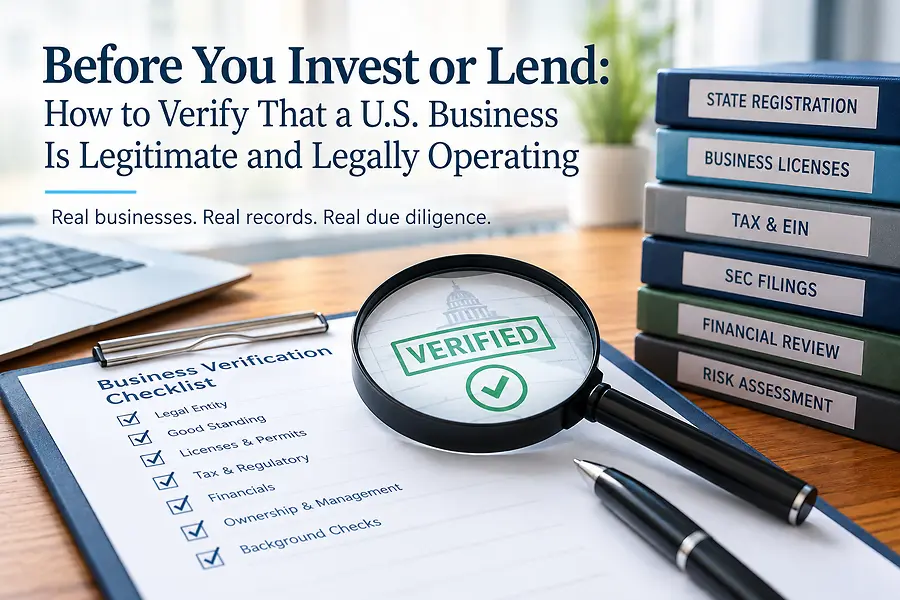
In today's business and investment environment, verifying a company is more important than ever. A company may have a professional website, business cards, social media pages, a corporate name, and even impressive financial claims—but those things do not necessarily prove that the company is legally registered or authorized to conduct business.
Recent developments in corporate-data verification highlight an important lesson: business identity must be verified against reliable, preferably official, records. The goal is to determine whether a company is a real legal entity, identify the correct company when businesses have similar names, determine whether it remains active, and avoid duplicate or incorrect records.
For investors, lenders, brokers, and anyone considering doing business with a company, the same principle applies.
A Company Name Is Not Proof That a Business Is Legal
One of the biggest mistakes people make is assuming that a company is legitimate simply because they can find it online.
A business name appearing on Google, LinkedIn, a website, or even a third-party corporate database does not by itself establish that the company is currently active or authorized to operate.
The first question should be:
Does this legal entity actually exist in the jurisdiction where it claims to be incorporated?
The next questions are:
- Is the entity currently active or in good standing?
- When was it formed?
- Who is the registered agent?
- What is the official entity or file number?
- Where was it incorporated?
- Is it registered to do business in other states?
- Does the company's legal name match its contracts and financial documents?
- Does the company have the licenses required for its particular industry?
- Are there regulatory filings that should be checked?
- Is the person representing the company actually authorized to act on its behalf?
These questions become particularly important before sending money, entering a joint venture, making a private investment, extending credit, or signing a major contract.
Step 1: Verify the Corporation or LLC With the State
In the United States, corporations and LLCs are generally created under state law, rather than through one central federal corporate registry.
Start with the Secretary of State—or the appropriate state agency—where the company claims to have been formed.
Search the company's exact legal name.
For example, if someone tells you they represent "ABC Capital Group," don't assume that is the company's legal name. It could be a DBA, trade name, brand, or simply a name being used informally.
Look for the actual entity, such as:
ABC Capital Group, LLC
or
ABC Capital Group, Inc.
The state record should allow you to compare information such as the entity name, formation date, status, entity number, registered agent, and filing history.
Many states provide online business-entity search systems. For example, Illinois provides an official business-entity database, while California provides online records for corporations, LLCs, and limited partnerships.
Step 2: Check the Company's Current Status
Finding a company is only the beginning.
A company could have been legally formed years ago but later:
- dissolved,
- administratively dissolved,
- revoked,
- forfeited,
- suspended,
- merged,
- converted into another entity, or
- otherwise lost its active status.
Therefore, look for the company's current status.
If the company is represented as "active," compare that information with the most recent state filing.
For a transaction involving substantial money, you may also want to obtain a Certificate of Good Standing or equivalent certificate from the state when available.
Step 3: Determine Where the Company Is Actually Authorized to Do Business
This is an important distinction.
A company may be incorporated in one state but conduct business in several others.
For example, a company might be incorporated in Delaware while maintaining its headquarters and conducting substantial business in Texas, Florida, California, or other states.
That means you should distinguish between:
Where the company was incorporated
and
Where the company is authorized to conduct business.
The incorporation record and the operating-state registration answer different questions.
If you're dealing with a company that operates in your state, check whether it is properly registered there when state law requires foreign qualification.
Step 4: Verify the EIN—But Understand What an EIN Does
A legitimate business may have an Employer Identification Number (EIN) issued by the IRS.
However, an EIN should not be treated as proof by itself that a company is legitimate, financially sound, or authorized to conduct a particular business.
The IRS provides business tax information and resources concerning EINs, employment taxes, business taxes, and other federal requirements.
Think of the EIN as one piece of the verification puzzle, not the entire puzzle.
Also, be cautious if someone sends you a document claiming to be an IRS confirmation letter. Documents can be altered or fabricated. Where verification matters, obtain information through appropriate official channels or professional due diligence rather than relying solely on documents supplied by the company.
Step 5: Check Business Licenses and Industry Regulations
A company can be legally incorporated and still not be legally authorized to perform a particular activity.
This distinction is extremely important.
For example, certain industries may require federal, state, county, or municipal licenses or regulatory approvals.
Depending on the business, you may need to investigate:
- Financial-services licenses
- Mortgage licenses
- Real-estate licenses
- Insurance licenses
- Securities registrations
- Money-transmitter licenses
- Contractor licenses
- Transportation authority
- Healthcare licenses
- Professional licenses
- State tax registrations
- Local business licenses
- Industry-specific permits
In other words:
"The company exists" does not necessarily mean "the company is licensed to do what it says it does."
Step 6: Check SEC Records When Appropriate
If a company claims to be publicly traded, files securities disclosures, or is raising investments in circumstances that may involve federal securities laws, investigate its records with the U.S. Securities and Exchange Commission.
The SEC's EDGAR system allows searches by company name, ticker, CIK number, and other information and provides access to electronic filings.
This can help determine whether the company's public claims are consistent with its regulatory filings.
For private investment opportunities, however, the absence of an SEC filing does not automatically mean the company is fraudulent. Securities laws contain exemptions and different requirements depending on the offering and circumstances. Professional legal advice may be appropriate before relying on an investment structure.
Step 7: Compare Multiple Sources
This is where modern entity-verification technology becomes particularly useful.
A company may appear under:
- a legal name,
- a DBA,
- a former name,
- a shortened name,
- a parent company,
- a subsidiary,
- a branch, or
- a similarly named, unrelated company.
Third-party databases can therefore be excellent research tools, but for important transactions, the underlying government record should remain the primary source.
Step 8: Verify the People Behind the Company
A company can be legally registered and still present a significant business risk.
You should also determine whether the individuals representing the company are actually connected to it.
Compare:
- Officers
- Directors
- Managers
- Registered agents
- Authorized representatives
- Company addresses
- Email domains
- Telephone numbers
- Corporate filings
For larger transactions, consider requesting corporate resolutions, operating agreements, organizational documents, or other evidence establishing that the individual has authority to sign.
Step 9: Look Beyond Corporate Registration
Corporate registration answers an important question:
Does this legal entity exist?
It does not answer every question you need answered before entering a transaction.
For a lender or investor, additional due diligence might include:
- Financial statements
- Bank statements
- Tax returns
- Litigation searches
- UCC filings
- Property records
- Bankruptcy records
- Licensing records
- Regulatory actions
- Credit history
- References
- Ownership documentation
- Proof of funds
- Insurance
- Contracts
- Corporate organizational documents
The appropriate level of diligence should increase with the amount of money and risk involved.
A Simple U.S. Business Verification Checklist
Before investing, lending money, partnering with, or entering a significant contract with a company, consider verifying the following:
Corporate Identity
- ☐ Exact legal business name
- ☐ State of formation
- ☐ Entity/file number
- ☐ Formation date
- ☐ Current active status
- ☐ Registered agent
- ☐ Certificate of Good Standing, when appropriate
Operating Authority
- ☐ Foreign qualification in other states
- ☐ State business licenses
- ☐ Industry-specific licenses
- ☐ Local permits
- ☐ Federal regulatory requirements
Tax & Regulatory
- ☐ EIN information where appropriate
- ☐ State tax registration
- ☐ SEC/EDGAR records when applicable
- ☐ Relevant federal or state regulatory databases
People & Ownership
- ☐ Officers/managers
- ☐ Directors
- ☐ Authorized signers
- ☐ Ownership structure
- ☐ Parent/subsidiary relationships
Financial & Risk Review
- ☐ Financial statements
- ☐ Tax returns
- ☐ Bank statements
- ☐ Litigation
- ☐ Bankruptcy
- ☐ UCC filings
- ☐ Liens
- ☐ References
- ☐ Proof of funds or financing
The Bottom Line
Technology can make corporate due diligence faster, but it does not eliminate the need for verification.
The lesson from matching work is especially valuable: the quality of a company's identity data depends on accurately connecting that company to the correct official record. The information, such as company names, locations, branch relationships, status, identifiers, and registry records, helps improve the accuracy of those matches.
For investors, lenders, brokers, and business owners, the practical lesson is simple:
Don't verify a business based on its website or what someone tells you. Verify the legal entity, verify its current status, verify its authority to conduct business, verify the people representing it, and then perform financial and regulatory due diligence appropriate to the transaction.
A company being registered is the starting point of due diligence—not the end of it.


