
Being A Christ Follower In Toxic Work Environments
Finding Faith and Courage in the Workplace: Lessons from David's Journey

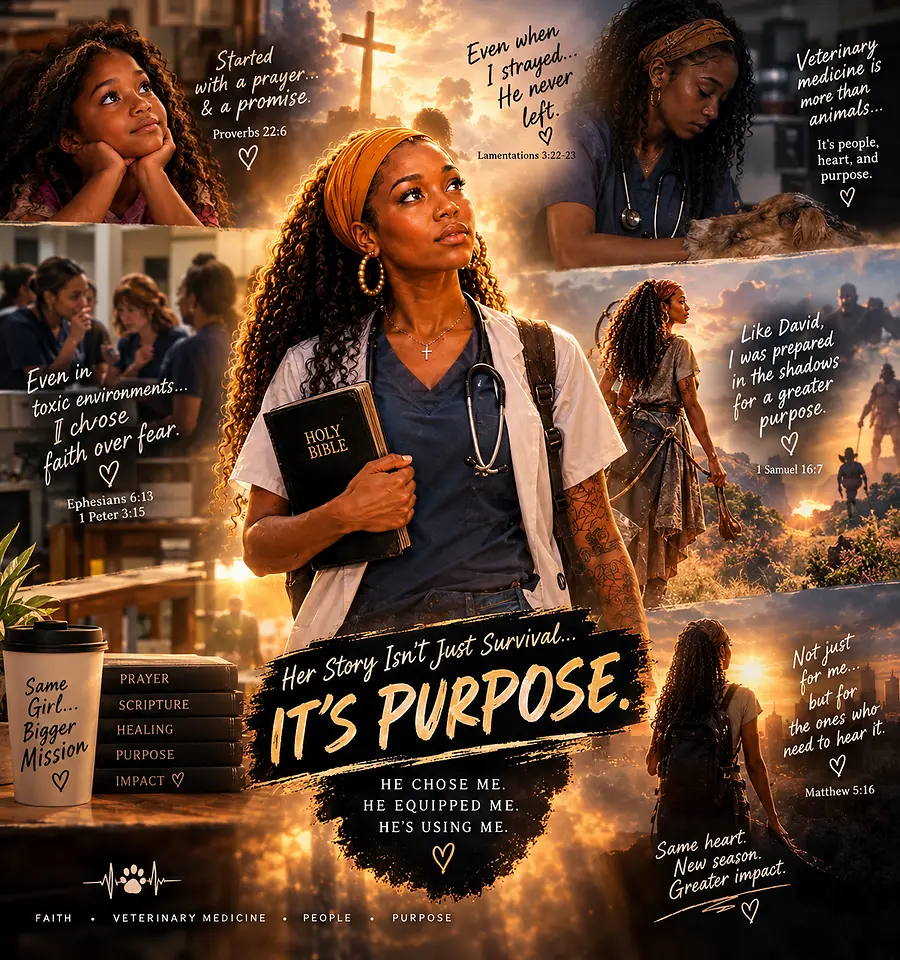
I have known and followed Christ since I was a young child. However, like many Christians, my walk with Him has been a journey filled with highs, lows, challenges, and moments of growth. As children, we often rely on our parents or guardians to remind us to pray, read the Bible, attend church, and build a relationship with God. As we grow older, however, we must learn to carry those teachings into adulthood and develop our own personal relationship with Him.
Proverbs 22:6 says, "Start children off on the way they should go, and even when they are old they will not turn from it." This verse resonates with me because, although there were times when I strayed in my personal life, I never completely lost sight of God. I am grateful for His mercy, patience, and continued presence throughout my journey. Interestingly, it has been my career that has taught me some of the most important lessons about what it truly means to follow Christ.
Veterinary medicine is a beautiful and rewarding field, but it also has a difficult side that is rarely discussed openly. Veterinary professionals face immense emotional pressure, and the profession has long struggled with mental health challenges and an elevated risk of suicide. Yet, when we talk about the struggles within this field, the conversation often centers on the demands of caring for animals. What about how we treat one another?
Behind closed doors, workplace bullying, mistreatment, unhealthy leadership, and fear can create environments where people feel powerless to speak up. Veterinary medicine is a relatively small professional community, and many people hesitate to use their voices because they fear judgment, retaliation, or damage to their careers. I understand that fear. However, I have learned that, as children of God, we cannot allow fear to silence us when something is wrong.
The Bible teaches us to stand firm in our faith, speak the truth in love, and act with courage. Being a beacon of light in a dark environment is not always easy, especially when that environment is one you care deeply about. Nevertheless, our faith should influence not only how we live outside of work but also how we conduct ourselves in our professional lives.
So, how do we apply the teachings of Jesus in a toxic work environment? What does that look like in practice? And perhaps one of the most difficult questions of all: What will others think when we choose to stand for what is right?
It was only recently that I began to understand these questions more deeply. As I reflected on Scripture, I found myself drawn to the story of David. His life offers a powerful example of how God can use seasons of rejection, adversity, and uncertainty to prepare us for a greater purpose.
David: Prepared in the Shadows
David was a remarkable leader, a courageous warrior, and eventually the king of Israel. Yet his story did not begin with a crown, a throne, or the admiration of others. It began in the fields, where he served as a shepherd.
When the prophet Samuel came to Jesse's household to anoint Israel's next king, David was not even the first son presented. His older brothers appeared to be the more obvious choices, but God saw something different. While people often judge by outward appearances, God looks at the heart (1 Samuel 16:7). David was the one God chose.
What I find especially meaningful about David's story is that his anointing did not immediately place him on a throne. He still had to grow, serve, face opposition, and endure difficult seasons. Before he became king, he had to learn what it meant to trust God when circumstances did not reflect the promise he had received.
David was questioned, underestimated, and challenged. When he stepped forward to face Goliath, even his own brother criticized him (1 Samuel 17:28). Others saw a young shepherd who appeared unqualified for battle, but David saw an opportunity to demonstrate his confidence in God.
David's victory over Goliath was more than a physical triumph. It was a demonstration of faith in the face of fear, intimidation, and overwhelming opposition. He did not allow other people's doubts to determine what he believed God could accomplish through him.
And yet, defeating Goliath did not mean David's struggles were over. He would later face jealousy, persecution, betrayal, and years of uncertainty before becoming king. His journey reminds us that spiritual growth is not measured by the absence of hardship. Sometimes, growth happens precisely because we must learn to trust God in the middle of it.
I relate to David's story because it reflects many of the struggles we face today. There may be moments when we feel overlooked, belittled, bullied, mistreated, or misunderstood. We may question why we are experiencing these things, especially when we are trying to do what is right.
But instead of allowing the voices of our critics to become louder than our faith, we can use these experiences as opportunities to deepen our relationship with God and demonstrate His character through our actions.
This does not mean that every difficult situation is a sign that God has chosen us for a particular role, nor does it mean we should accept mistreatment without question. Rather, David's story reminds us that our circumstances and other people's opinions do not define our worth. We can remain faithful to God while seeking wisdom, setting healthy boundaries, and standing against what is wrong.
Standing Firm When the World Pushes Back
David was not the only person in Scripture who faced opposition for standing firm in his faith. Jesus Himself experienced rejection, criticism, betrayal, and hatred. In John 15:18, Jesus tells His disciples, "If the world hates you, keep in mind that it hated me first."
This verse reminds me that doing what is right will not always make us popular. Sometimes, choosing integrity means standing alone. Sometimes, speaking up means being misunderstood. And sometimes, doing the right thing requires more courage than remaining silent.
But our responsibility as Christians is not to win everyone's approval. It is to live in a way that reflects Christ.
In the workplace, this can mean refusing to participate in gossip, treating others with dignity even when they do not treat us the same way, addressing harmful behavior appropriately, and speaking up when someone is being mistreated. It can also mean recognizing when a situation requires support from leadership, human resources, professional organizations, or other appropriate channels.
Standing firm does not mean responding to cruelty with cruelty. It does not mean allowing anger to control our actions or believing that we must endure harmful circumstances to prove our faith. Jesus calls us to truth, love, wisdom, and courage. Those qualities can coexist with accountability and healthy boundaries.
We must also remember that forgiveness does not mean excusing harmful behavior, and extending grace does not mean eliminating consequences. We can pray for people who mistreat us while still holding them accountable for their actions. We can show compassion without compromising our values.
As Christians, we are called to be a light in the darkness, not to become part of the darkness ourselves.
Bringing Christ Into Veterinary Medicine
When I put on my veterinary professional hat, I remind myself of one fundamental principle: we are here to care for animals and to support the people who make that care possible.
Animal welfare must remain central to our work. However, caring for animals does not excuse mistreating the people who dedicate their lives to them. Compassion should not stop at the treatment table. It should extend to our colleagues, support staff, leadership teams, clients, and everyone who contributes to the care of our patients.
When an unhealthy workplace culture becomes normalized, it can be tempting to stay quiet and simply adapt. We may tell ourselves that this is just how the industry operates, that speaking up will not change anything, or that protecting our careers is more important than addressing what is wrong.
But what happens when silence allows the cycle to continue?
If we see repeated disrespect, bullying, dishonesty, or mistreatment, we should not automatically accept it as part of the profession. The Bible encourages us to exercise discernment and test what we encounter rather than accepting everything at face value (1 John 4:1). We can apply that principle by examining workplace behaviors, seeking wise counsel, and considering whether our actions align with the values Christ teaches us.
Of course, I am not suggesting that speaking up is easy. It can be frightening to challenge an unhealthy culture, especially in a small professional community where reputations and relationships matter. There may be consequences, and we must use wisdom in deciding how to respond.
But courage does not require us to be reckless. We can document concerns, seek guidance, use appropriate reporting channels, establish boundaries, and support colleagues who are struggling. We can also recognize when leaving an unhealthy workplace is the wisest and healthiest decision.
Faithfulness to God does not require us to sacrifice our well-being to prove our commitment. Sometimes, standing firm means confronting a problem. Other times, it means protecting our peace and choosing a healthier environment.
The goal is not to condemn everyone who disagrees with us or to assume that every conflict is a spiritual battle. The goal is to approach difficult situations with discernment, humility, integrity, and a willingness to do what is right, even when doing so is uncomfortable.
I believe that when we begin supporting one another rather than competing against or tearing one another down, we create opportunities for meaningful change. When people see others standing up for what is right with grace and conviction, they may find the courage to do the same. Little by little, the darkness begins to give way to the light.
A Final Word of Encouragement
If you are navigating a difficult workplace while trying to grow in your relationship with Christ, remember that you are not alone. You do not have to be perfect to represent Him, and you do not have to have all the answers to stand for what is right.
David's life reminds us that growth often happens long before anyone recognizes our potential. He was a shepherd before he was a king, and he faced years of hardship even after being anointed. His journey teaches us to remain faithful in the seasons when we feel overlooked, uncertain, or unprepared.
So, the next time you feel belittled, dismissed, or afraid to speak up, remember that another person's opinion does not determine your worth. Seek God's wisdom. Examine your own heart. Ask yourself whether your response reflects the character of Christ. And when something is wrong, consider how you can address it with courage, truth, and love.
Someone may be watching how you handle a difficult situation. Your example may encourage another person to speak up, seek help, or choose a different path. We may never know the full impact of our actions, but that does not make them any less important.
We have an opportunity to break unhealthy cycles in the professions and communities we love. In veterinary medicine, that means creating a culture where compassion extends beyond our patients and into the way we treat one another. It means remembering that professional excellence and Christlike character should never be at odds.
If you are unfamiliar with David's story, or if you are beginning or renewing your walk with Christ, I encourage you to read his story from beginning to end, particularly in 1 Samuel and 2 Samuel. Do more than read the words. Reflect on the experiences, the challenges, the decisions, and the ways David's relationship with God developed throughout his life. Consider where you see similarities in your own personal and professional journey.
Most importantly, ask God for the wisdom to know when to speak, the courage to stand, the humility to listen, and the strength to act with integrity.
Being a growing follower of Christ does not mean we will never encounter darkness. It means we are continually learning how to walk in His light, even when the path is difficult.
Stay encouraged, stand firm in your faith, and continue to be a light wherever God has placed you.
Stay blessed, my brothers and sisters in Christ!

Keyana Daniels is a Licensed Veterinary Technician with 13+ years of veterinary medicine experience and expertise in anesthesia, surgery, and emergency care. She earned her degree from Penn Foster Group, won Student of the Year in 2020, and now works remotely with providing veterinary triage. Passionate about mentoring, she supports veterinary technician students, hosts a podcast sharing veterinary field stories,…





